Join us on a literary world trip!
Add this book to bookshelf
Grey
Write a new comment Default profile 50px
Grey
Subscribe to read the full book or read the first pages for free!
All characters reduced
Colonial Wars - cover

Colonial Wars

Amelia Khatri

Translator A AI

Publisher: Publifye

  • 0
  • 0
  • 0

Summary

Colonial Wars explores the multifaceted history of independence movements and their lasting global impacts.Through case studies like the American Revolution and 20th-century decolonization efforts, the book examines the intricate dynamics of power, anti-colonial resistance, and nation-building.

 
One intriguing aspect is the analysis of how economic exploitation, political oppression, and cultural suppression fueled these struggles.Another significant point is the assessment of military strategies and diplomatic maneuvers employed by both colonizers and those seeking liberation.

 
The book progresses by first establishing a framework for understanding colonialism.It then delves into specific conflicts across Africa, Asia, and Latin America, analyzing common themes and unique characteristics.The approach analyzes the motivations behind independence movements, the strategies employed, and the long-term impacts on newly formed nations.

 
Ultimately, the book offers a comparative analysis of these wars, highlighting factors that contributed to success or failure and underscoring the enduring consequences of colonial rule in shaping the post-colonial era.
Available since: 02/17/2025.
Print length: 66 pages.


Other books that might interest you

  • Sickening - Anti-Black Racism and Health Disparities in the United States - cover

    Sickening - Anti-Black Racism...

    Anne Pollock

    • 0
    • 0
    • 0
    A crucial component of anti-Black racism is the unconscionable disparity in health outcomes between Black and white Americans. Sickening examines this institutionalized inequality through dramatic, concrete events from the past two decades, revealing how unequal living conditions and inadequate medical care have become routine. 


    From the spike in chronic disease after Hurricane Katrina to the lack of protection for Black residents during the Flint water crisis—and even the life-threatening childbirth experience for tennis star Serena Williams—author Anne Pollock takes listeners on a journey through the diversity of anti-Black racism operating in healthcare. She goes beneath the surface to deconstruct the structures that make these events possible, including mass incarceration, police brutality, and the hypervisibility of Black athletes' bodies. Ultimately, Sickening shows what these shocking events reveal about the everyday racialization of health in the United States. 


    Concluding with an examination of racialized healthcare during the COVID pandemic and the Black Lives Matter rebellions of 2020, Sickening cuts through the mind-numbing statistics to vividly portray healthcare inequalities. In a gripping style, Pollock shows the devastating reality and consequences of systemic racism on the lives and health of Black Americans.
    Show book
  • Stories on Lord Shiva series -18 - From various sources of Shiva Purana - cover

    Stories on Lord Shiva series -18...

    Anusha HS

    • 0
    • 0
    • 0
    Lord shiva is adi and he is only the anthya. He is the sole reason for the happenings in both the movable and immovable worlds. Therefore, it is said that not even a spring of grass will move without his permission. He is the one who has given life to all the creatures. He is also the one who takes away the lives of all the creatures. Sadhus sages and aghoraas practice severe penance without minding day and night on Lord Shiva. He blesses his devotees with boons. He is called Bole Shankar. All recite his five syllabled mantra or panchakshari mantra " om Namah Shivaya" which is the most popular one among all the other mantras. Lord Shiva who is also called Parameswara is the one who has got no birth and death. He is only the beginning and he is the end. Nandi which happens to be the vehicle of Lord Shiva is a bull.
    Show book
  • The Young H G Wells - Changing the World - cover

    The Young H G Wells - Changing...

    Claire Tomalin

    • 0
    • 0
    • 0
    From acclaimed literary biographer Claire Tomalin, a complex and fascinating exploration of the early life of the influential writer and public figure H. G. Wells 


    How did the first forty years of H. G. Wells's life shape the father of science fiction? 


    From his impoverished childhood in a working-class English family and determination to educate himself at any cost to his complicated marriages, love affair with socialism, and the serious ill health that dominated his twenties and thirties, H. G. Wells's extraordinary early life would set him on a path to become one of the world's most influential writers. The sudden success of The Time Machine and The War of the Worlds transformed his life and catapulted him to international fame; he became the writer who most inspired Orwell and countless others and predicted men walking on the moon seventy years before it happened. 


    In this remarkable, empathetic biography, Claire Tomalin paints a fascinating portrait of a man like no other, driven by curiosity and desiring reform, a socialist and a futurist whose new and imaginative worlds continue to inspire today.
    Show book
  • The Human Psychology Bible - (2 Books in 1) The Secrets to Understanding Human Behavior and What Makes People Tick - cover

    The Human Psychology Bible - (2...

    Alan G. Fields

    • 0
    • 0
    • 0
    Dive into the depths of the mind with "The Human Psychology Bible," a comprehensive two-part series that seeks to unravel the intricate tapestry of human behavior and thought. Authored by the insightful Alan G. Fields, this definitive compilation, featuring "Human Psychology 101" and its advanced counterpart "Human Psychology 202," offers a profound look into what propels our actions, shapes our personalities, and defines our interactions. 
    "The Human Psychology Bible" is not just another academic text; it's an engaging journey into understanding the gray complexities that govern our everyday lives. Alan G. Fields draws upon extensive research, real-life anecdotes, and relatable stories, breaking down the seven core aspects of human psychology: emotions, personality, decision-making, morality, perception, behavior, and relationships. 
    In "Human Psychology 101," Fields lays the foundation, mapping the landscapes of the mind with a vibrant introduction to psychological principles. It's a guide designed to elucidate the mechanics of the mind, offering a window into why people behave the way they do — a sort of psychological sleight of hand that transforms the mystifying into the comprehensible. 
    Advancing to "Human Psychology 202," the exploration deepens. Fields skillfully addresses the complexities of human thought processes, unmasking the often irrational patterns that can lead to negativity and self-sabotage. This section delves into the power of thought and its profound impact on our actions, encouraging readers to break free from the chains of limited thinking and embrace the full spectrum of mental possibilities.
    Show book
  • All These Things Added - Finding the Heavenly State in Everyday Life - cover

    All These Things Added - Finding...

    James Allen

    • 0
    • 0
    • 0
    Are you searching for something more—a lasting peace and a purpose that the world cannot provide? In this profound and practical sequel to his classic, As a Man Thinketh, James Allen reveals the path to discovering the riches that lie within your own soul. 
    James Allen was a pioneer of the self-help movement, whose short but impactful life remains as instructive as his prose. Born in Leicester, England, in 1864, his world was shattered at age fifteen when his father, a businessman, was murdered in New York before dying. This tragedy forced Allen to leave school and work a series of jobs to support his family.  
    In 1903, he published As a Man Thinketh, a compact, powerful book that would become a cornerstone of New Thought philosophy and inspire millions worldwide. Its central premise—that the mind is the master-weaver of both inner character and outer circumstance—was revolutionary in its simplicity. 
    Seeking a quiet life to match his teachings, Allen and his family moved to the small coastal town of Ilfracombe. He rose at dawn daily to write and meditate in his garden, living the principles of mental discipline and spiritual serenity he espoused. 
    All These Things Added is not merely a book to be read; it is a map for the supreme spiritual journey. Written during the serene, contemplative years of Allen's own life, it reflects his mature philosophy, guiding you to gently dismantle the illusions of lack and fear to discover the one place where true freedom resides: the Kingdom of your own perfected self. 
    Through eloquent prose that speaks directly to the heart, you will learn to relinquish the burdens of selfish desire, cultivate a mind rooted in purity and love, and move from a life of struggle to one of divine ease. This is the core of Allen's enduring legacy: a call to stop seeking outwardly for what can only be found within. Your journey to the added life—a life of righteousness, serenity, and soulful triumph—begins with a single, inward step.
    Show book
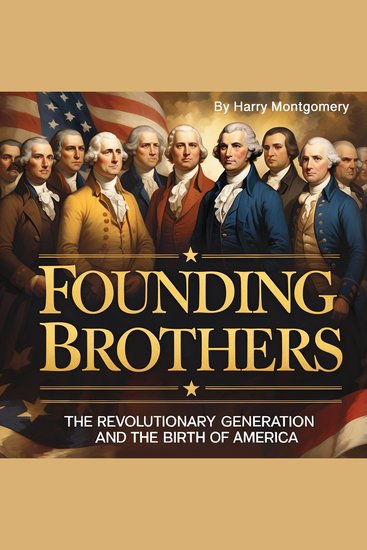
  • Founding Brothers - The Revolutionary Generation and the Birth of America - cover

    Founding Brothers - The...

    Harry Montgomery

    • 0
    • 0
    • 0
    The events that led to one of the most infamous moments in early American history began with a series of escalating tensions between two towering figures of the revolutionary generation. At the heart of this saga were Alexander Hamilton and Aaron Burr, whose personal and political differences culminated in a duel that would forever change the course of their lives and the nation. The rivalry between these men had been simmering beneath the surface for years, driven by conflicting visions of America’s future and a deeply personal sense of pride and honor. As the nation struggled to define itself, the intensity of political passions mirrored the violence that would erupt on a fateful morning along the banks of the Hudson River. 
    Hamilton, a key architect in establishing the new republic’s financial system and a fervent advocate for a strong central government, had found himself at odds with the more cautious and opportunistic Burr. Their interactions were marked by fiery debates and personal insults, each encounter stoking the flames of discord. This tension reached its climax when a series of statements and challenges, amplified by the politically charged atmosphere of the day, left little room for reconciliation. In the culture of honor that prevailed at the time, retreating or appearing weak was not an option, and thus the challenge to a duel was seen as an unavoidable, albeit tragic, path to vindication. 
    On that brisk morning, amid a landscape still haunted by the memories of revolution and laden with the promise of a new beginning, both men prepared to face each other under strict codes of conduct. The duel was not just a matter of personal honor; it was emblematic of the turbulent and often dangerous era in which the young nation was emerging.
    Show book