
Join us on a literary world trip!
Add this book to bookshelf
Grey
Write a new comment Default profile 50px
Grey
Subscribe to read the full book or read the first pages for free!
All characters reduced
Battle Of Stalingrad - cover

Battle Of Stalingrad

Amelia Khatri

Translator A AI

Publisher: Publifye

  • 0
  • 0
  • 0

Summary

"Battle of Stalingrad" examines one of World War II's most brutal and pivotal battles on the Eastern Front. The book explores the German assault, inhumane conditions, and the surprising Soviet resistance. It emphasizes the collision of ideologies and the test of human will, rather than solely focusing on military strategy. Understanding this battle reveals the devastating consequences of ideological extremism and the limits of military power. The book challenges conventional military histories by highlighting the human dimension of warfare.

 
The narrative begins with the strategic context, including Hitler's obsession with capturing Stalingrad and Stalin's determination to defend it. It then chronicles the ferocious urban warfare within the city, detailing the horrors faced by soldiers and civilians.

 
Lastly, the book analyzes the Soviet counter-offensive, Operation Uranus, and concludes by assessing the battle's long-term consequences, including its impact on morale and its role as a turning point in World War II. The book draws upon archival documents and eyewitness accounts to provide a balanced and nuanced account.
Available since: 02/17/2025.
Print length: 53 pages.

Other books that might interest you

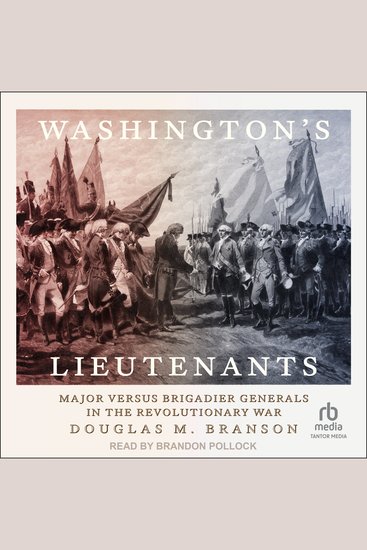
  • Washington's Lieutenants - Major versus Brigadier Generals in the Revolutionary War - cover

    Washington's Lieutenants - Major...

    Douglas M. Branson

    • 0
    • 0
    • 0
    As commander-in-chief of the Continental Army, George Washington developed the strategy that won the Revolutionary War, but while Washington directed some battles, his strategy for the most part was carried out by his subordinates. In the spirit of the best military history and biography, Washington's Lieutenants tells the story of the generals who served under Washington from 1775 to 1781. 


    Based on extensive research, the book finds the brigadier generals a laudable group of commanders. A quarter of all brigadiers died in the service of the new nation. 


    Only three served for the war's duration, including the great Nathanael Greene and Henry Knox. Ten resigned. Benedict Arnold turned coat. At least three were involved in the so-called Conway Cabal of 1777–78 to oust General Washington. The controversial Horatio Gates, self-proclaimed victor of Saratoga, was accused of cowardice at the Battle of Camden, South Carolina. 


    At once entertaining information about some of the Revolutionary War's most colorful military commanders and an insightful analysis of how the young nation fought for its independence, Washington's Lieutenants will be essential during the wars 250th anniversary and beyond.
    Show book
  • To The Call of Bugles - A History of the Percy Tenantry Volunteers 1798–1814 - cover

    To The Call of Bugles - A...

    Bill Openshaw

    • 0
    • 0
    • 0
    This highly readable illustrated biography on the Percy Tenantry Volunteers has been written with exclusive access to the current Duke of Northumberland's treasure trove of archive records. This book is for anyone interested in military history, especially Revolutionary and the Napoleonic war period, and for those looking at the local history of Northumberland, and especially Alnwick Castle.
    The history of Britain's conflict with France between 1793 and 1815 is well documented. Nevertheless, one aspect that has scant coverage, is that of the role of Volunteers.  In 1798, afraid of impending invasion by France's all-conquering armies the British desperately needed to defend their shores. To The Call of Bugles reveals, for the first time, how among those who stood forward in Home Guard style military bodies, there was no finer example than that of the valiant Percy Tenantry Volunteers, created by the 2nd Duke of Northumberland, General Hugh Percy. This amateur body of men, 1,500 strong, consisting of cavalry, artillery and riflemen, was put together, trained, armed, dressed and operated by General Hugh Percy. This book provides stories from the original volunteers, an in-depth understanding of how such a corps was organised and reveals how they were fashioned into an elite and innovative fighting force.
    Show book
  • Faking Me: A Gay Accidental Secret Royal Romance - Erotic Gay M M Short Sex Story - cover

    Faking Me: A Gay Accidental...

    M Dick

    • 0
    • 0
    • 0
    SECRET ROYALTY GAY ROMANCE 
    Austin is down on his luck, working odd jobs trying to cover his tuition. 
    He had no idea it would lead him to love. With a prince. A secret prince. 
    But not only is the prince’s true identity a secret, there are more secrets to him. 
    Will love be enough? 
    This is a fast-paced, steamy, insta-love standalone with no cheating and a HEA ending intended for adults.
    Show book
  • City Networks - Connectivity and Urban Development - cover

    City Networks - Connectivity and...

    Lyric Vale

    • 0
    • 0
    • 0
    Connectivity is a critical element in shaping the development and functionality of modern cities. As urbanization accelerates, the ability to connect people, services, and infrastructure becomes fundamental in ensuring that cities grow in a sustainable, efficient, and equitable manner. Whether through transportation, digital infrastructure, or social systems, connectivity determines the overall effectiveness of urban environments. It not only enables economic growth and innovation but also enhances the quality of life for urban residents, facilitating better access to services, opportunities, and resources. As cities evolve, improving connectivity has become one of the most pressing priorities for urban planners, policymakers, and developers. 
    Historically, the evolution of urban connectivity was rooted in physical infrastructure. Roads, railways, and ports formed the foundation for the development of cities, enabling the movement of goods, services, and people. These early forms of connectivity allowed urban centers to thrive, driving economic activity and creating spaces for cultural exchange. As cities grew, so did their need for more complex and advanced networks. In the 21st century, digital connectivity has added a new layer of importance to urban development. High-speed internet, mobile technology, and digital communication systems have transformed how cities function, providing real-time access to information and services that were previously unavailable. 
    The concept of the "smart city" highlights the profound impact of digital connectivity on urban life. By integrating technologies such as the Internet of Things (IoT), artificial intelligence, and big data, cities can improve everything from traffic management to resource distribution. Smart city solutions enable cities to operate more efficiently and sustainably, optimizing the use of energy, water, and other resources while reducing waste and pollution.
    Show book
  • I Think Therefore I’m Wrong - Descartes and the Birth of Overconfidence - cover

    I Think Therefore I’m Wrong -...

    Sophia Blackwell

    • 0
    • 0
    • 0
    I Think, Therefore I’m Wrong: Descartes and the Birth of Overconfidence is your gloriously sarcastic, brutally honest, and deeply unhinged guide to the man who launched modern philosophy with one anxious thought spiral and never looked back. 
    René Descartes: French, wealthy, suspicious of everything, and armed with just enough Latin to convince the world that his personal identity crisis was actually a groundbreaking intellectual framework. From doubting the entire universe to claiming God exists because the idea of God felt right, Descartes pioneered a system so elegantly flawed it haunted philosophers for centuries—and now you get to enjoy the wreckage. 
    In this book, Sophia Blackwell (Kant You Not, Leibniz’s Monads) takes you on a laugh-out-loud demolition tour of: 
    The Four-Step Method of Doubt, also known as gaslighting the cosmos 
    The Cogito, or how to accidentally make thinking sound smug 
    God as epistemological tech support 
    Mind-body dualism, or “what if you’re just a haunted skeleton?” 
    Descartes’ legacy in science, psychology, AI, and every freshman who says “I'm not my body, bro.” 
    Whether you’re a philosophy student, a recovering Cartesian, or just here to watch the metaphysical world burn, this book explains Descartes’ ideas the way they were always meant to be understood: with sarcasm, side-eye, and a glass of wine. 
    I think, therefore I spiral. Let’s go
    Show book
  • New Zealand - A History of the Land and Its People - cover

    New Zealand - A History of the...

    Lillian Brooks

    • 0
    • 0
    • 0
    New Zealand, known as Aotearoa in Māori, is a land rich in history and cultural significance. Located in the southwestern Pacific Ocean, this island nation is renowned not only for its stunning landscapes but also for the diverse stories that have shaped its identity. The history of New Zealand is marked by the migration of its first inhabitants, the Māori, and the later arrival of Europeans, both of whom have contributed to the country’s unique social and cultural fabric. 
    The Māori people, the first to settle the islands, arrived from eastern Polynesia between the 9th and 13th centuries. Their journey to New Zealand is a story of exploration, resilience, and connection to the land. The Māori developed a sophisticated society with rich traditions, strong spiritual beliefs, and a deep connection to the natural world. Their oral histories, cultural practices, and the Māori language (Te Reo Māori) continue to shape the nation’s identity to this day. 
    The arrival of Europeans in the 17th century, particularly the Dutch explorer Abel Tasman and later Captain James Cook, marked the beginning of profound change for the Māori and the land itself. European settlers, driven by the promise of economic opportunities, eventually established colonies in the 19th century. This period saw the signing of the Treaty of Waitangi in 1840, an agreement that aimed to establish a partnership between the Māori and the British Crown. Despite its noble intentions, the treaty's implementation and interpretation have been subjects of contention and legal battles for decades, particularly regarding Māori land rights.
    Show book