Join us on a literary world trip!
Add this book to bookshelf
Grey
Write a new comment Default profile 50px
Grey
Subscribe to read the full book or read the first pages for free!
All characters reduced
Aztec Time - cover

Aztec Time

Amelia Khatri

Translator A AI

Publisher: Publifye

  • 0
  • 0
  • 0

Summary

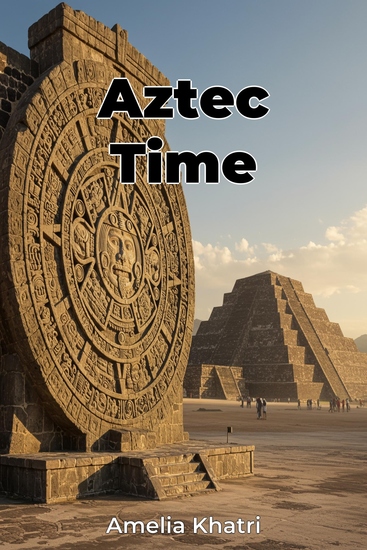
Aztec Time explores how the Aztec civilization meticulously tracked time using a dual-calendar system, deeply entwined with their religious observances and agricultural practices. This system, comprised of the 365-day solar Xiuhpohualli and the 260-day ritual Tonalpohualli, dictated not only the timing of ceremonies but also agricultural cycles and even warfare. The Aztecs' sophisticated timekeeping provides a window into their worldview, showcasing their ability to integrate spiritual beliefs with practical necessities.

 
The book uniquely examines the Aztec calendar as more than just a timekeeping device, presenting it as a framework that structured their entire society and reflected their relationship with the natural world. For instance, the convergence of the two calendars every 52 years marked a period of great cosmological significance.

 
Using archaeological findings, ethnohistorical accounts, and archaeoastronomy, Aztec Time presents a comprehensive overview, beginning with the components of the calendar and progressing through its religious significance, influence on social hierarchies, and its broader legacy in Mesoamerican studies. The arguments are supported by diverse evidence, offering insights into ancient cultures and the development of complex systems of knowledge. By understanding the Aztec calendar, readers gain a deeper appreciation for how this Mesoamerican civilization shaped its world.
Available since: 03/04/2025.
Print length: 59 pages.

Other books that might interest you

  • Narasimha Dev - Lion Of Devotion Protector Of The Devotees - cover

    Narasimha Dev - Lion Of Devotion...

    Sripad Jagannatha Das

    • 0
    • 0
    • 0
    Discover the awe-inspiring tale of Narasimha, the manifest man-lion incarnation of Vishnu, who descends to the earthly realm to restore balance and uphold the eternal Vedic tradition. As a destroyer of evil and a protector of dharma, Narasimha’s story is one of divine intervention, fierce justice, and unwavering devotion. 
    In this powerful narrative, witness the Supreme Lord’s miraculous appearance to save the devoted Prahlada from the tyranny of his demonic father, Hiranyakashipu. Explore the dual nature of Narasimha—His fearsome visage with fiery eyes, sharp teeth, and tumultuous roars strikes terror into the hearts of the wicked, while His tender, lotus-like hands offer shelter and reassurance to His devotees. 
    This audiobook delves into the significance of Narasimha as the ultimate protector, removing obstacles on the spiritual path and safeguarding those who seek refuge in Him. It challenges conventional notions, inviting listeners to expand their understanding of the universe and its myriad possibilities beyond earthly confines. 
    Perfect for those seeking inspiration, spiritual insight, or a deeper connection to the timeless teachings of the Vedic tradition, Narasimha: The Divine Protector is a journey into the heart of faith, courage, and divine grace.
    Show book
  • History of England from the Accession of James II - (Volume 3 Chapter 14) - cover

    History of England from the...

    Thomas Babington Macaulay

    • 0
    • 0
    • 0
    This is volume 3 chapter 14 of a series of books written by the Baron Macaulay in the 19th century. It starts with a brief resume of the history of England up until the Stuart kings and then starts to delve into a little more detail. Macaulay is primarily fascinated by ending of any claim to divine right of kings and the growing role of Parliament in the governing of the country. He sees the accession of William and Mary (Dutch, Protestant royalty) to the British throne as a key moment in the history of the British Isles. This is a book delightful for the literary gifts of the author and intriguing for his view of 18th century English and world politics. (Jim Mowatt) 
    This volume covers various 17th century events including a military campaign in Ireland and the Church of England oath-swearing controversy, in which some clergymen refused to swear an oath to King William and Queen Mary required by the crown (Karen Merline)
    Show book
  • Out Of This World - cover

    Out Of This World

    Neville Goddard, Noah Press

    • 0
    • 0
    • 0
    Out Of This World introduces Neville’s “fourth-dimensional” view: the future is not a distant place, but a state you can enter now through imagination. He teaches you to live from the end; mentally occupying the completed outcome until it feels natural. By shifting state, you shift the world you experience. This book is a clear bridge between mystical ideas and a disciplined method for selecting and sustaining a new reality.
    
    “Live in the end” methodology
    States as realities you can enter now
    Imagination as time-transcending power
    Practical mental discipline and persistence
    Show book
  • The Lost World of Byzantium - cover

    The Lost World of Byzantium

    Jonathan Harris

    • 0
    • 0
    • 0
    The acclaimed author of Byzantium and the Crusades "offers a fresh take on this fabled but hidden civilization" across eleven centuries of history (Colin Wells). 


    For more than a millennium, the Byzantine Empire presided over the juncture between East and West, as well as the transition from the classical to the modern world. Rather than recounting the standard chronology of emperors and battles, leading Byzantium scholar Jonathan Harris focuses on a succession of archetypal figures, families, places, and events. 


    Harris's introduction presents a civilization rich in contrasts, combining orthodox Christianity with paganism, and classical Greek learning with Roman power. Though frequently assailed by numerous armies, Byzantium survived by dint of its unorthodox foreign policy. Over time, its sumptuous art and architecture flourished, helping to establish a deep sense of Byzantine identity in its people. 


    Synthesizing a wealth of sources to cover all major aspects of the empire's social, political, military, religious, cultural, and artistic history, Harris's study illuminates the heart of Byzantine civilization and explores its remarkable and lasting influence on the modern world.
    Show book
  • Meditation is to Discover an Area in Which There is No Movement of Thought - Saanen 1974 - Public Talk 7 - cover

    Meditation is to Discover an...

    Jiddu Krishnamurti

    • 0
    • 0
    • 0
    Meditation is to discover an area in which there is no movement of thought"—28 July 1974Has the world and its thought-based activity bred fear?Can hidden fears and subtle forms of pleasure be exposed through analysis?What is a mind to do when it sees the falseness of analysis and introspective examination?Is the controller different in nature from what he says he is going to control?Can the mind empty itself of time, direction and movement, which is the ending of thought?What place has knowledge in meditation?Can thought and meditation live together harmoniously in daily action?Is the speaker teaching you higher knowledge? All the speaker is saying is: watch yourself.Questions from the audience followed the talk.
    Show book
  • Learning is Action - Claremont 1968 - Students Discussion 2 - cover

    Learning is Action - Claremont...

    Jiddu Krishnamurti

    • 0
    • 0
    • 0
    Learning is action - 12 November 1968 
    • Our education is concerned with the accumulation of knowledge.Very few of us are capable of living a life without the influence of specialists. 
    • What is the point of going to a university, getting a degree and disappearing into the vast structure of society? 
    • Q: How shall we approach the idea of study? 
    • If you express from something already accumulated it is a deadly bore, but if 
    you are all the time watching, not only yourself but the world, you are learning. 
    • Q: You say that a mantra is an escape. Do you think that people use drugs as an escape or because they want to become closer? 
    • When I observe myself I cannot learn if I condemn what I find. 
    • We observe through our imagination, through our image, through our knowledge.
    Show book