Join us on a literary world trip!
Add this book to bookshelf
Grey
Write a new comment Default profile 50px
Grey
Subscribe to read the full book or read the first pages for free!
All characters reduced
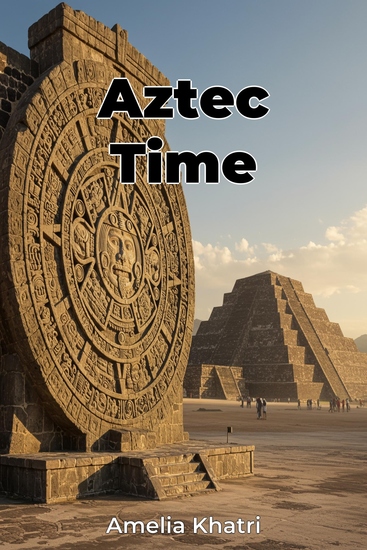
Aztec Time - cover

Aztec Time

Amelia Khatri

Translator A AI

Publisher: Publifye

  • 0
  • 0
  • 0

Summary

Aztec Time explores how the Aztec civilization meticulously tracked time using a dual-calendar system, deeply entwined with their religious observances and agricultural practices. This system, comprised of the 365-day solar Xiuhpohualli and the 260-day ritual Tonalpohualli, dictated not only the timing of ceremonies but also agricultural cycles and even warfare. The Aztecs' sophisticated timekeeping provides a window into their worldview, showcasing their ability to integrate spiritual beliefs with practical necessities.

 
The book uniquely examines the Aztec calendar as more than just a timekeeping device, presenting it as a framework that structured their entire society and reflected their relationship with the natural world. For instance, the convergence of the two calendars every 52 years marked a period of great cosmological significance.

 
Using archaeological findings, ethnohistorical accounts, and archaeoastronomy, Aztec Time presents a comprehensive overview, beginning with the components of the calendar and progressing through its religious significance, influence on social hierarchies, and its broader legacy in Mesoamerican studies. The arguments are supported by diverse evidence, offering insights into ancient cultures and the development of complex systems of knowledge. By understanding the Aztec calendar, readers gain a deeper appreciation for how this Mesoamerican civilization shaped its world.
Available since: 03/04/2025.
Print length: 59 pages.

Other books that might interest you

  • An Infinite Fountain of Light - Jonathan Edwards for the Twenty-First Century - cover

    An Infinite Fountain of Light -...

    George M. Marsden

    • 0
    • 0
    • 0
    Christians need to pause once in a while to get their bearings. For perspective on our own times and how we got here, it helps to listen to wise guides from other eras. In An Infinite Fountain of Light, the renowned American historian George Marsden illuminates the landscape with wisdom from one such mentor: Jonathan Edwards.
    Drawing on his deep expertise on Edwards and American culture, Marsden explains where Edwards stood within his historical context and sets forth key points of his complex thought. By also considering Benjamin Franklin and George Whitefield, two of Edwards's most influential contemporaries, Marsden unpacks the competing cultural and religious impulses that have shaped our times. In contrast, Edwards offered us an exhilarating view of the centrality of God's beauty and love. Christians' love for God, he taught, can be the guiding love of our lives, opening us to transformative joy and orienting all our lesser loves.
    "There is an infinite fullness of all possible good in God, a fullness of every perfection, of all excellency and beauty, and of infinite happiness," wrote Edwards. "This infinite fountain of light should, diffusing its excellent fullness, pour forth light all around."
    With Marsden's guidance, readers will discover how Edwards's insights can renew our own vision of the divine, of creation, and of ourselves.
    Show book
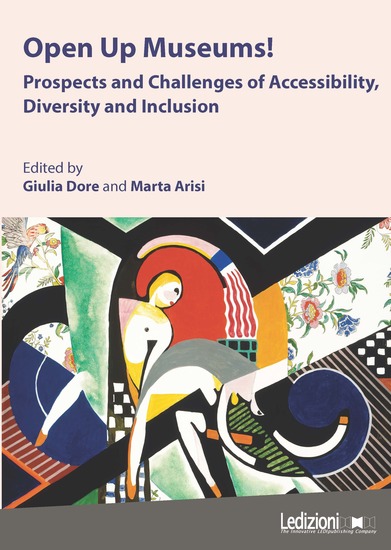
  • Open Up Museums! - Prospects and Challenges of Accessibility Diversity and Inclusion - cover

    Open Up Museums! - Prospects and...

    Giulia Dore, Marta Arisi

    • 0
    • 0
    • 0
    This edited book comprises a selection of essays inspired by the presentations delivered during the workshop 'Open Up Museums! Prospects and challenges of Accessibility, Diversity and Inclusion', co-organised in the Spring of 2022 by three EU-funded projects – reCreating Europe, DANCING, and inDICEs, and hosted by MUSE – Museo delle Scienze, and Mart – Museo di arte moderna e contemporanea di Trento e Rovereto.
    In the book, academics and cultural heritage practitioners reflect on how to promote 'openness' in the cultural sector. Exploring the concepts of Accessibility, Diversity and Inclusion, they offer different views on institutions and practices, giving substance to the multifold concept of 'open' culture in museums.
    Show book
  • A Minute for Caregivers - When Everyday Feels Like Monday - cover

    A Minute for Caregivers - When...

    Peter Rosenberger

    • 0
    • 0
    • 0
    Family caregivers struggle with keeping their heads above water while caring for an impaired loved one. Most caregivers feel their well-being is sacrificed for the well-being of their loved ones. Hanging on until their loved one passes away is simply not acceptable for a caregiver to live a healthy life. Caregivers can live a life of meaning—and not just simply survive. A Minute for Caregivers offers families with special needs children, aging parents, wounded warriors, trauma victims, mental illness, addiction, and any other chronic impairment "just in time" practical, emotional, and spiritual help in dealing with the (often) traumatic challenges of caring for an impaired loved one.
    Show book
  • A History of Ireland in 100 Episodes - Ancient Medieval and Modern Ireland - cover

    A History of Ireland in 100...

    Jonathan Bardon, Fergal Tobin

    • 0
    • 0
    • 0
    This authoritative and comprehensive history of Ireland covers the entire history of the island from the Ice Age to the peace process in 100 short episodes. In this thoughtful analysis of Irish society, Bardon integrates the significant cultural and literary history of Ireland with its political and social past.
    Based on the hugely popular BBC radio series A Short History of Ireland, each episode stands alone, providing a snippet of Irish history in five minutes' reading. In turn, to read each episode in sequence from beginning to end provides a magisterial history of Europe's most western land.
    Show book
  • NLP: Neuro Linguistic Programming Techniques for Social Influence Persuasion Manipulation Communication Skills and Mind Control to master Dark psychology Body Language and CBT - cover

    NLP: Neuro Linguistic...

    Sebastian Clark

    • 0
    • 0
    • 0
    Learn how to get whatever you want, whenever you want it! 
    Neuro-Linguistic Programming, or NLP, is the study of the mind and how it processes information. It’s a powerful set of techniques that can help you understand yourself and others better. 
    It’s based on the idea that all human behavior can be explained by understanding how people think, feel, and communicate. 
    Imagine being able to get what you want in life with ease — simply by using the power of persuasion. 
    With NLP, that’s entirely possible. 
    You can learn how to make anyone do anything you want them to! 
    Whether you need to convince your boss for a raise or get your partner to agree with something, NLP will give you the tools you need. Such as:Mastering language patterns: Learn how to use language to influence someone’s thinking, emotions, and behavior.Tried and tested rapport techniques: Boost your communication skills by building a strong connection with anyone you talk to.Mind control techniques that work on ANYONE: Gain the power to reframe any situation so that it works in your favor.Methods to make everyone an open book: You’ll never have to wonder about what they’re thinking or what their true intentions are because they’ll tell you themselves.And more! 
    Once you learn NLP, you will have the power to change your own life for the better — and help others do the same. 
    You’ll be able to read people like a book, understand their motivations, and influence them in ways that were once impossible.Scroll up, get the audiobook, and start listening!
    Show book
  • Vampires and Werewolves: The Legends and Folk Tales about History’s Most Notorious Mythical Beings - cover

    Vampires and Werewolves: The...

    Charles River Editors

    • 0
    • 0
    • 0
    People have always been afraid of the dead. Since the dawn of humanity, people have both cared for those who have deceased yet also tried to keep them away. There are a myriad of legends and beliefs about the dead coming back, and one of the more persistent ones is of the vampire. 
    	Werewolves have long been a staple of popular culture. In the 19th century and 20th century, there were countless books, plays, and films about people who turned into wolves or wolf like humanoids and went on rampages. The figure of the werewolf is so familiar that people across the world are familiar with the folklore, and the beliefs that they transform during a full moon, can only be stopped with silver, and transmit their disease by biting their victims. 
    	In fact, those beliefs were not originally part of werewolf folklore, but later embellishments by artists. The belief in lycanthropy is far older and more complex than most people suspect, dating all the way back to antiquity, and werewolves were once assumed to be very real. Indeed, people were even put on trial and executed because the courts of law were convinced they could change their form and kill innocent people. For thousands of years, werewolves have represented a strange and ancient tradition that still echoes through culture to this day. 
    	This common understanding of vampires actually obscures many European and most non-European traditions of bloodsucking monsters. For example, in China, Japan, and the Middle East, there are spirits that will drain the life force of an unwary person, but these magical beings were never mortal humans. In African and Native American traditions, there are monsters that do the same, but while they are supposed to be of this Earth, they too are not human beings. 
    Show book