Junte-se a nós em uma viagem ao mundo dos livros!
Adicionar este livro à prateleira
Grey
Deixe um novo comentário Default profile 50px
Grey
Assine para ler o livro completo ou leia as primeiras páginas de graça!
All characters reduced
Ancient Flood Records - cover
LER

Ancient Flood Records

Amelia Khatri

Tradutor A AI

Editora: Publifye

  • 0
  • 0
  • 0

Sinopse

Ancient Flood Records investigates how major floods have shaped Earth's geological features and the trajectory of human civilization. By examining geological records like sedimentary deposits, archaeological evidence such as settlement placements, and ancient texts, the book uncovers compelling insights into past inundations. For instance, the placement of ancient cities and the destruction layers within them offer tangible evidence of how catastrophic floods impacted human populations. The book argues that these events acted as catalysts for societal restructuring, innovation, and migration.

 
The book uniquely integrates geological, archaeological, and textual evidence to provide a holistic understanding. It moves beyond simple catastrophism, exploring how societies adapted to these natural events. The book is structured in three parts, progressing from geological evidence to archaeological findings, and finally, to flood narratives across cultures. This approach connects to climate science by examining potential drivers of past flooding events.

 
Ultimately, Ancient Flood Records aims to provide a balanced, evidence-based assessment, acknowledging uncertainties while offering a comprehensive overview. Understanding ancient floods is vital for anticipating and mitigating risks associated with climate change and building more resilient communities.
Disponível desde: 17/02/2025.
Comprimento de impressão: 69 páginas.

Outros livros que poderiam interessá-lo

  • The Physics of Miraculous Healing - How Emotion Mind and Spirit Enable Unlimited Self-Healing - cover

    The Physics of Miraculous...

    Joseph Selbie

    • 0
    • 0
    • 0
    During a near-death experience, an end-stage terminal cancer patient had a profound, emotionally transformative experience in which she let go of all fear—she rallied and became cancer free in a few short weeks. A devout woman, body twisted, wasted, and brought to the brink of death by years of multiple sclerosis, heard a Voice, stood up, and walked—she was healed in minutes. Although these and thousands of similarly amazing cases have been medically verified, most doctors and most people believe that such cases cannot be true because the science underlying modern medicine doesn't provide any explanation for how such rapid physical change could be possible. Medicine's underlying science, however, has changed little despite nearly a hundred years of breakthroughs in physics—breakthroughs that do provide scientific explanations for these cases. 


    Modern physics' breakthroughs support millennia old spiritual traditions that suggest that not only is extraordinary, miraculous healing possible, but that we have innate soul powers—our emotions, personal beliefs, and our ability to connect to Spirit—that directly and powerfully determine our health and ability to self-heal. Modern physics and experiential spiritual traditions give us an unlimited view of health and healing that puts controllable influences, emotion, belief, and connection to Spirit, in charge.
    Ver livro
  • Immigrant Warrior - A Challenging Life in War and Peace - cover

    Immigrant Warrior - A...

    Henrik O. Lunde

    • 0
    • 0
    • 0
    "There is much military wisdom to be gleaned from Lunde's writings and this makes his autobiography a must-have for any military historian. It is also a wonderful read for anyone simply seeking to read about and appreciate the life and experiences of a very fine soldier." — Vietnam MagazineHenrik Lunde grew up in Norway and came to the United States with his parents as a teenager. After completing high school, he attended the University of California at Berkeley, graduating in 1958 as the Honor Graduate in the History Department. He also received an appointment in the Regular Army.  After the Basic Infantry Officer, Ranger and Airborne courses, and his first duty station with the 2nd Battle Group, 6th Infantry Regiment in Berlin, Hank spent 18 months with a covert Special Forces unit in Berlin. In 1963 he attended the Infantry Officer Career Course at Fort Benning and was designated an Honor Graduate. He then attended the elite Pathfinder Course before reporting to Fort Campbell, Kentucky for assignment to the elite 101st Airborne Division.  He deployed to Vietnam with 1st Brigade, 101st Airborne Division, in 1965. For most of his tour he commanded a rifle company. On his return to the States Hank worked as Branch Chief at the Airborne Test Division at Fort Bragg. Still, at the end of 1967, he volunteered for the 9th Division in the Delta despite becoming disillusioned with the tactical/strategic conduct of the war. In the 9th Division, he served as Brigade S-3 and battalion executive officer. He then moved to the Vietnamese II Corps as deputy operations adviser.  After graduating from the Command and General Staff College in 1970, in the upper 10% of the class, he moved on to Syracuse University to obtain a master’s degree. He then returned to Vietnam in 1973, serving as Chief of Negotiations of the U.S. Delegation to the FPJMT set up by the 1973 Paris Peace Treaty to account for the dead and missing. After a year at the Political/Military Division of the Army General Staff with southeast Asia as his responsibility area Hank attended the U.S. Army War College as the second youngest student in 1975–76. From 1976 to 1979, he served in the Plans of Policy branch of Supreme Headquarters Allied Powers Europe. His last assignment was as Director of National and International Security Studies for Europe at the Army War College. Colonel Lunde is highly decorated from his three tours in Vietnam.
    Ver livro
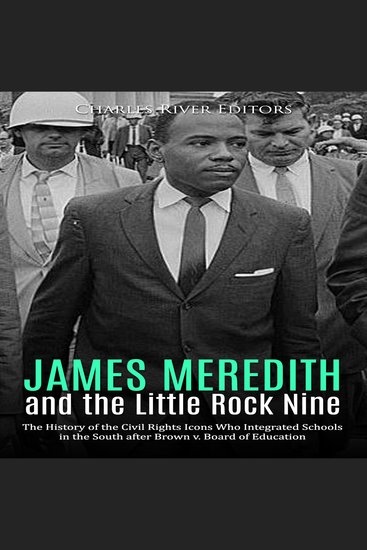
  • James Meredith and the Little Rock Nine: The History of the Civil Rights Icons Who Integrated Schools in the South after Brown v Board of Education - cover

    James Meredith and the Little...

    Editors Charles River

    • 0
    • 0
    • 0
    For millions of kids, high school is a tumultuous time, with social highs and lows, academic pressure, and extracurricular wins and losses, but for the Little Rock Nine, the first African American students to attend a previously segregated high school in Little Rock, Arkansas, those years were nightmarish.  
    Getting into Central High School was an obstacle witnessed by the entire nation, but that was only the beginning of their ordeal, because once they were permitted to step through the doors, their true battle began, pitting them against bullies, tormentors, and narrow-minded ignorance. While many teenagers’ main concern is finding a date for prom, theirs was surviving until lunch, and when some students were worrying about making the volleyball team, they were worried about making it home alive each day. The Little Rock Nine and their families and neighbors could not trust the local government to serve them, the school system to treat them fairly, or the police to protect them. As Melba Patillo Beals, one of the Little Rock Times, noted, “All my life I had felt unprotected by city officials…Whites had control of the police, the firemen, and the ambulances. They could decide who got help and who didn’t. Even if the Ku Klux Klan ravaged one of our homes, we wouldn’t call the police for help.” 
    Meredith is still remembered for the almost surreal scenes that came with his admission to the school, but those historic moments required a prolonged fight. After a drawn out lawsuit that involved the State of Mississippi appealing the lower court’s decision, he was finally set to attend the university in September 1962, only to be repeatedly prevented by a mob, which included Mississippi Governor Ross Barnett. Governor Barnett had earlier attempted to stop Meredith’s admission by changing state laws to ban anyone who had been convicted of a state crime; Meredith’s “crime” had been false voter registration.
    Ver livro
  • A Sudden Clash of Thunder - Talks on Zen Stories - cover

    A Sudden Clash of Thunder -...

    Osho

    • 0
    • 0
    • 0
    According to Osho, laughter is "the very essence of Zen". And while the theme of these talks is that meditation - watching, remaining alert and aware - is the path to self-realization, Osho encourages us first to "be happy, and meditation will follow".
    Through Zen stories, jokes and answers to questions, Osho highlights our conditioning - our learned social and cultural behavior and beliefs - as the barrier to our natural state of happiness.
    Wielding his words like a humorous, compassionate Zen stick, Osho shows us how we can begin to recognize our conditioning and see that it is not the same as our authentic self.
    "This is the whole effort of all the masters: to create a sudden clash of thunder so those who are fast asleep can be awakened." (Osho)
    
    - Truth and Knowledge
    - Center and Periphery
    - From Accidental to Essential
    - Real Love
    - The Real Self
    - The Paradox of Love
    - Only the Gold
    - Compassion, Love, and Sex
    - The Laughing Buddha
    - Toward Nothingness
    © & ℗1976 OSHO International Foundation
    Ver livro
  • Vigipeniology - The Essence of Renewed Pleasure - cover

    Vigipeniology - The Essence of...

    Winsome Rose

    • 0
    • 0
    • 0
    This may be one of the best books you will ever read, and some of the most vital pieces of information you will ever receive regarding sexual health and fitness. As you read through this book you will come across pages with personal information I shared. I share my journey not to boast, discourage, or seek sympathy from you, my lovely readers, but to build a bridge with you. You may be seeking to harness the power of your sexuality and fitness. There is a deeply personal narrative at the heart of my work. I have witnessed the transformative impact that certain types of information can have on an individual's confidence and self-expression. This book is an extension of my commitment to helping others realize their full potential. It is not a one-size-fits-all-all, and neither should it be taken as a substitute for professional guidance or treatment, but a suggestive guide to your wake-up call that may evoke your willingness to start your journey to sexual health and fitness and holistic well-being. Hey, can you do me a favor? Just smile for me. Yeah, that is a start. Thank you, and best wishes.
    Ver livro
  • Reconsidering Reparations - cover

    Reconsidering Reparations

    Olúfẹ́mi Táíwò

    • 0
    • 0
    • 0
    Reparations for slavery have become a reinvigorated topic for public debate over the last decade. Most theorizing about reparations treats it as a social justice project—either rooted in reconciliatory justice focused on making amends in the present; or, they focus on the past, emphasizing restitution for historical wrongs. Olúfémi O. Táíwò argues that neither approach is optimal, and advances a different case for reparations—one rooted in a hopeful future that tackles the issue of climate change head on, with distributive justice at its core. This view, which he calls the "constructive" view of reparations, argues that reparations should be seen as a future-oriented project engaged in building a better social order; and that the costs of building a more equitable world should be distributed more to those who have inherited the moral liabilities of past injustices. 


    This approach to reparations, as Táíwò shows, has deep and surprising roots in the thought of Black political thinkers such as James Baldwin, Martin Luther King Jr, and Nkechi Taifa, as well as mainstream political philosophers like John Rawls, Charles Mills, and Elizabeth Anderson. Táíwò's project has wide implications for our views of justice, racism, the legacy of colonialism, and climate change policy.
    Ver livro