Begleiten Sie uns auf eine literarische Weltreise!
Buch zum Bücherregal hinzufügen
Grey
Einen neuen Kommentar schreiben Default profile 50px
Grey
Jetzt das ganze Buch im Abo oder die ersten Seiten gratis lesen!
All characters reduced
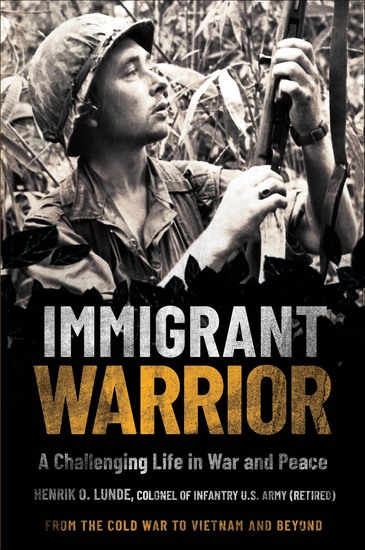
Immigrant Warrior - A Challenging Life in War and Peace - cover

Immigrant Warrior - A Challenging Life in War and Peace

Henrik O. Lunde

Verlag: Casemate

  • 0
  • 0
  • 0

Beschreibung

"There is much military wisdom to be gleaned from Lunde's writings and this makes his autobiography a must-have for any military historian. It is also a wonderful read for anyone simply seeking to read about and appreciate the life and experiences of a very fine soldier." — Vietnam MagazineHenrik Lunde grew up in Norway and came to the United States with his parents as a teenager. After completing high school, he attended the University of California at Berkeley, graduating in 1958 as the Honor Graduate in the History Department. He also received an appointment in the Regular Army.  After the Basic Infantry Officer, Ranger and Airborne courses, and his first duty station with the 2nd Battle Group, 6th Infantry Regiment in Berlin, Hank spent 18 months with a covert Special Forces unit in Berlin. In 1963 he attended the Infantry Officer Career Course at Fort Benning and was designated an Honor Graduate. He then attended the elite Pathfinder Course before reporting to Fort Campbell, Kentucky for assignment to the elite 101st Airborne Division.  He deployed to Vietnam with 1st Brigade, 101st Airborne Division, in 1965. For most of his tour he commanded a rifle company. On his return to the States Hank worked as Branch Chief at the Airborne Test Division at Fort Bragg. Still, at the end of 1967, he volunteered for the 9th Division in the Delta despite becoming disillusioned with the tactical/strategic conduct of the war. In the 9th Division, he served as Brigade S-3 and battalion executive officer. He then moved to the Vietnamese II Corps as deputy operations adviser.  After graduating from the Command and General Staff College in 1970, in the upper 10% of the class, he moved on to Syracuse University to obtain a master’s degree. He then returned to Vietnam in 1973, serving as Chief of Negotiations of the U.S. Delegation to the FPJMT set up by the 1973 Paris Peace Treaty to account for the dead and missing. After a year at the Political/Military Division of the Army General Staff with southeast Asia as his responsibility area Hank attended the U.S. Army War College as the second youngest student in 1975–76. From 1976 to 1979, he served in the Plans of Policy branch of Supreme Headquarters Allied Powers Europe. His last assignment was as Director of National and International Security Studies for Europe at the Army War College. Colonel Lunde is highly decorated from his three tours in Vietnam.
Verfügbar seit: 23.03.2023.
Drucklänge: 400 Seiten.

Weitere Bücher, die Sie mögen werden

  • Imperial Rome - From Augustus to the Fall - cover

    Imperial Rome - From Augustus to...

    Rogan Fish

    • 0
    • 0
    • 0
    The fall of the Roman Republic in the late first century BCE paved the way for a new era, one defined by the leadership of a single man: Augustus. Born Gaius Octavius, he emerged as the heir of Julius Caesar and transformed Rome from a state of political turmoil into a stable empire. His rise to power was marked by strategic alliances, military victories, and significant political reforms that laid the foundation for imperial rule. 
    The aftermath of the Republic’s collapse saw Rome in chaos. The assassination of Julius Caesar in 44 BCE triggered a power struggle between his supporters and those who sought to restore the old Republic. Octavian, as he was then known, capitalized on his status as Caesar’s adopted son and formed the Second Triumvirate with Mark Antony and Marcus Lepidus. Together, they pursued and defeated Caesar’s assassins, Brutus and Cassius, at the Battle of Philippi in 42 BCE. However, tensions among the triumvirs soon escalated. Lepidus was forced into retirement, and Octavian turned against Antony, who had allied himself with Cleopatra of Egypt. Their rivalry culminated in the Battle of Actium in 31 BCE, where Octavian’s naval forces decisively defeated Antony and Cleopatra, leading to their eventual suicides. With no remaining challengers, Octavian stood as the unopposed ruler of Rome. 
    Rather than seizing power as a dictator, Octavian carefully crafted his authority to appear as a restoration of Republican values. In 27 BCE, he formally returned power to the Senate, a move that won him widespread support and the honorary title "Augustus." However, this gesture was largely symbolic, as he retained control over the military and key provinces. His governance established the principate, a system in which the emperor ruled under the guise of republican traditions while holding ultimate authority.
    Zum Buch
  • The Men in the Arena - England Australia and the Battle for the 2003 Rugby World Cup - cover

    The Men in the Arena - England...

    Tom English, Peter Burns

    • 0
    • 0
    • 0
    The ultimate World Cup showdown, in the words of those who were there.
    
    From 1997 to 2003 England and Australia battled for domination of the rugby world in one of the greatest rivalries the sport has ever known. In The Men in the Arena, William Hill shortlisted authors Peter Burns and Tom English explore every aspect of the teams’ journey to the 2003 Rugby World Cup final, telling the story primarily in the words of the protagonists at the center of the battle.
    
    Featuring exclusive new interviews with players and coaches from both teams plus an array of superstars who faced them from New Zealand, Ireland, France, Wales and beyond, this is the inside story like it has never been told before.
    
    'A splendid re-telling of English rugby's most celebrated story. Cracking stuff from start to finish' - Robert Kiston, The Guardian
    Zum Buch
  • Writing for Impact - 8 Secrets from Science That Will Fire Up Your Readers’ Brains - cover

    Writing for Impact - 8 Secrets...

    Bill Birchard

    • 0
    • 0
    • 0
    Read by the author. 
    Learn the keys to energizing your writing, engaging readers, and breaking out with influence. 
    What good will it do to skillfully craft a written argument if you lose your audience? Simple emails, formal reports, blogs, presentations, articles—they need punch to gain influence. Clear structure and logic alone won’t do. To engage readers, you need to make mentally stimulating choices in language—choices that electrify your readers’ mental hotspots. 
    Veteran journalist Bill Birchard reveals the secret of making that happen. He blends the findings from a global cadre of psychologists and neuroscientists with lessons from his long, successful career as a professional writer. In Writing for Impact, he details eight potent writing strategies, based on the latest scientific breakthroughs, to give you the power to write faster, win over more people, and earn influence as a thought leader. 
    As a reader, you will:Discover the story of recent scientific research that shows how the right language rewards readers mentally, engaging them with hits of dopamine and more.Learn the eight time-tested writing strategies—strategies you can apply immediately—to become a better, more impactful writer and communicator.Learn three dozen tactics to hook readers with each strategy, tactics proven to work based on how the brain processes language and meaning.Find engaging writing examples to illustrate each strategy and inspire you to write with punch that keeps your audience coming back for more.Master the eight-part strategic framework step by step, giving yourself a methodical means to develop yourself into a writer who communicates like a pro. 
      
    Accompanying figures are included in the audiobook companion PDF download.
    Zum Buch
  • From Normandy to the Rhine - The Allied Push to Liberate Western Europe - cover

    From Normandy to the Rhine - The...

    Sage Winters

    • 0
    • 0
    • 0
    The liberation of Western Europe in the Second World War remains one of the most significant military campaigns in history. The Allied push from Normandy to the Rhine marked the beginning of the end for Nazi Germany, culminating in its eventual surrender in May 1945. However, the path to victory was neither smooth nor inevitable. It was a campaign marked by intense fighting, strategic challenges, and the determination of soldiers from across the globe. 
      
    Following the D-Day landings on June 6, 1944, the Allies sought to free France from German occupation and drive Nazi forces back toward Germany. The operation, which involved an unprecedented amphibious invasion, was a turning point in the war. The success of the landings, despite the heavy losses, opened a second front in Europe, forcing Hitler to divert critical resources away from the Eastern Front, where the Soviet Union was steadily advancing. Yet, the Allies’ victory was not guaranteed, as German forces, though weakening, still posed formidable resistance. 
      
    The Battle of Normandy, with its brutal fighting in the hedgerows and small villages, proved to be just the beginning. The Allies encountered fierce opposition as they pushed eastward through France. While the liberation of Paris in August 1944 was a symbol of hope, it came with its own set of challenges. The need to secure vital supply lines, adapt to changing battle conditions, and coordinate across multiple national forces created both logistical and strategic headaches.
    Zum Buch
  • Workbook: What Happened to You? - Conversations on Trauma Resilience and Healing - cover

    Workbook: What Happened to You?...

    Liam Daniels, Alice Moore

    • 0
    • 0
    • 0
    Note: This audiobook is included (for free) inside its respective print and e-book versions. 
    Workbook: What Happened to You? (Oprah Winfrey and Bruce Perry) 
    In a powerful and compelling conversation, Oprah and Dr. Perry discuss the importance of our past in shaping us and why asking “What’s wrong with you?” might be an unhelpful and misguided question. They propose shifting the focus to “What happened to you?” instead. This may seem simple, but it has been groundbreaking in changing the way we understand and think about trauma, which in turn has offered a significantly more optimistic approach to recovery. But this is just one of the core messages of Oprah and Dr. Perry’s book. Want to know what the other core messages are? 
    “Workbook: What Happened to You?” not only provides all the powerful ideas, practices, and concepts that Oprah and Dr. Perry discuss in their original book in a clear and concise format, but it also offers interactive exercises, reflective and thought-provoking questions, tools, resources for healing, and supplementary information; all designed to enrich your understanding and help you apply what you’ve read. 
    You will get:A powerful combination of storytelling and the latest research on neuroscience and traumatology.Shocking facts about trauma, information on different methods of treatment, and much more!An immersive experience that will bridge the gap between the book's teachings and your own life. 
    While it is beneficial to have read their original work, it’s not compulsory, as this workbook will provide you with all the information you need to engage with the topic and exercises. Don't miss out on the combined wisdom of these two giants. 
    Disclaimer: This is an unofficial, third-party workbook for Oprah Winfrey and Bruce Perry’s book “What Happened to You?”
    Zum Buch
  • The Golden Age of Piracy - The Rise Fall and Enduring Popularity of Pirates - cover

    The Golden Age of Piracy - The...

    David Head

    • 0
    • 0
    • 0
    Twelve authors shed new light on the true history and enduring mythology of seventeenth– and eighteenth–century pirates in this anthology of scholarly essays. 


    The twelve entries in The Golden Age of Piracy discuss why pirates thrived in the seas of the New World, how pirates operated their plundering ventures, how governments battled piracy, and when and why piracy declined. Separating Hollywood myth from historical fact, these essays bring the real pirates of the Caribbean to life with a level of rigor and insight rarely applied to the subject. 


    The Golden Age of Piracy also delves into the enduring status of pirates as pop culture icons. Audiences have devoured stories about cutthroats such as Blackbeard and Henry Morgan since before Robert Louis Stevenson wrote Treasure Island. By looking at the ideas of gender and sexuality surrounding pirate stories, the renewed interest in hunting for pirate treasure, and the construction of pirate myths, the contributing authors tell a new story about the dangerous men, and a few dangerous women, who terrorized the high seas.
    Zum Buch