Join us on a literary world trip!
Add this book to bookshelf
Grey
Write a new comment Default profile 50px
Grey
Subscribe to read the full book or read the first pages for free!
All characters reduced
Magic Trick Principles - cover

Magic Trick Principles

Ambrose Delaney

Translator A AI

Publisher: Publifye

  • 0
  • 0
  • 0

Summary

Magic Trick Principles unveils the secrets behind captivating illusions, exploring the art and science that make magic so compelling. It delves into why we're easily deceived and the pleasure we derive from it, revealing how magicians exploit cognitive biases and manipulate our attention. The book highlights that magic isn't supernatural but a blend of psychological manipulation and precise engineering, where understanding perception is key.

 
The book progresses from fundamental psychological concepts to in-depth examinations of misdirection techniques, like verbal cues and body language. It also analyzes the mechanics of classic illusions, such as Pepper's ghost, demonstrating how they exploit optical principles. By understanding the psychology of magic, one can also understand that even the most complex illusions rely on simple engineering. This unique approach combines scientific rigor with artistic appreciation, providing insights applicable beyond entertainment.

 
The book uses psychology, history and engineering to explain how magic works and why we are so easily amazed. The principles discussed have real-world applications in fields like marketing, design, and law enforcement, making it a valuable resource for a broad audience.
Available since: 03/31/2025.
Print length: 71 pages.


Other books that might interest you

  • Your Thought - cover

    Your Thought

    Mitansh

    • 0
    • 0
    • 0
    “Believe you can and you're halfway there. No one can make you feel inferior without your consent.” “Success is not how high you have climbed, but how you make a positive difference to the world.” “Opportunities don't happen
    Show book
  • Heels Across a Wooden Floor - cover

    Heels Across a Wooden Floor

    Mike Blake

    • 0
    • 0
    • 0
    Heels Across a Wooden Floor: A Poem / Song lyrics  
    https://www.amazon.com/dp/B086KTZMKP 
    About the eternal pull of love, from a dancing perspective.  
    Imagine walking into a nightclub, and seeing the woman of your dreams skipping across 
    the dance floor; elegantly, with heels that she uses to swivel and cavort in an organic  
    fashion. Enticing you to join, even if you can't dance, at least with your eyes. 
    And to the women, giving over to an abduction of your senses into the realms of the  
    dance, urging you to join in that sensual celebration.
    Show book
  • Superbook - The World of Superhero Movies According to Smersh Pod - cover

    Superbook - The World of...

    John Rain

    • 0
    • 0
    • 0
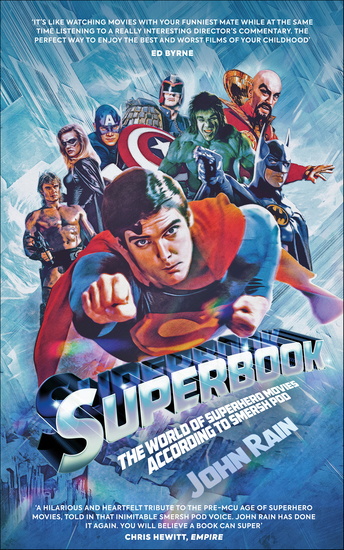
    If you mention the word ‘superhero’ these days, everyone and their mum can tell you a potted history of it all, because they’ve sat through numerous phases, extended TV series, and animated side-specials of expansive character-development, culminating in extraordinary final chapters, with the screen literally stacked full of characters battling one another while your eyes bleed with excitement and spectacle.
    
    But before 1997, people would generally only think of a few things: Christopher Reeve smiling as he keeps a watchful eye over Earth’s atmosphere, Michael Keaton running around Gotham while dressed in molded rubber. Nicholas Hammond's Spider-Man being hauled up a wall on a rope, pretending to grip it, while also being a foot away from it. Bill Bixby trying not to get angry, Flash Gordon arriving in another galaxy, that was essentially a soft porn film, Dolph Lundgren mumbling in broken English while Frank Langella hammed behind a mask, and how Michael Crawford dressed like a bird was the closest thing Disney had to a cinematic universe.
    
    Despite starting on a high in 1978, by 1997 there could be no doubt that the genre was dead. Out was the sheen of verisimilitude, and in were Bat-credit-cards, ugly CGI, slashed budgets, rubber nipples and Martin Sheen in a girdle.
    
    So, whatever happened to the heroes? Join John Rain as he walks through every film of note from 1978 to 1997, and examines just what went wrong, and how. Is it a bird? Is it a plane? No, it’s SUPERBOOK.
    Show book
  • Birthday at Boars Head - A Detective Vincente Mystery - cover

    Birthday at Boars Head - A...

    Chris Williams, Dean Gallagher

    • 0
    • 0
    • 0
    Birthday at Boars Head is a wonderful whodunit from the creative folks at Live Audio Theater. Set in a sprawling manor house overlooking the Rogue River in Southern Oregon, this engaging script includes all the classic elements of a manor house mystery. There’s a creepy old mansion, a greedy family, a visiting British detective, and there’s even a butler named Grimsby! So, curl up with your headphones or speakers and a hot café mocha and match wits with Detective Vincente in this delightful homage to old-time radio mysteries. The first in the four-part Detective Vincente series. “It’s pronounced Vincente with an e! ”
    Show book
  • Ultimate Guide to Music Monetization - A Complete Breakdown of the Strategies Platforms & Tools That Pay Artists - cover

    Ultimate Guide to Music...

    Shawn Folk

    • 0
    • 0
    • 0
    The Ultimate Guide to Music Monetization 
    A Practical Breakdown of How Artists Earn in the Modern Music Industry 
    In today’s music industry, making great music isn’t enough—understanding how money is made is just as essential. The Ultimate Guide to Music Monetization is a practical, research-driven resource created to help artists, managers, and independent creatives make sense of the evolving monetization landscape. 
    This guide breaks down the many different ways artists can earn income, not to promise riches, but to help you understand how each model actually works, where its limitations lie, and how artists are using them today. 
    Inside, you'll find:Clear explanations of streaming, licensing, NFTs, catalog advances, social tokens, direct sales, subscriptions, and moreAnalysis of the platforms and companies leading each monetization modelInsights into the incentives behind industry messaging—from distributors to marketers to creatorsReal-world pros and cons of each path, so you can make informed decisions based on your goals and circumstances 
    Written by Gif of Payusnomind, an artist, marketer, and founder of the first YouTube channel offering comparative analysis of music distribution platforms, this guide offers an unbiased look at the business side of music, free from hype, and focused on helping you understand the options available. 
    If you're trying to find the right path, build sustainable systems, or just want to know what’s behind the curtain, this book is a valuable starting point.
    Show book
  • First Quarter - cover

    First Quarter

    John Tuomey

    • 0
    • 0
    • 0
    In this reflective and enriching memoir, John Tuomey navigates the places and memories of his life over the scope of twenty-five years. First recognised for the urban regeneration of Dublin's Temple Bar, which included the construction of the Irish Film Institute, the National Photographic Archive and Gallery of Photography, his life in architecture led him to design social and cultural spaces such as the Lyric Theatre in Belfast, the Glucksman Gallery in UCC and the Victoria & Albert East Museum in London.
    
    Imbued with many inter-textual references to poetry, drama and literature and written in limpid prose, this memoir is inherently literary in nature. Tuomey looks back to his early life where he was born in Tralee and lived in different counties around Ireland, from small towns to country landscapes, from schooldays in Dundalk to student activism at University College Dublin. He traces the pathways that led to his formation as an architect, reflecting on the many cultural and social influences on his life. He excels in capturing the social landscape of Dublin in the 1980s and pays particular attention to the many buildings and social hubs of the inner city. His transient years of moving from Dublin to London, and subsequently working in places like Nairobi and Milan, chronicle the international influences on his outlook. The key relationships in his life, including meeting his future wife, Sheila – a fellow student of architecture in UCD – and his pivotal employment by James Stirling in 1976, form the backbone of his personal and professional life.
    
    Tuomey's expertise in his field is unsurpassed, with meticulous detail given to the finer aspects of design and architecture. His thoughts on the challenges facing the encroaching erasure of city life in Dublin are essential reading for anyone with an interest in the future of building in the city.
    Show book