¡Acompáñanos a viajar por el mundo de los libros!
Añadir este libro a la estantería
Grey
Escribe un nuevo comentario Default profile 50px
Grey
Suscríbete para leer el libro completo o lee las primeras páginas gratis.
All characters reduced
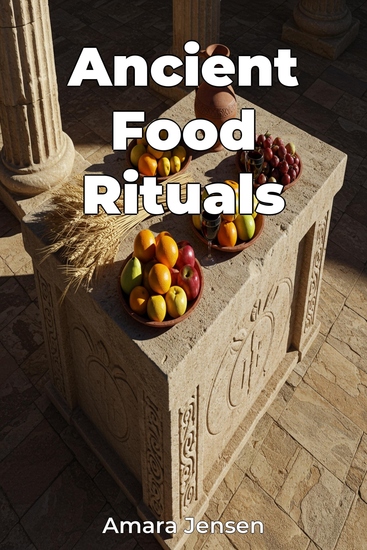
Ancient Food Rituals - cover

Ancient Food Rituals

Amara Jensen

Traductor A AI

Editorial: Publifye

  • 0
  • 0
  • 0

Sinopsis

Ancient Food Rituals explores the deep connections between food, spirituality, and religious ceremonies throughout history. It examines how these practices have shaped human societies and belief systems. Early societies saw success in agriculture and hunting as divine favor, imbuing food with spiritual significance. The book argues these rituals provide insights into cultural values, revealing food as more than just sustenance.

 
The book starts with fundamental concepts like the symbolic meanings of foods, such as bread representing life and wine symbolizing transformation. It then delves into specific food rituals from ancient Egypt, Greece, Rome, Mesoamerica, and early Judaism and Christianity. Each chapter focuses on a particular civilization or religious tradition, examining the foods that were considered sacred and the rituals surrounding their preparation and consumption.

 
Drawing from archaeological records, ancient texts, and ethnographic studies, the book highlights common threads and unique adaptations across different cultures. It culminates in a discussion of the enduring legacy of ancient food rituals in contemporary society, showing how modern dietary practices and religious celebrations echo these ancient traditions. This approach offers a broad comparative analysis of food and spirituality.
Disponible desde: 11/03/2025.
Longitud de impresión: 64 páginas.

Otros libros que te pueden interesar

  • 1932 - FDR Hoover and the Dawn of a New America - cover

    1932 - FDR Hoover and the Dawn...

    Scott Martelle

    • 0
    • 0
    • 0
    At the start of 1932, the nation's worst economic crisis has left one-in-four workers without a job, countless families facing eviction, banks shutting down as desperate depositors withdraw their savings, and growing social and political unrest. Amid this turmoil, a political decision looms that will determine the course of the nation. It's a choice between two men with very different visions of America: Incumbent Republican Herbert Hoover and New York's Democratic Governor Franklin Delano Roosevelt. 


    Veteran journalist Scott Martelle provides a gripping narrative retelling of that vitally significant year as social and political systems struggled under the weight of the devastating Dust Bowl, economic woes, rising political protests, and growing demand for the repeal of Prohibition. That November, voters overwhelmingly rejected decades of Republican rule and backed Roosevelt and his promise to redefine the role of the federal government while putting the needs of the people ahead of the wishes of the wealthy. 


    Deftly told, this illuminating work spotlights parallel events from that pivotal year and brings to life figures who made headlines in their time but have been largely forgotten today. Ultimately, it is the story of a nation that, with the help of a leader determined to unite and inspire, took giant steps toward a new America.
    Ver libro
  • A Rare Recording of Yuri Bezmenov - cover

    A Rare Recording of Yuri Bezmenov

    Yuri Bezmenov

    • 0
    • 0
    • 0
    Yuri Bezmenov (1939 - January 5, 1993), was a Soviet journalist for RIA Novosti and a former KGB informant who defected to Canada. After being assigned to a station in India, Bezmenov eventually grew to love the people and the culture of India. At the same time, he began to resent the KGB-sanctioned repression of intellectuals who dissented from Moscow's policies and he decided to defect to the West. Bezmenov is best remembered for his anti-communist lectures and books published in the 1980s under the alias of Tomas David Schuman.
    Ver libro
  • How to Be a Good Manipulator: Using Psychology Biology and Authority to Bend People Without Breaking Them - cover

    How to Be a Good Manipulator:...

    A.A. Castor

    • 0
    • 0
    • 0
    What if manipulation wasn't evil—just effective? 
    How to Be a Good Manipulator is not a guide for the moral or the meek. It's for readers who want to understand the psychology, biology, and brutal mechanics of control—whether to resist it or wield it. 
    In this unapologetic breakdown of influence and deception, author A.A. Castor doesn't offer comfort—he offers clarity. Through real psychological principles, dark behavioral tactics, and disturbingly familiar case studies, this book teaches how people are shaped, steered, and sometimes enslaved without ever realizing it. 
    From cult leaders to corporate climbers, from toxic relationships to spiritual influencers, this guide explores:How fear, shame, and hope override logicHow to frame reality and become the voice of "truth"Why people follow confidence—not correctnessThe emotional addiction of "love-bombing and withdrawal"How to use charisma, guilt, authority, and confusion to bend behaviorWhy freedom is often just a prettier cage—and how to make them love it 
    Whether you want to recognize the tactics being used on you or become the one pulling the strings, this book is a mirror, a manual, and a weapon. 
    Disturbingly honest. Laughably real. Absolutely lethal..
    Ver libro
  • Social Class and Mobility - Understanding the Dynamics - cover

    Social Class and Mobility -...

    Fred Grandsen

    • 0
    • 0
    • 0
    Social class and mobility are central concepts in understanding how societies function and evolve. The classification of individuals into different social classes based on income, occupation, education, and wealth shapes life experiences, opportunities, and access to resources. At the same time, social mobility—the ability of individuals or groups to move within a social hierarchy—determines whether societies remain rigidly stratified or allow for upward and downward movement. These dynamics influence economic stability, political structures, and cultural identities, making the study of social class and mobility essential for comprehending broader social patterns. 
    Social class is typically divided into broad categories such as the upper class, middle class, working class, and lower class. Each class has distinct characteristics that define access to wealth, education, job opportunities, and social networks. For example, the upper class often benefits from inherited wealth and exclusive professional opportunities, while the working and lower classes may experience financial instability and limited career advancement. These disparities create divisions that influence daily life, from the quality of healthcare received to the neighborhoods people can afford to live in. 
    Social mobility refers to changes in an individual’s or family’s social position over time. Mobility can be upward, where individuals improve their socioeconomic status, or downward, where they experience a decline. It can also be intergenerational, occurring across multiple generations, or intragenerational, happening within an individual’s lifetime. Various factors influence mobility, including education, economic conditions, public policies, and structural barriers such as discrimination or unequal access to opportunities.
    Ver libro
  • Glimmers Journal - Reflect on the Small Moments That Bring You Joy Safety and Connection - cover

    Glimmers Journal - Reflect on...

    Deb Dana

    • 0
    • 0
    • 0
    From the conceptualizer of glimmers—prompts to help you savor the micromoments of joy and well-being in your day. 


    First coined in Deb Dana's book Polyvagal Theory in Therapy, "glimmers" are the micromoments in your day that spark a sense of joy. They can be anything from catching a view of the skyline to cuddling with your pet. Glimmers tell your nervous system that you are safe and okay in the world, thus shifting your system's response from defense to calm. When we notice and name glimmers, we train our nervous system to be open to more of these moments—expanding our overall sense of well-being. 


    This beautiful journal provides a framework for listeners to name and savor their glimmers. Expertly crafted prompts encourage listeners to notice various types of glimmers that they might otherwise be unaware of—such as glimmers in nature or in the arts, "every day" glimmers, social glimmers, and even the range of glimmer "flavors." Glimmers Journal is for anyone looking to build a foundation of wellness and regulation.
    Ver libro
  • The Albigensian Crusade - Heresy and Conflict - cover

    The Albigensian Crusade - Heresy...

    Harris Ropes

    • 0
    • 0
    • 0
    The Cathars emerged as one of the most distinctive and controversial religious movements of medieval Europe, particularly in the Languedoc region of modern-day southern France. Rooted in dualist beliefs, the Cathars rejected many of the core teachings of the Catholic Church, viewing the material world as the creation of an evil force and striving for spiritual purity. Their growing influence in the 12th and 13th centuries alarmed both the Church and secular rulers, eventually leading to their violent suppression during the Albigensian Crusade. 
    The origins of Catharism can be traced to earlier dualist traditions, particularly those of the Bogomils in the Balkans. These beliefs likely spread into western Europe through trade routes and missionary activity, finding fertile ground in the tolerant and prosperous culture of Languedoc. Cathar teachings were based on a stark division between the material and spiritual realms. They believed that the physical world was ruled by a malevolent force, often associated with Satan, while the true God presided over the spiritual world. This view led them to reject the Catholic Church, which they saw as corrupt and complicit in the worship of the material. Unlike the Church, which emphasized hierarchical structure, the Cathars maintained a simpler, more egalitarian approach to religious life. 
    Cathar society was structured around two primary groups: the Perfects and the Believers. The Perfects, considered the spiritual elite, led austere lives dedicated to prayer, fasting, and celibacy. They followed strict moral codes, renouncing wealth and worldly pleasures in pursuit of spiritual enlightenment. Believers, while not held to the same rigorous standards, supported the Perfects and aspired to receive the consolamentum, a ritual that purified the soul before death. Cathars rejected many Catholic sacraments, including baptism by water, believing instead in a form of spiritual baptism.
    Ver libro