Join us on a literary world trip!
Add this book to bookshelf
Grey
Write a new comment Default profile 50px
Grey
Subscribe to read the full book or read the first pages for free!
All characters reduced
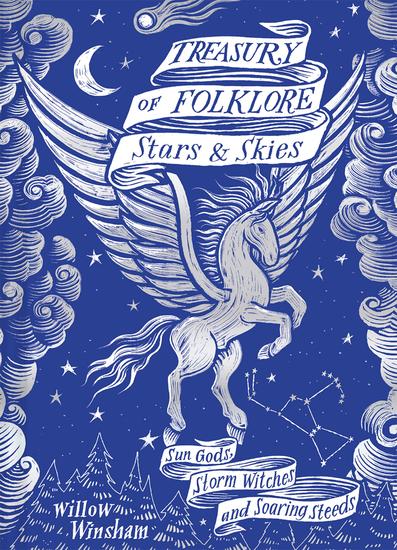
Treasury of Folklore: Stars and Skies - Sun Gods Storm Witches and Soaring Steeds - cover

Treasury of Folklore: Stars and Skies - Sun Gods Storm Witches and Soaring Steeds

Willow Winsham

Publisher: Batsford

  • 0
  • 0
  • 0

Summary

Following on from the hugely popular Treasury of Folklore: Seasand Rivers and Woodlands and Forests comes Treasury of Folklore: Stars and Skies, an exploration of the mysteries of the stars, skies and heavens above.
People have gazed up at the same stars for millennia, trading stories about them; conjuring gods and goddesses; mapping the constellations; and navigating the complex human world below. The tales, traditions and myths included here traverse countries and continents and have been chosen to highlight how humans are linked through time and place, with shared dreams, fears and ways of rationalising the unknown.
Under 'Stars and Heavens' Willow delves into rosy fingered dawn and the hubris of Icarus, the Greek myths surrounding the constellations and the omen of meteors, the trials of the Hawaiian goddess Hina and the legend of the rabbit in the moon. In the section on 'Skies' we are introduced to winged Pegasus and the Firebird, the Witch of Westray and stories of storms, the mysteries of the Northern Lights and unexplained UFOs. 
Treasury of Folklore: Stars and Skies is a fascinating portal into a rich history of myths surrounding the sky, an aspect of the natural world that continues to fascinate and confound.
Available since: 08/17/2023.
Print length: 176 pages.

Other books that might interest you

  • The Olive Tree - A Personal Journey Through Mediterranean Olive Groves - cover

    The Olive Tree - A Personal...

    Carol Drinkwater

    • 0
    • 0
    • 0
    An olive farmer journeys through Spain, Italy, and North Africa to find the future of agriculture in an age of chemicals and climate challenges. Carol Drinkwater’s beloved olive farm in the South of France was suffering badly from destructive pests and premature ripening. In a hunt for answers, she decided to set out on her own for a fact-finding tour of Spain, Italy, Morocco, and Algeria. In The Olive Tree, Carol recounts not only the agricultural education she gained during her travels, but the dangers she faced as terrorist bombs rocked one of her destinations and a group of beekeepers helped shepherd her through dangerous territory. Through it all, she confronts issues faced by farmers and non-farmers alike in today’s world, from climate change to diminishing water reserves to the excessive use of chemicals. Ultimately, she will return to her land in Provence with a new appreciation for the urgency of these problems—and with an ingenious vision for the future shared with her by a brilliant group of olive growers . . .Praise for the Olive Farm series “Vibrant, intoxicating and heartwarming.” —Sunday Express “Spellbinding . . . a must for anyone who dreams of moving to a kinder climate and starting a new life.” —Choice
    Show book
  • Workforce 40 - How AI the Home Office and the Gig Economy Are Disrupting the Status Quo - cover

    Workforce 40 - How AI the Home...

    Gerard Szatvanyi

    • 0
    • 0
    • 0
    What’s coming next for today’s workforce, and the companies behind them? For those eager and willing to adapt, the possibilities are nearly endless, says author Gerard Szatvanyi. Recent advances in technology have led to new trends, and this global transformation holds tremendous potential. Nearly every industry will be impacted, and organizations that set the right vision could benefit from breaking into new markets and creating specialized niches. Organizations have the opportunity to utilize AI solutions to equip team members and uplevel their skills. Along the way, they’ll need to think through the purpose of the office. It will also become increasingly important to follow smart protocols when hiring virtually and to take care as they operate in new regions to ensure these places align with their values. 
     
    As AI moves into the lives of everyday workers, companies can be assured that the human touch will still be essential. Even as machine learning and automation reduce the need for intense labor, team members will be tasked with higher level responsibilities, including the job of supervising AI and making final decisions. Firms can expect to see benefits ranging from increased productivity, higher rates of worker satisfaction, improved efficiencies, and the potential to produce new revenue streams from specialized products and services. Having an open mind and a willingness to think differently could help organizations increase their chances to gain — and hold — a strong position in their respective industries. 
     
    With more than 20 years of experience in the tech industry, Szatvanyi has long been fascinated with digital solutions and their impact. As founder of OSF Digital, a global IT services company, he has worked with clients and brands around the world, consulting and directing digital initiatives to equip organizations with the tools they need to reach consumer expectations and demand. 
    Show book
  • Infinite Darkness - How Dark Matter Shapes Our Reality - cover

    Infinite Darkness - How Dark...

    Dirk Fallon

    • 0
    • 0
    • 0
    Dark matter is one of the most intriguing mysteries in modern science. Despite making up approximately 27% of the universe, it cannot be seen or detected directly using traditional instruments. The name "dark matter" itself stems from the fact that it does not emit, absorb, or reflect light, making it invisible to the electromagnetic spectrum. However, its existence is inferred from its gravitational effects on visible matter, such as galaxies, stars, and other celestial objects. Without dark matter, the motion of galaxies would not make sense, as they appear to be moving far too quickly for the amount of visible matter they contain. This unseen substance holds galaxies together and ensures the stability of the universe’s large-scale structure. 
    The story of dark matter begins in the 1930s with the work of Swiss astronomer Fritz Zwicky. While studying the Coma galaxy cluster, Zwicky found that the visible matter in the galaxies was not enough to account for the way the galaxies were moving. He proposed that there must be some form of unseen mass providing additional gravitational pull, which he called "dark matter." Although his hypothesis was met with skepticism, it laid the foundation for further research into this invisible force. 
    Over the following decades, scientists gathered more indirect evidence supporting the existence of dark matter. In the 1970s, astronomer Vera Rubin and her colleague Kent Ford observed the rotation of galaxies and found that stars on the outer edges were moving much faster than expected. Based on the laws of physics and the visible mass, these stars should have been moving more slowly and would have been flung out of their orbits. The only explanation for their high speed was the presence of a significant amount of unseen mass—dark matter.
    Show book
  • Nikola Tesla and Thomas Edison - (2 Books in 1) The Rival Inventors Who Powered the Modern Era - cover

    Nikola Tesla and Thomas Edison -...

    Michael W. Simmons

    • 0
    • 0
    • 0
    "Nikola Tesla and Thomas Edison: The Rival Inventors Who Powered the Modern Era" is an enthralling two-in-one volume that unites the remarkable stories of two of history's most extraordinary inventors. Authored by Michael W. Simmons, this composite work weaves together the parallel narratives of Tesla and Edison, whose innovations and rivalry forged the path of the technological age. 
    The first section, derived from "Nikola Tesla: Prophet of The Modern Technological Age," immerses readers in the mysterious and groundbreaking world of Nikola Tesla. Renowned for inventions like the induction motor and contributions to electrical engineering, Tesla's life was filled with achievements that bordered on the magical. This book takes readers from Tesla's extraordinary childhood experiences in Croatia, through his fierce competition with Edison, to his ambitious projects that revolutionized technology and occasionally, like in New York, almost literally shook the world. Relationships with key figures such as Mark Twain, J.P. Morgan, and Albert Einstein are explored, revealing the depth of Tesla's impact in various spheres. 
    Transitioning to "Thomas Edison: American Inventor," the second section of the book, readers encounter the quintessential story of American innovation. Edison's journey from conducting experiments in his youth to inventing the phonograph and the incandescent light bulb is a testament to his inventive genius. Through Edison’s personal writings and contemporary accounts, the book vividly brings to life the experience of witnessing Edison's inventions for the first time. His friendships with notable individuals like Henry Ford and his wartime efforts offer a comprehensive view of a man whose inventions illuminated the world. 
    Together, these stories form "Nikola Tesla and Thomas Edison a compelling narrative. 
    Show book
  • Theory of Relativity - Einstein's Revolutionary Ideas on Space Time and Gravity - cover

    Theory of Relativity -...

    Mark Hedges

    • 0
    • 0
    • 0
    The early 20th century marked a turning point in physics, as classical mechanics, which had been the foundation of scientific thought for centuries, began to show limitations in explaining certain phenomena. Isaac Newton’s laws of motion and gravitation had provided an elegant and highly successful framework for understanding the physical world, but as experimental techniques improved, inconsistencies began to emerge. The most significant of these was the behavior of light and electromagnetism, which did not conform to Newtonian mechanics. This contradiction laid the groundwork for one of the most revolutionary theories in science—Einstein’s theory of relativity. 
    At the heart of the problem was the nature of light. Classical physics assumed that waves needed a medium to propagate, much like sound waves require air or water waves need a surface. This led scientists to propose the existence of an invisible substance known as the luminiferous ether, which was thought to permeate space and serve as the medium for electromagnetic waves. However, experimental efforts to detect the ether, most notably the Michelson-Morley experiment in 1887, failed to find any evidence of its existence. This posed a major challenge to classical mechanics, as it suggested that light did not require a medium and always traveled at the same speed, regardless of the observer’s motion.
    Show book
  • The Big Quiet - One Woman's Horseback Ride Home - cover

    The Big Quiet - One Woman's...

    Lisa D. Stewart

    • 0
    • 0
    • 0
    At 54, Lisa Stewart set out to regain the fearless girl she once had been, riding her horse, Chief, 500 miles home. Hot, homeless, and on horseback, she snapped back into every original cell. On an extraordinary homegoing from Kansas City to Bates and Vernon Counties in Missouri, Lisa exhausted herself, faced her past, trusted strangers, and stayed in the middle of her frightened horse to document modern rural America, the people, animals, and land.
    Show book