Join us on a literary world trip!
Add this book to bookshelf
Grey
Write a new comment Default profile 50px
Grey
Subscribe to read the full book or read the first pages for free!
All characters reduced
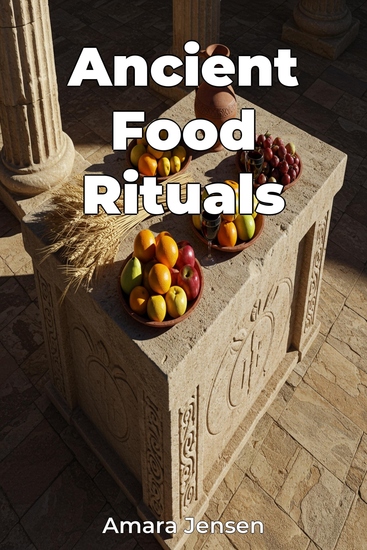
Ancient Food Rituals - cover

Ancient Food Rituals

Amara Jensen

Translator A AI

Publisher: Publifye

  • 0
  • 0
  • 0

Summary

Ancient Food Rituals explores the deep connections between food, spirituality, and religious ceremonies throughout history. It examines how these practices have shaped human societies and belief systems. Early societies saw success in agriculture and hunting as divine favor, imbuing food with spiritual significance. The book argues these rituals provide insights into cultural values, revealing food as more than just sustenance.

 
The book starts with fundamental concepts like the symbolic meanings of foods, such as bread representing life and wine symbolizing transformation. It then delves into specific food rituals from ancient Egypt, Greece, Rome, Mesoamerica, and early Judaism and Christianity. Each chapter focuses on a particular civilization or religious tradition, examining the foods that were considered sacred and the rituals surrounding their preparation and consumption.

 
Drawing from archaeological records, ancient texts, and ethnographic studies, the book highlights common threads and unique adaptations across different cultures. It culminates in a discussion of the enduring legacy of ancient food rituals in contemporary society, showing how modern dietary practices and religious celebrations echo these ancient traditions. This approach offers a broad comparative analysis of food and spirituality.
Available since: 03/11/2025.
Print length: 64 pages.

Other books that might interest you

  • A Classic Interview with Rock Icon Syd Barrett of Pink Floyd - cover

    A Classic Interview with Rock...

    Syd Barrett

    • 0
    • 0
    • 0
    Roger Keith "Syd" Barrett (January 6, 1946 to July 7, 2006) was an English singer, songwriter, guitarist and co-founder of Pink Floyd. He was the band's frontman and primary songwriter for their debut album, The Piper at the Gates of Dawn (1967), and portions of their second album, A Saucerful of Secrets (1968). In April 1968, Barrett was ousted from Pink Floyd amid speculation of mental illness and his use of psychedelic drugs. In 1972, Barrett retired from public life and guarded his privacy until his death of pancreatic cancer in 2006. The following is from an August 1967 interview.
    Show book
  • Northeaster - A Story of Courage and Survival in the Blizzard of 1952 - cover

    Northeaster - A Story of Courage...

    Cathie Pelletier

    • 0
    • 0
    • 0
    For many, the past few years have been defined by climate disaster. Stories about once-in-a-lifetime hurricanes, floods, fires, droughts, and even snowstorms are now commonplace. But dramatic weather events are not new and Northeaster, Cathie Pelletier's breathtaking account of the 1952 snowstorm that blanketed New England, offers a valuable reminder about nature's capacity for destruction as well as insight into the human instinct for preservation. 


    Northeaster weaves together a rich cast of characters whose lives were uprooted and endangered by the storm. Housewives and lobstermen, loggers and soldiers were all trapped as snow piled in drifts twenty feet high. The storm smothered hundreds of travelers in their cars, covered entire towns, and broke ships in half. In the midst of the blizzard's chaos, there were remarkable acts of heroism and courageous generosities. Doctors braved the storm to help deliver babies. Ordinary people kept their wits while buried in their cars, and others made their way out of forests to find kindhearted strangers willing to take them in. 


    It's likely that none of us know how we would handle a confrontation with a blizzard or other natural disaster. But Northeaster shows that we have it inside to fight for survival in some of the harshest conditions that nature has to offer.
    Show book
  • Robert E Lee’s Greatest Victories - cover

    Robert E Lee’s Greatest Victories

    Editors Charles River

    • 0
    • 0
    • 0
    After Lee succeeded the wounded Johnston, he pushed McClellan’s Army of the Potomac away from Richmond and back up the Peninsula in late June, only to then swing his army north to face a second Union army, John Pope’s Army of Virginia. Needing to strike out before the Army of the Potomac successfully sailed back to Washington and linked up with Pope’s army, Lee daringly split his army to threaten Pope’s supply lines, forcing Pope to fall back to Manassas to protect his flank and maintain his lines of communication. At the same time, it left half of Lee’s army (under Stonewall Jackson) potentially exposed against the larger Union army until the other wing (under James Longstreet) linked back up. Thus, in late August 1862, the Army of Northern Virginia and the Army of Virginia found themselves fighting over nearly the exact same land the South and North fought over in the First Battle of Bull Run 13 months earlier.  
    Of all the Civil War battles fought, and of all the victories achieved by Robert E. Lee at the command of the Confederate Army of Northern Virginia, the Battle of Chancellorsville is considered the most tactically complex and ultimately the most brilliant Confederate victory of the war. In early May 1863, the Army of the Potomac was at the height of its power as it bore down on Robert E. Lee’s Army of Northern Virginia near Fredericksburg, where the Confederates had defeated them the previous December. The Union behemoth had spent most of the winter season being reorganized and drilled by “Fighting Joe” Hooker, an aggressive commander who had fought hard at places like Antietam. With an army nearing 130,000 men, Hooker’s Army of the Potomac was twice the size of the Army of Northern Virginia. Lee’s heavily outnumbered army went on to win the most stunning victory of the war, but it cost them nearly 25% of their men and Stonewall Jackson.
    Show book
  • Discover Your Inner Artist: A 10-Week Guided Journey - Unleash Your Artistic Potential: Dive into a Captivating 10-Week Audio Guided Journey! - cover

    Discover Your Inner Artist: A...

    Marcus Thornfield

    • 0
    • 0
    • 0
    Discover Your Inner Artist: A 10-Week Guided Journey 
    ⭐⭐ Simplified Guide & Explanations Included ⭐⭐  
    Are you looking to progress in your creative journey and solidify your artistic potential by embarking on a 10-week guided adventure?  
    Seeking a comprehensive guide that provides all necessary elements to transform your life through art? 
    Your search ends here! 
    This guide serves as your definitive companion for deepening your understanding, applying your creativity, and engaging in hands-on exercises. With this, you're geared for success. 
    Updated for the latest insights and methodologies in creative exploration. 
    Key features of this enriched guide: 
    - Profound insights about unleashing your creativity 
    - Detailed explanations on transforming your life through a guided art journey 
    - Fruitful strategies for nurturing your artistic skills and tackling creative blocks 
    Our guide distinguishes itself through comprehensive coverage, which is essential for your artistic triumph. Concepts aren't merely skimmed; they are delved into with precision. 
    Please note that this guide is not affiliated with any official art program and is purely an independent resource for your benefit. 
    Designed with a clear structure and easy-to-understand language, our guide ensures smooth transitions between topics. Say goodbye to dense jargon and welcome clear, precise, and technically accurate content. 
    So, why wait? Click the BUY NOW button, secure your guide, and begin your journey to creative transformation!
    Show book
  • Essays: First Series Art - cover

    Essays: First Series Art

    Ralph Waldo Emerson

    • 0
    • 0
    • 0
    What is art? A mere imitation of life or something far greater—an act of creation that reveals the soul of the universe? Ralph Waldo Emerson, the philosopher-poet of American transcendentalism, elevates art beyond the canvas, beyond words, beyond form itself. In this essay, he explores the divine spark within creativity, arguing that true art is not bound by technique or tradition but flows from the spirit of the artist, a force both mysterious and essential.
    Emerson's vision is not for the passive observer but for those who seek to understand art as a living energy, a reflection of the highest truths. He sees the poet, the painter, the sculptor not as mere craftsmen but as visionaries, shaping the world with the raw power of imagination. Art, in its purest form, is not just a product—it is a revelation.
    For artists, dreamers, and seekers of meaning, Art is an invitation to look beyond the surface, to see beauty not as decoration but as a force that shapes existence itself. Read Emerson and rediscover art as you have never seen it before—alive, infinite, and transcendent.
    Show book
  • The Experiencer - Idealistic emergence God science and you - unified An idealistic theory of the world and a story about awakening - cover

    The Experiencer - Idealistic...

    Tom W. Ottmar

    • 0
    • 0
    • 0
    The author firmly believes that the philosophical standpoint of idealism provides the correct understanding of the world. Nothing material exists; all are conceptions in a single, universal consciousness. 
    Is it possible? Is it likely? 
    This book shows that it is, in fact, the most likely explanation of all. In a mental world, it is easy to connect the natural sciences with humanistic fields such as psychology, language, music, sociology, ethics, religion – and everything else. 
    Common laws govern them all. Poetry and weather can be explained by the fundamental mechanisms of emergence and complexity dynamics. Economy, trees, gossip, elementary particles and cosmological events all follow the same laws in their development. 
    What, then, is a human being? What are life and death? What is time? You get specific answers. 
    The author says that he has ”known” things all his life, but it took many years before the knowledge entirely broke through. The first part of the book is about this awakening. You get to know precisely how it happened and what is required for it to occur. 
    The book’s second part presents a complete theory of the world. It is idealistic (Plato, Descartes), i.e. based on the fact that thought and consciousness are fundamental, while all the material things we see around us are mental conceptions which are also experienced as qualia; something tangible, felt, material, physical. 
    This is a book like no other, and it not only sets the mind spinning but presents what may well be an accurate description of the universe in which we live. 
    At the same time, it goes deep into being human; what it is in essence, and also why we experience life’s pain, fear, longing, etc. – and how we can live more in harmony with our authentic self, which is something quite different from what most people think.
    Show book