Join us on a literary world trip!
Add this book to bookshelf
Grey
Write a new comment Default profile 50px
Grey
Subscribe to read the full book or read the first pages for free!
All characters reduced
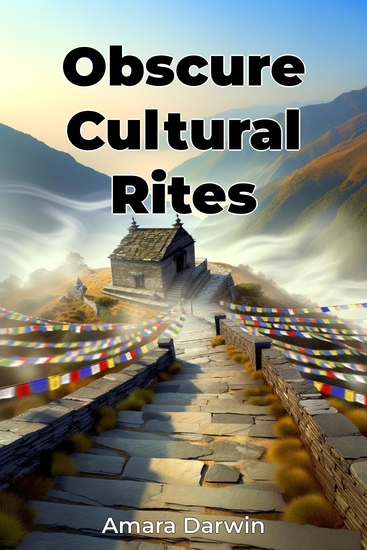
Obscure Cultural Rites - cover

Obscure Cultural Rites

Amara Darwin

Publisher: Publifye

  • 0
  • 0
  • 0

Summary

"Obscure Cultural Rites" offers a fascinating exploration of lesser-known ceremonies and traditions that continue to shape communities worldwide, drawing from extensive research across five continents and spanning over two centuries of anthropological documentation.

 
This comprehensive study examines how traditional practices persist and adapt in our rapidly modernizing world, with a particular focus on transition rites, agricultural ceremonies, and healing rituals that remain vital to cultural identity and social cohesion. Through meticulous fieldwork in twenty-eight communities across Asia, Africa, and South America, the book reveals remarkable discoveries about previously undocumented rituals.

 
From the mountain communities of Papua New Guinea to the isolated valleys of the Himalayas, readers encounter unique coming-of-age ceremonies and agricultural practices that continue to govern community life. Particularly intriguing is the revelation that many traditional agricultural rites contain sophisticated environmental knowledge, while healing ceremonies often incorporate effective psychological interventions that complement modern medicine.

 
The book progresses logically through three main sections, beginning with transition rites, moving through agricultural ceremonies, and concluding with healing rituals. Drawing from over 200 interviews with community elders and ritual practitioners, it presents a balanced view of how traditional practices interact with contemporary challenges. This approach makes complex anthropological concepts accessible to both academic researchers and general readers, while maintaining scholarly integrity and addressing crucial questions about cultural preservation in an increasingly globalized world.
Available since: 01/08/2025.
Print length: 110 pages.


Other books that might interest you

  • Egyptian Religious Festivals and Rituals - Celebrations of the Divine - cover

    Egyptian Religious Festivals and...

    Omar Khalil

    • 0
    • 0
    • 0
    Religious festivals in ancient Egypt were not just moments of worship but essential aspects of social, political, and spiritual life. These celebrations brought communities together, reaffirmed the divine authority of the pharaoh, and ensured the continued favor of the gods. Through elaborate ceremonies, processions, and offerings, Egyptians demonstrated their devotion while reinforcing the cosmic order, known as Ma’at. 
    Religion was deeply woven into the fabric of daily life, and festivals provided opportunities for the people to express their reverence for the gods beyond routine temple rituals. Many celebrations coincided with agricultural cycles, aligning the will of the gods with the prosperity of the land. The inundation of the Nile, for example, was both a natural and a divine event, prompting rituals to honor deities like Hapi, the god of the flood. The timing of major festivals was often determined by celestial events, linking human activities with the movement of the stars and planets. 
    The pharaoh played a crucial role in these religious festivities, acting as both a political leader and a divine intermediary. He was believed to be the earthly representative of the gods, ensuring the stability of Egypt by maintaining a strong connection with the divine realm. Many ceremonies included the pharaoh making offerings to the gods, participating in processions, or performing symbolic acts to renew his legitimacy and strength. One of the most significant of these was the Sed Festival, a grand event that reaffirmed the ruler’s divine right to govern. Through public participation in such festivals, the people reaffirmed their trust in the pharaoh’s ability to maintain cosmic balance.
    Show book
  • Open Secret An - The Family Story of Robert and John Gregg Allerton - cover

    Open Secret An - The Family...

    Nicholas L. Syrett

    • 0
    • 0
    • 0
    In 1922 Robert Allerton—described by the Chicago Tribune as the “richest bachelor in Chicago”—met a twenty-two-year-old University of Illinois architecture student named John Gregg, who was twenty-six years his junior. Virtually inseparable from then on, they began publicly referring to one another as father and son within a couple years of meeting. In 1960, after nearly four decades together, and with Robert Allerton nearing ninety, they embarked on a daringly nonconformist move: Allerton legally adopted the sixty-year-old Gregg as his son, the first such adoption of an adult in Illinois history. 
     
    An Open Secret tells the striking story of these two iconoclasts, locating them among their queer contemporaries and exploring why becoming father and son made a surprising kind of sense for a twentieth-century couple who had every monetary advantage but one glaring problem: they wanted to be together publicly in a society that did not tolerate their love. Deftly exploring the nature of their design, domestic, and philanthropic projects, Nicholas L. Syrett illuminates how viewing the Allertons as both a same-sex couple and an adopted family is crucial to understanding their relationship’s profound queerness. By digging deep into the lives of two men who operated largely as ciphers in their own time, he opens up provocative new lanes to consider the diversity of kinship ties in modern US history.
    Show book
  • Into the Zone - Audio Essays - cover

    Into the Zone - Audio Essays

    Hari Kunzru

    • 0
    • 0
    • 0
    From the acclaimed author of White Tears and Red Pill–a brilliant collection from Hari Kunzru’s celebrated podcast. 
     
    Opposites and borders are never as clear as we think. With a novelist's eye for the unexpected, author Hari Kunzru takes listeners into the gray zone between life and death, public and private, black and white, and more. Along the way he meets philosophers and punk musicians, New Age gurus and space explorers, and together they investigate liminal spaces around the world. 
     
    Into the Zone: Audio Essays includes a new foreword and afterword providing bookends to a series of brilliantly crafted intersections on history and the evolution of identity. 
     
    Please note: This collection includes content that has been released in the podcast series.
    Show book
  • Renaissance - The European Cultural Artistic Political and Economic Rebirth - cover

    Renaissance - The European...

    Kelly Mass

    • 0
    • 0
    • 0
    When we think of the Renaissance, we often think of paintings. And indeed, many painters and sculptors were part of the artistic transformation the Renaissance caused. But there was more. The Renaissance basically formed a period of collective enlightenment and freedoms that put an end to certain tyrannies and false notions from the Middle Ages. 
    The Renaissance is a time in European history marking the shift from the Middle Ages to modernity and covering the 15th and 16th centuries, identified by an effort to restore and exceed ideas and accomplishments of classical antiquity. It happened after the Crisis of the Late Middle Ages and was related to great social change. Aside from the basic periodization, advocates of a "long Renaissance" might put its start in the 14th century and its end in the 17th century. 
    Rather than a few years or specific dates, let’s take a look at what the extensive time period of the Renaissance provided, and what it leaves us with today.
    Show book
  • Islamic Empires of India The: The History of the Muslim Dynasties that Ruled India Before the British - cover

    Islamic Empires of India The:...

    Editors Charles River

    • 0
    • 0
    • 0
    India has been the location of many different empires throughout its long history. The Indus Valley Civilization was home to one of the world’s first civilizations more than 5,000 years ago, and despite India’s tradition of cultural and political pluralism, several rulers attempted to place the entire Sub-Continent under the rule of one dynasty or government with a dominant religion. Most of these would-be rulers were far from successful, although a few came close, setting the template for later conquerors. 
    The religion of Islam had entered India centuries earlier through merchants and missionaries, but, in the 10th century, warrior bands of Muslims began establishing themselves permanently in what is today Pakistan. From their permanent strongholds, these Muslim warriors of Turkish descent raided northern India, eventually capturing the city of Delhi and establishing what would become the Delhi Sultanate.  
    The Delhi Sultanate was comprised of five dynasties that expanded their borders, and Islam, at sword point, but also through diplomacy and trade. The Delhi Sultanate became known as a state that welcomed the expertise of foreigners, no matter their religion, and promoted the welfare of its citizens through a host of social programs. Eventually, the Delhi Sultanate grafted ideas and inspiration from India’s pre-Islamic past with those of Islam to create a state that was quite unique and powerful. 
    The Mughals, a group with Turkish and Mongolian roots, used gunpowder weapons to sweep into northern India, topple the existing Islamic dynasty in Delhi, and eventually subject most of India to their rule. The term “gunpowder empire” was originally coined by Russian scholar V. V. Bartold and popularized by American historians William McNeil and Marshall Hodgson in the mid-20th century to describe the Islamic Ottoman, Safavid, and Mughal empires, which they claimed came to power through gunpowder.
    Show book
  • Tears Over Russia - A Search for Family and the Legacy of Ukraine's Pogroms - cover

    Tears Over Russia - A Search for...

    Lisa Brahin

    • 0
    • 0
    • 0
    Between 1917 and 1921, twenty years before the Holocaust began, an estimated 100,000 to 250,000 Jews were murdered in anti-Jewish pogroms across the Ukraine. Lisa grew up transfixed by her grandmother Channa’s stories about her family being forced to flee their hometown of Stavishche, as armies and bandit groups raided village after village, killing Jewish residents. Channa described a perilous three-year journey through Russia and Romania, led at first by an American who had snuck into the Ukraine to save his immediate family and ended up leading an exodus of nearly eighty people to safety. With almost no published sources to validate her grandmother’s tales, Lisa embarked on an incredible journey to tell Channa’s story, forging connections with archivists around the world to find elusive documents to fill in the gaps of what happened in Stavishche. She also tapped into connections closer to home, gathering testimonies from her grandmother’s relatives, childhood friends, and neighbors. The result is a moving historical family narrative that speaks to universal human themes—the resilience and hope of ordinary people surviving the ravages of history and human cruelty. With the growing passage of time, it is unlikely that we will see another family saga emerge so richly detailing this forgotten time period. Tears Over Russia eloquently proves that true life is sometimes more compelling than fiction.
    Show book