Join us on a literary world trip!
Add this book to bookshelf
Grey
Write a new comment Default profile 50px
Grey
Subscribe to read the full book or read the first pages for free!
All characters reduced
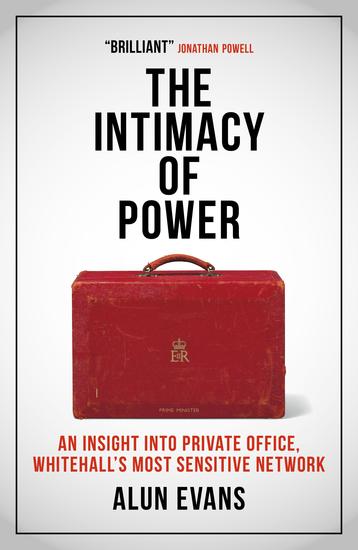
The Intimacy of Power: An insight into private office Whitehall's most sensitive network - Why Private Office Matters - cover

The Intimacy of Power: An insight into private office Whitehall's most sensitive network - Why Private Office Matters

Alun Evans

Publisher: Biteback Publishing

  • 0
  • 0
  • 0

Summary

Have you ever wondered what happens behind the scenes in the corridors of power during a major crisis or after a ministerial reshuffle? How do new government ministers get to grips with their portfolios and priorities? Who guides and supports them? And why, sometimes – during events such as 'Partygate' – do things go wrong?
In this meticulously researched book, former senior civil servant Alun Evans lifts the lid on a vital but little-known cog in the machinery of government: private office and the private secretaries who work within it.
Private secretaries exercise huge influence, and yet most of us have never heard of them. They are the ones who manage the flow of work, who whisper quietly in ministers' ears and who have been Prime Ministers' closest, most trusted and most discreet confidants. At critical moments in our national history – from the Falklands War to the Westland affair, from Black Wednesday to the 2008 financial crash, from New Labour to the coalition government – they have been central but hidden players.
With exceptional access to former Prime Ministers and decision-makers, Evans explores what private office is and why it matters to British democracy. He argues that following the egregious constitutional breaches of Boris Johnson's premiership, private office must once again be taken seriously so it can return to being the independent junction box of government and a vital part of the British constitution.
Available since: 05/28/2024.
Print length: 432 pages.
Other books that might interest you

  • A Real Right to Vote - How a Constitutional Amendment Can Safeguard American Democracy - cover

    A Real Right to Vote - How a...

    Richard L. Hasen

    • 0
    • 0
    • 0
    Throughout history, too many Americans have been disenfranchised or faced needless barriers to vote. Part of the blame falls on the Constitution, which does not contain an affirmative right to vote. The Supreme Court has made matters worse by failing to protect voting rights and limiting Congress's ability to do so. The time has come for voters to take action and push for an amendment to the Constitution that would guarantee this right for all. 


    Drawing on troubling stories of state attempts to disenfranchise military voters, women, African Americans, students, former felons, Native Americans, and others, Richard Hasen argues that American democracy can and should do better in assuring that all eligible voters can cast a meaningful vote that will be fairly counted. He shows how a constitutional right to vote can deescalate voting wars between political parties that lead to endless rounds of litigation and undermine voter confidence in elections, and can safeguard democracy against dangerous attempts at election subversion. 


    The path to a constitutional amendment is undoubtedly hard, especially in these polarized times. A Real Right to Vote explains what's in it for conservatives who have resisted voting reform, and reveals how the pursuit of an amendment can yield tangible dividends for democracy long before ratification.
    Show book
  • Titans of Capital - How Concentrated Wealth Threatens Humanity - cover

    Titans of Capital - How...

    Peter Phillips, Dan Kovalik

    • 0
    • 0
    • 0
    A fascinating examination of the rapid concentration of global capital, with chapters that focus on China and Russia. 


    In Titans of Capital, Peter Phillips, a political sociologist, poses three key research questions: To what extent do the wealthy influence—or even dominate—decision making that affects all of us in society? Who are the most powerful people? And how does the accumulation of capital work? 


    Networks of wealthy individuals have evolved since the COVID-19 pandemic, and Titans of Capital shows how the financial investments of transnational elites threaten human rights and the future of the planet. Phillips warns that while continued concentration of global capital increases the profits enjoyed by the global economy's "Titans,", it also increases global inequality, starvation, and civil unrest, threatening the lives of the hundreds of millions of people living in extreme poverty. It is imperative to ask how we can reverse the concentration of Titan wealth and revitalize grassroots democracy unbridled by extreme wealth. Identifying 117 global Titans by name and exposing the networks and interests that unite them provides listeners opposed to militarism and committed to economic equality with crucial tools to directly engage the power elite who endanger life on earth.
    Show book
  • The Hell Bomb - cover

    The Hell Bomb

    William L. Laurence

    • 0
    • 0
    • 0
    The Hell Bomb by Pulitzer Prize–winning journalist William L. Laurence is a sobering, meticulously detailed account of the dawn of the hydrogen bomb era. Written in the early 1950s, this scientific and political examination offers a front-row perspective on one of the most terrifying technological advancements in human history. Drawing on firsthand experiences from his time at Los Alamos and exclusive interviews with leading figures such as Hans A. Bethe, Laurence unpacks the terrifying potential of thermonuclear fusion and its unparalleled destructive power. 
    More than just a scientific treatise, The Hell Bomb wrestles with the ethical dilemmas and geopolitical consequences of nuclear armament in a rapidly changing post–World War II world. Laurence urges the public to confront the moral weight of such weapons and consider the path humanity must choose as it stands on the brink of unimaginable devastation. 
    Narrated with gravity and insight by Nathan Edwards, this audiobook remains a critical historical document and a powerful warning from the nuclear age's front lines.
    Show book
  • The US Congress - A Very Short Introduction - cover

    The US Congress - A Very Short...

    Donald A. Ritchie

    • 0
    • 0
    • 0
    Donald A. Ritchie, a congressional historian for forty years, takes listeners on a fascinating, behind-the-scenes tour of Capitol Hill, pointing out the key players, explaining their behavior, and translating parliamentary language into plain English. He also explores the essential necessity of compromise to accomplish anything significant in the legislative arena. However, recent events show that political polarization has hardened and produced gridlock. The 2020 election also produced a more diverse membership in terms of gender, ethnicity, religion, and ideology, with primary elections resulting in the defeat of moderate candidates, making bipartisan compromise harder to achieve. 


    Among the most significant events, the Senate ignored President Obama's last nomination to the Supreme Court and then adopted a "nuclear option" to streamline future Supreme Court confirmations. The House also twice impeached President Trump, processes that starkly expose the differences between the majority-rule requirements of the House and the super-majority requirements of the Senate. This new edition explains how the parties have changed in light of the unprecedented politics of the past four years, culminating in the mob attack on the U.S. Capitol on January 6, 2021, and how this development has affected both the House and the Senate.
    Show book
  • Codebreakers - How Allied Intelligence Cracked Enemy Codes and the Tide - cover

    Codebreakers - How Allied...

    Sage Winters

    • 0
    • 0
    • 0
    The art of codebreaking has long been an essential aspect of warfare, serving as a hidden weapon that can change the course of history. During World War II, intelligence efforts were not only about gathering information; they were about deciphering the secrets encoded by the enemy to gain a strategic advantage. As technology evolved, so did the complexity of military ciphers, making the task of breaking enemy codes more challenging and more critical than ever. "Codebreakers: How Allied Intelligence Cracked Enemy Codes and the Tide" delves into the extraordinary efforts of Allied cryptographers, whose tireless work behind the scenes helped secure victories that shifted the balance of the war. 
      
    The importance of cryptography in World War II cannot be overstated. The ability to read an enemy’s messages before they had time to act was a decisive factor in numerous key battles and campaigns. The German Enigma machine, a sophisticated encryption device, represented the pinnacle of Nazi Germany’s efforts to protect its communications. Breaking this code was essential to the Allied success, and it was a challenge that seemed insurmountable at the time. However, a group of brilliant minds, including Alan Turing, led the charge in deciphering the Enigma cipher, providing the Allies with invaluable intelligence that allowed them to anticipate German movements, thwart attacks, and save countless lives. 
      
    At the heart of this monumental achievement was Bletchley Park, a secret British facility that became the epicenter of codebreaking during the war. Here, the brightest mathematicians, linguists, and engineers worked tirelessly, often under immense pressure, to crack the German and later the Japanese codes.
    Show book
  • The Tragic Mind - Fear Fate and the Burden of Power - cover

    The Tragic Mind - Fear Fate and...

    Robert D. Kaplan

    • 0
    • 0
    • 0
    A moving meditation on recent geopolitical crises, viewed through the lens of ancient and modern tragedy 
     
    Some books emerge from a lifetime of hard-won knowledge. Robert D. Kaplan has learned, from a career spent reporting on wars, revolutions, and international politics in Europe, the Middle East, and East Asia, that the essence of geopolitics is tragedy. In The Tragic Mind, he employs the works of ancient Greek dramatists, Shakespeare, German philosophers, and the modern classics to explore the central subjects of international politics: order, disorder, rebellion, ambition, loyalty to family and state, violence, and the mistakes of power. The great dilemmas of international politics, he argues, are not posed by good versus evil—a clear and easy choice—but by contests of good versus good, where the choices are often searing, incompatible, and fraught with consequences. A deeply learned and deeply felt meditation on the importance of lived experience in conducting international relations, this is a book for everyone who wants a profound understanding of the tragic politics of our time.
    Show book