Join us on a literary world trip!
Add this book to bookshelf
Grey
Write a new comment Default profile 50px
Grey
Subscribe to read the full book or read the first pages for free!
All characters reduced
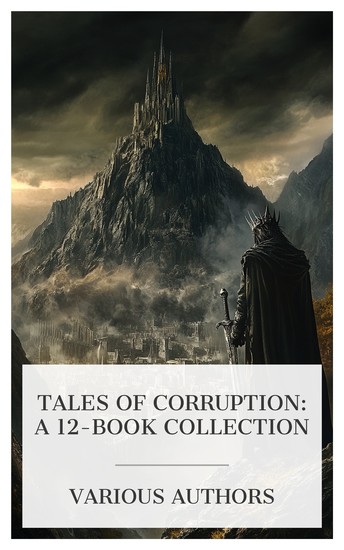
Tales of Corruption: A 12-Book Collection - The King of the Mountains Satan's Invisible World Displayed The History of Tammany Hall etc - cover

Tales of Corruption: A 12-Book Collection - The King of the Mountains Satan's Invisible World Displayed The History of Tammany Hall etc

Alphonse Daudet, Charles Baudelaire, Edmond About, Robert Holloway, W. T. Stead, Gustavus Myers, Emily Sarah Holt, L. O. Curon, Robert O. Harland, W. A. Wilkins

Publisher: e-artnow

  • 0
  • 0
  • 0

Summary

Tales of Corruption: A 12-Book Collection brings together an extraordinary diversity of literary styles and themes, encapsulating an era characterized by moral ambiguity and ethical dilemmas. The anthology traverses genres and moods, from the haunting elegance of symbolism to the sharpness of social critique, showcasing an array of narratives centered around the perpetual tension between integrity and decadence. Standout narratives captivate with their intense exploration of corruption's many faces, weaving a tapestry of stories that reflect both the dark underbelly of human ambition and society's struggle with moral decay. The collection features notable authors such as W. A. Wilkins, Alphonse Daudet, and Charles Baudelaire, whose works collectively enrich this anthology's theme of corruption. Each author, with their unique literary backgrounds, contributes distinctly to the dialogue of moral and ethical decline. This compilation is embedded within the broader literary movements of realism, symbolism, and naturalism of the 19th and early 20th centuries, offering readers an immersive experience into the cultural and social critiques of their time. The diversity of voices coalesces to provide a multifaceted exploration of corruption, painting vivid portraits of societal downfall and resilience. Tales of Corruption is an invaluable compendium for readers seeking to engage with a multitude of perspectives on a timeless theme. This anthology offers an educational journey through differing narrative styles and thematic explorations, promising a depth of insights that will provoke thought and discussion. Embrace this unique chance to traverse through intricately woven stories that dissolve the boundaries of time, encouraging readers to reflect on the perennial struggles against corruption in its many forms. Immerse yourself in this compelling dialogue among prolific voices as they explore the enduring human challenge of righteousness.
Available since: 03/04/2025.
Print length: 2546 pages.

Other books that might interest you

  • The Montezuma Emerald - cover

    The Montezuma Emerald

    Rodrigues Ottolengui

    • 0
    • 0
    • 0
    Rodrigues Ottolengui was an American writer and pioneering dentist born in Charleston, SC, who lived most of his life in New York City. Ottolengui was one of the first dentists to use X-rays and was a specialist in orthodontics and root canal therapy. In the 1890s, Ottolengui published four novels and a collection of detective short stories, including The Montezuma Emerald. 
    A seasoned stage actor, Raymond Stottlemyre was born and raised in Pelican Rapids, MN. He has worked in local radio, narrated audio programs, and has performed in hundreds of plays over the decades.
    Show book
  • The Doll - The Lost Short Stories - cover

    The Doll - The Lost Short Stories

    Daphne du Maurier

    • 0
    • 1
    • 0
    “Early stories [that] vividly portrays with humor, candidness, and detail du Maurier’s fascination with the problems of human connection.” —Publishers Weekly 
     
    Perhaps best known for her immortal gothic masterwork Rebecca—the basis for the Academy Award–winning motion picture directed by Alfred Hitchcock—Daphne de Maurier began her illustrious writing career penning short stories. In The Doll, thirteen of du Maurier’s early shorter fictional works have been collected—each story written before the author’s twenty-third birthday and some in print for the first time since the 1930s. Compelling tales of human foibles and tragic romance, the stories in The Doll represent the emergence of a remarkable literary talent who later went on to create Jamaica Inn, The Birds, and other classic works. This breathtaking collection of short fiction belongs on the bookshelf of every Daphne du Maurier fan. 
     
    “[D]electably florid.” —New York Times Book Review 
     
    “[Du Maurier’s] storytelling gifts are formidable.” —Kirkus Reviews
    Show book
  • A Somewhat Improbable Story - From their pens to your ears genius in every story - cover

    A Somewhat Improbable Story -...

    G K Chesterton

    • 0
    • 0
    • 0
    G K Chesterton (29 May 1874 – 14 June 1936) was a poet, novelist, playwright, literary commentator, editor, biographer, journalist, orator and theologian.  He was often dubbed as the “prince of paradox” for his light whimsical style that often addressed serious issues such as politics and religion.  The latter was as a member and defender of the Christian faith and the former was shaped by a distrust of concentrated wealth and power.  He advocated Distributionism and said that every man should be allowed to own "three acres and a cow."  These political views have spread round the world, crediting Chesterton as the father of the “small is beautiful” movement.  It is also said to have influenced Gandhi in seeking a genuine nationalism for India rather than imitating the British state.   
    Chesterton was remarkably prolific but perhaps his most famous creation is Father Brown.  Within this character Chesterton’s clever writing and profound ideas reveal truths, often with humour as the detective priest pursues the answers to his cases.
    Show book
  • The Bin Laden Plot - cover

    The Bin Laden Plot

    Rick Campbell

    • 0
    • 0
    • 0
    A US destroyer is torpedoed by an Iranian submarine and Captain Murray Wilson of the USS Michigan is flown to the Pentagon to meet with the Secretary of the Navy (SecNav). There Wilson learns that the Iranian submarine is just a cover story. One of the United States' own fully automated unmanned underwater vehicles has gone rogue, its programing corrupted in some way. Murray is charged with hunting it down and taking it out before the virus that's infected its operating system can infect the rest of the fleet. 


    At the same time, the head of the SEAL detachment aboard the USS Michigan is killed and Lonnie Mixell, a former US operative, now assassin for hire, is responsible. And that is only the first SEAL to be hunted down and killed. Jake Harrison, fellow SEAL, discovers that these SEALs had one mission in common—they were all on the team that killed Bin Laden. Or so the world was told. 


    As Wilson discovers that his mission is actually meant to cover up dangerous acts of corruption, even treason, Harrison discovers that the assassin is out to protect the same forces. Forces too powerful for either of them to take on alone.
    Show book
  • The Dunwich Horror — Part 8 of 10 - cover

    The Dunwich Horror — Part 8 of 10

    H. P. Lovecraft

    • 0
    • 0
    • 0
    Welcome to Timeless Terrors No. 62, continuing H. P. Lovecraft’s descent into cosmic nightmare: The Dunwich Horror. 
    The devastation left in the wake of the unseen horror deepens. Across the battered hills of Dunwich, homes lie in ruin, fields are torn apart, and the air itself feels wrong — twisted by the passage of something that should not exist. The invisible behemoth roams beyond human reach, and fear has become an inescapable presence in the countryside. 
    In the aftermath, hope flickers for the first time. A small band of scholars prepares to confront what cannot be seen, armed not with weapons, but with forbidden knowledge and desperate incantations. Yet even this fragile resistance feels terrifyingly inadequate against a force born beyond the stars. 
    Narrated by Amazon-bestselling horror author Jonathan Dunne, this chapter carries the story toward its turning point — where human defiance stands face to face with an indifferent and ancient terror that was never meant to be fought. 
    This is Part 8 of a 10-part complete audiobook. Stay tuned — the end begins to take shape.
    Show book
  • Her Turn - From their pens to your ears genius in every story - cover

    Her Turn - From their pens to...

    D H Lawrence

    • 0
    • 0
    • 0
    David Herbert Lawrence was born on the 11th September 1885 in Eastwood, Nottinghamshire, a coal mining town where the reality of a harsh life was only useful as experiences for future literary works. 
    He was educated at Beauvale Board School and became the first local boy to receive a scholarship to attend Nottingham High School. After 3 years he became a junior clerk in Haywood’s surgical appliances factory. He was also attempting a literary career which, in the short term, led to a teacher training position in Eastwood and later a teaching qualification from University College, Nottingham.  
    Lawrence’s first efforts were poems, short stories and a draft of ‘The White Peacock’. Moving to London and a teaching position in Croydon his writing attracted the attention of Ford Madox Ford, editor of The English Review, and he commissioned him to write ‘Odour of Chrysanthemums’.  
    Wanting to write full-time he now began work on what would become ‘Sons and Lovers.   
    In 1912 he met the older and married mother-of-three Frieda Weekley. They eloped to Germany and here Lawrence could see for himself the growing tensions with France.  So keen was his interest that he was arrested and accused of being a British spy.  
    In early 1914 Frieda obtained her divorce and they returned to Britain to be married just days before the outbreak of war. Owing to her German parentage, and his own public dislike of militarism and violence, the couple were treated with contempt and suspicion throughout the war years.  
    Despite this he continued to write but his reputation in England was so tarnished and, mirrored by his own disdain for the country, he and Frieda left England in November 1919, first for Europe and then America via Ceylon and Australia. 
    They bought a ranch in Taos, New Mexico and visited Mexico several times. The third visit in March 1925 caused a near fatal attack of malaria. To convalesce they moved to Florence. Here he continued work on ‘Lady Chatterley’s Lover’ which for many years would cause controversy. A renewed interest in oil painting resulted in an exhibition in 1929 which was raided by the police and several works were confiscated.  
    D H Lawrence died of complications arising from a bout of tuberculosis on the 2nd of March 1930 in Vence, France.  He was 44.
    Show book