Join us on a literary world trip!
Add this book to bookshelf
Grey
Write a new comment Default profile 50px
Grey
Subscribe to read the full book or read the first pages for free!
All characters reduced
Divine Comedy (Complete Edition) - Enriched edition Illustrated & Annotated - cover

Divine Comedy (Complete Edition) - Enriched edition Illustrated & Annotated

Alighieri Dante

Translator Henry Francis Cary

Publisher: Good Press

  • 0
  • 0
  • 0

Summary

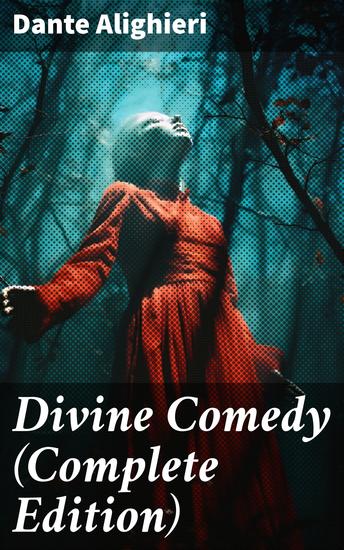
Dante Alighieri's 'Divine Comedy (Complete Edition)' is a monumental epic poem, masterfully woven in the early 14th century, which uniquely interlaces allegory, theology, and rich cultural commentary. Comprising three canticas'—Inferno, Purgatorio, and Paradiso'—the work takes the reader on a transformative journey through the realms of the afterlife. Dante's use of the vernacular Tuscan dialect, coupled with intricate symbolism and vivid imagery, makes the text not only an impressive literary achievement but also a profound exploration of moral philosophy and the human condition, set against the backdrop of medieval Christianity and politics. Dante, an influential figure of the Italian Renaissance, drew upon his personal experiences, including his exile from Florence, as well as the political and social tumult of his time. His profound knowledge of classical authors and his deep Christian faith converge in this work, which reflects his desire for spiritual redemption and understanding of divine justice. Dante's innovative narrative techniques, along with his intellectual and emotional depth, showcase his mastery as both a poet and a philosopher. Highly recommended for those intrigued by the intersections of faith, philosophy, and literature, 'Divine Comedy' transcends its historical context, addressing timeless themes of love, justice, and human aspirations. This complete edition invites readers to experience not only the poetic journey of Dante himself but also to reflect on their own spiritual quests and moral dilemmas.

In this enriched edition, we have carefully created added value for your reading experience:
- A succinct Introduction situates the work's timeless appeal and themes.
- The Synopsis outlines the central plot, highlighting key developments without spoiling critical twists.
- A detailed Historical Context immerses you in the era's events and influences that shaped the writing.
- An Author Biography reveals milestones in the author's life, illuminating the personal insights behind the text.
- A thorough Analysis dissects symbols, motifs, and character arcs to unearth underlying meanings.
- Reflection questions prompt you to engage personally with the work's messages, connecting them to modern life.
- Hand‐picked Memorable Quotes shine a spotlight on moments of literary brilliance.
- Interactive footnotes clarify unusual references, historical allusions, and archaic phrases for an effortless, more informed read.
Available since: 11/18/2023.
Print length: 546 pages.

Other books that might interest you

  • The Poetry of Dante Gabriel Rossetti - Renowned poet and painter who founded the Pre-Raphaelite Brotherhood and influenced the Aesthetic movement - cover

    The Poetry of Dante Gabriel...

    Dante Gabriel Rossetti

    • 0
    • 0
    • 0
    Dante Gabriel Rossetti was born on May 12th 1828 in London, England. 
    As a youth he was "self-possessed, articulate, passionate and charismatic" but also "ardent, poetic and feckless". Like his siblings, including famed poet Christina Georgina Rossetti, he most wished to be a poet but had a keen eye as a painter, having shown a great interest in Medieval Italian art.  
    Together with William Holman Hunt and John Everett Millais they developed and founded the Pre-Raphaelite Brotherhood. It’s mission; to reform English art and return to the detail, intense colours, and complex compositions of Quattrocento Italian and Flemish art.  
    The brotherhood's magazine, The Germ, was first published in 1850 with Rossetti contributing a poem, "The Blessed Damozel", and a story about a fictional Italian artist inspired by a vision of a woman who bids him combine the human and the divine in his art. 
    Rossetti first met his future wife, Elizabeth Siddal, a model, in 1849 who was later sitting for him and involved in an intense relationship.  By 1852 they withdrew from society; totally absorbed in each other. The lovers nicknamed each other; "Guggums" and "Dove".   
    In 1861, Rossetti, together with William Morris, became a founding partner in the decorative arts firm, Morris, Marshall, Faulkner & Co. Rossetti contributed designs for stained glass and other decorative objects. 
    Meanwhile his marriage to Lizzie was troubled.  The terrible hurt of Rossetti’s affairs with other women had caused her stress leading to depression and other illnesses. She now began to take, and become addicted to, laudanum. In 1861, Lizzie became pregnant but the resultant birth was a stillborn daughter.  Lizzie’s post-partum depression was followed by an overdose of laudanum the following year.  Rossetti was devastated and, at her funeral in Highgate Cemetery, he buried the bulk of his unpublished poems with her body. 
    Poetry and painting are closely entwined in Rossetti's work. He frequently wrote sonnets to accompany his pictures, while also creating art to illustrate poems such as "Goblin Market" by his sister. 
    His personal life was closely woven into his work, especially his relationships with his models and muses.  William Morris’s wife, Jane, regularly sat for him during the next few years, and it was said she "consumed and obsessed him in paint, poetry, and life".  
    During these years, Rossetti was prevailed upon by friends to exhume his poems from his wife's grave which he eventually did, collating and publishing them in 1870.  Their eroticism and sensuality caused much offence. One, "Nuptial Sleep", described a couple falling asleep after sex. It was part of the sonnet sequence The House of Life, a complex series tracing the physical and spiritual development of an intimate relationship.  Rossetti described the sonnet form as a "moment's monument" and these were his crowning literary achievement.  
    Toward the end of his life, he sank into a morbid state, shadowed by addiction to chloral hydrate and increasing mental instability. He spent his last years as a recluse at Cheyne Walk and died on Easter Sunday, April 9th, 1882. 
     This volume comes to you from Portable Poetry, a specialized imprint from Deadtree Publishing.  Our range is large and growing and covers single poets, themes, and many compilations.
    Show book
  • Chips and Splinters - A Collection of Poems and Essays - cover

    Chips and Splinters - A...

    Edward S Sorenson

    • 0
    • 0
    • 0
    A delightful selection of entertaining poems, short essays, and written conversations involving the people of 20th-century rural Australia and some of their working animals. 
    This collection includes “When Dad Drives Home From Town,” “When the Sailor Rode the Brumby,” “The Old Barn School,” and many more.
    Show book
  • Nine Lives - cover

    Nine Lives

    Kent Zimmerman

    • 0
    • 0
    • 0
    This audiobook is narrated by an AI Voice.   
    9 LIVES is an early "identity" poem, composed and described as an archetypal need to relate human experience of the natural world in a poem song or play and lyrically indexed as: 
    A MEMORY 
    OF CATCHES 
    IN WORD WORLD III 
    A BALLET 
    FOR LETTING GO 
    OF O 
    O RHY THM 
    OF WOODWINDS 
    PLAYING
    Show book
  • A Dream Play - cover

    A Dream Play

    August Strindberg

    • 0
    • 0
    • 0
    A Dream Play (Swedish: Ett drömspel) was written in 1901 by the Swedish playwright August Strindberg. It was first performed in Stockholm on 17 April 1907. It remains one of Strindberg's most admired and influential dramas, seen as an important precursor to both dramatic Expressionism and Surrealism.  The primary character in the play is Agnes, a daughter of the Vedic god Indra. She descends to Earth to bear witness to problems of human beings. She meets about 40 characters, some of them having a clearly symbolical value (such as four deans representing theology, philosophy, medicine, and law). After experiencing all sorts of human suffering (for example poverty, cruelty, and the routine of family life), the daughter of gods realizes that human beings are to be pitied.  - Summary by WikipediaCast List:The Daughter of Indra (Agnes); Voice of the Women (+ All); The Crew: Amanda FridayThe Officer (+All in III): Ron AltmanThe Lawyer; All Right-Minded: Chuck WilliamsonThe Poet: Lucy PerryThe Voice of Indra: om123The Glazier; Voice of the Men, Tenor and Bass (+All); The Crew: alanmapstoneThe Father; He (+All); The Second Coalheaver; Dean of Philosophy: ToddHWThe Mother: Margaret EspaillatLena: Rebecca Braunert-PlunkettThe Portress; The Wife; The Gentleman: CaprishaPageThe Billposter: EccentricOwlVictoria (also "A Woman's Voice from Above"); She (+All): Elizabeth KlettThe Ballet Girl; Voice of the Children (+All); The Crew: Frances BrownThe Male Chorus Singer; The Boy (+All the Boys): Libby GohnThe Prompter; The Blind Man (+All): Mary JThe Policeman; The Husband; Dean of Jurisprudence: Arnaldo MachadoChristine; The First Coalheaver: KHandThe Master of Quarantine (+All in Act II): Zachary Brewster-GeiszThe Pensioner (+ All); The Naval Officer; Dean of Theology: Prachi PendseThe Maids; The Lady; Don Juan: WoollyBeeEdith; Dean of Medicine: Anna SimonThe Teacher: SavannahLord Chancellor: Josh KirshNarrator: Sarah TerryEdited by Chuck Williamson
    Show book
  • Work without Hope - cover

    Work without Hope

    Samuel Taylor Coleridge

    • 0
    • 0
    • 0
    LibriVox volunteers bring you nine different recordings of Work without Hope, by Samuel Taylor Coleridge, in honor of Labor Day. This was the weekly poetry project for the week of September 3rd, 2006.
    Show book
  • Runaway Dreams - cover

    Runaway Dreams

    Richard Wagamese

    • 0
    • 0
    • 0
    Having developed an impressive reputation for his many novels and non-fiction works, Richard Wagamese now presents a collection of stunning poems ranging over a broad landscape. He begins with an immersion in the unforgettable world where “the ancient ones stand at your shoulder … making you a circle / containing everything.” 
    These are Medicine teachings told from the experience of one who lived and still lives them. He also describes his life on the road when he repeatedly ran away at an early age, and the beatings he received when the authorities tried “to beat the Indian right out of me.” Yet even in the most desperate situations, Wagamese shows us Canada as seen through the eyes and soul of a well-worn traveller, with his love of country, his love of people. Through it all, there are poems of love and music, the language sensuous and tender.
    		 
    Bespeak Audio Editions brings Canadian voices to the world with audiobook editions of some of the country’s greatest works of literature, performed by Canadian actors.
    Show book