Join us on a literary world trip!
Add this book to bookshelf
Grey
Write a new comment Default profile 50px
Grey
Subscribe to read the full book or read the first pages for free!
All characters reduced
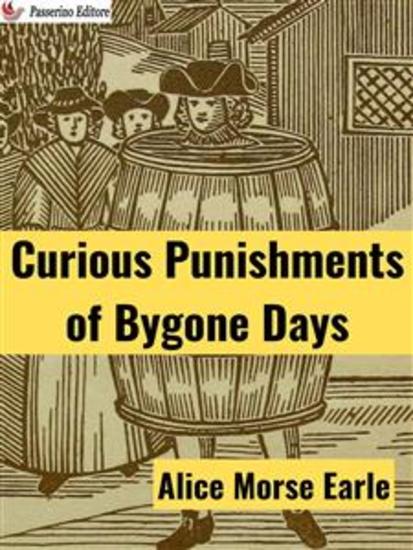
Curious Punishments of Bygone Days - cover

Curious Punishments of Bygone Days

Alice Morse Earle

Publisher: Passerino

  • 0
  • 0
  • 0

Summary

Curious Punishments of Bygone Days is a history book published in 1896. It was written by Alice Morse Earle and printed by Herbert S. Stone & Company. Earle was a historian of Colonial America, and she writes in her introduction:

In ransacking old court records, newspapers, diaries and letters for the historic foundation of the books which I have written on colonial history, I have found and noted much of interest that has not been used or referred to in any of those books. An accumulation of notes on old-time laws, punishments and penalties has evoked this volume.

As the title suggests, the subject of the chapters is various archaic punishments. Morse seems to make a distinction between stocks for the feet, in the Stocks chapter, and stocks for the head, described in the Pillory article- which itself clashes with the modern day understanding of a pillory as a whipping post.

Alice Morse Earle (April 27, 1851 – February 16, 1911) was an American historian and writer from Worcester, Massachusetts.
Available since: 04/18/2024.
Other books that might interest you

  • Owning Your Skills - A Quick Guidebook of Tips and Stories for Using Your Transferable Skills to Earn the Job You Want - cover

    Owning Your Skills - A Quick...

    Kyrabe Stories

    • 0
    • 0
    • 0
    Are you ready to switch jobs but don’t know where to start? Or do you feel like you don’t have the right skills to make a career change? Then this guidebook is meant for you! 
    We tend to come up with many excuses to remain where we are when deep down we would love nothing more than a fresh start in a career that doesn’t have us groaning in despair while preparing for the next shift. This book is filled with tips and stories to help guide you through many of the job search, application, and interview hurdles. 
    What’s included in this quick guidebook:Activities for identifying your transferable skillsGuidance on how to recognize stepping-stone opportunitiesWays to calculate how much your skills are worthSimple tricks to improving your job searchInformation on how the applicant tracking system (ATS) worksSuggestions for optimizing your resume and cover letterTips to help you mentally prepare for sharing your skills with the interviewer 
    This guidebook offers step-by-step assistance for navigating the job search process and overcoming the challenges posed by the current uncertain times. Despite fierce competition, the book equips you with the tools to stand out to hiring managers and recruiters and increase your chances of securing your desired job. 
    Get ready to leverage your skills and achieve your career goals with this comprehensive resource. Begin listening today!
    Show book
  • Nineteen Ways of Looking at Consciousness - cover

    Nineteen Ways of Looking at...

    Patrick House

    • 0
    • 0
    • 0
    A concise, elegant, and thought-provoking exploration of the mystery of consciousness and the functioning of the brain.Despite decades of research, remarkable imagery, and insights from a range of scientific and medical disciplines, the human brain remains largely unexplored. Consciousness has eluded explanation.Nineteen Ways of Looking at Consciousness offers a brilliant overview of the state of modern consciousness research in twenty brief, revealing chapters. Neuroscientist and author Patrick House describes complex concepts in accessible terms, weaving brain science, technology, gaming, analogy, and philosophy into a tapestry that illuminates how the brain works and what enables consciousness. This remarkable book fosters a sense of mystery and wonder about the strangeness of the relationship between our inner selves and our environment.A Macmillan Audio production from St. Martin’s Press.
    Show book
  • Christianity and Critical Race Theory - A Faithful and Constructive Conversation - cover

    Christianity and Critical Race...

    Robert Chao Romero, Jeff M. Liou

    • 0
    • 0
    • 0
    Critical Race Theory (CRT) has become a lightning rod in American politics and evangelical Christianity. This book offers a critical but constructive and sympathetic introduction to CRT written from a perspective rooted in Scripture and Christian theology. The authors take us beyond caricatures and misinformation to consider how CRT can be an analytical tool to help us understand persistent inequality and injustice—and to see how Christians and churches working for racial justice can engage CRT in faithful and constructive ways. 


    The authors explore aspects of CRT that resonate with well-trod Christian doctrine but also that challenge or are corrected by Christian theology. They also address the controversial connection that critics see between CRT and Marxism. Their aim is to offer objective analysis and critique that go beyond the debates about social identity and the culture wars and aid those who are engaging the issues in Christian life and ministry. Reflection/discussion questions, exercises, a glossary of key CRT terms, and suggested readings make the book helpful for students or small groups.
    Show book
  • The Lost Language of Symbolism Volume 1 - An Inquiry Into the Origin of Certain Letters Words Names Fairy-Tales Folklore and Mythologies - cover

    The Lost Language of Symbolism...

    Harold Bayley

    • 0
    • 0
    • 0
    Mining information from mythology, folklore, religious texts, and fairy tales from around the world, a foremost expert on symbols explains word origins and their meanings. The ultimate symbols are the letters and words in language as Bayley moves beyond mere pictures to understand the vital messages that have been ignored or lost across the centuries
    Show book
  • How to Become Famous - Lost Einsteins Forgotten Superstars and How the Beatles Came to Be - cover

    How to Become Famous - Lost...

    Cass R. Sunstein

    • 0
    • 0
    • 0
    It's hard to imagine our world without its stars and celebrity geniuses—they become a part of our culture and history, seeming permanent and preordained. But as Cass Sunstein shows in this startling book, that is far from the case. Focusing on both famous and forgotten (or simply overlooked) artists and luminaries in music, literature, business, science, politics, and other fields, he explores why some individuals become famous and others don't and offers a new understanding of the role of greatness, luck, and contingency in the achievement of fame. 


    First, Sunstein examines recent research—on informational cascades, power laws, network effects, and group polarization—to probe the question of how people become famous. He explores what ends up in the history books, in the great religious texts, and in the literary canon—and how that changes radically over time. He delves into the rich and entertaining stories of a diverse cast of famous characters, from John Keats, William Blake, and Jane Austen to Bob Dylan, Ayn Rand, and Stan Lee—as well as John, Paul, George, and Ringo. 


    How to Become Famous takes you on a fun, captivating, and at times profound journey that will forever change your perspective on the latest celebrity's "fifteen minutes," the nature of memory, success and failure in business, and our enduring fascination with fame.
    Show book
  • The Greater Reset - Reclaiming Personal Sovereignty Under Natural Law - cover

    The Greater Reset - Reclaiming...

    Michael D. Greaney, Dawn K. Brohawn

    • 0
    • 0
    • 0
    From a hidden spark in the early days of 2020, the COVID-19 pandemic soon roared across every nation, decimating lives, economies, and social norms. Rather than uniting people to defeat a common enemy, the pandemic has widened economic, political, and social divisions everywhere. It has pitted faith against reason and inflamed the global scourges of poverty, racism, war, and environmental destruction. 
    The pandemic has also surfaced proposals to remake the global economy and society. Most notable—and infamous—are a set of recommendations from the 2020 World Economic Forum calling for “the Great Reset.” Blending welfare state socialism and monopoly capitalism, this would systematically eliminate a fundamental bulwark of personal independence and freedom—the universal right to, and rights of, private property. 
    Is the Great Reset the malevolent scheme of a vast global elite to control the lives of ordinary people or a well-intentioned but dangerously misguided approach to correct systemic ills? Regardless, there is a question we all must ask: how will the dignity, freedom, and power of each human person be protected and promoted when universal human rights and their Transcendent Source have been rendered irrelevant? In The Greater Reset, Greaney and Brohawn trace the historical, religious, political, and economic roots of humanity’s perilous condition and how returning to God-given, universal principles of natural law, with equal access to the institutions of the common good, can help build a more just, liberating, prosperous, and hopeful future for every person.
    Show book