Join us on a literary world trip!
Add this book to bookshelf
Grey
Write a new comment Default profile 50px
Grey
Subscribe to read the full book or read the first pages for free!
All characters reduced
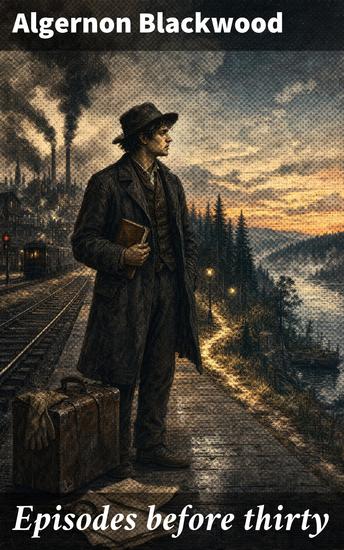
Episodes before thirty - cover

Episodes before thirty

Algernon Blackwood

Publisher: Good Press

  • 0
  • 0
  • 0

Summary

Algernon Blackwood's Episodes Before Thirty is a memoir-like sequence of autobiographical sketches recounting the formative adventures, misadventures, and spiritual awakenings of his youth. Moving through episodes of travel, hardship, odd employment, and inner discovery, the book combines documentary candor with the atmospheric sensitivity that distinguishes Blackwood's supernatural fiction. Though not a novel of the uncanny in the strict sense, it belongs to the broader context of late Victorian and early modernist life-writing, where self-exploration, restless mobility, and the search for meaning become central literary concerns. Its prose is vivid, reflective, and often quietly lyrical. Blackwood himself was one of the most distinctive writers of supernatural literature in English, renowned for works such as The Willows and Ghost Stories. Before achieving literary fame, however, he led an unusually varied life, including years in Canada and the United States, where he endured financial insecurity and pursued a range of occupations. These early experiences furnished him with both the worldly observation and mystical receptivity that shape this volume, making it an indispensable key to his imaginative development. This book is especially recommended to readers interested in Blackwood beyond the ghost story, as well as to scholars of autobiography, spiritual modernity, and fin-de-siècle culture. It offers not only a portrait of a writer in formation but also a compelling meditation on experience itself.
Available since: 06/29/2026.
Print length: 265 pages.
Other books that might interest you

  • The Menorah - Jewish parents have differing views on their daughters marriage ideals - cover

    The Menorah - Jewish parents...

    Benjamin Rosenblatt

    • 0
    • 0
    • 0
    The bookshelves of American literature are incredible collections that have gathered together centuries of very talented authors.  From this continent their fame spread and whilst among their number many are now forgotten or neglected their talents endure.  Among them is Clark Ashton Smith.
    Show book
  • The Blind Accordionist - cover

    The Blind Accordionist

    C. D. Rose

    • 0
    • 0
    • 0
    In the novel Who's Who When Everyone Is Someone Else, the character "C. D. Rose" (not to be confused with the author C. D. Rose) searches an unnamed middle-European city for the long-lost manuscript of a little-known writer named Maxim Guyavitch. That search was fruitless, but in The Blind Accordionist, "C. D. Rose" has found the manuscript—nine sparkling, fable-like short stories—and he presents them here with an (hilarious) introduction explaining the discovery, and an afterword providing (hilarious) critical commentary on the stories, and what they might reveal about the mysterious Guyavitch. 


    The Blind Accordionist is another masterful book of world-making by the real C. D. Rose, absorbing in its mix of intelligence and light-heartedness, and its ultimate celebration of literature itself. It is the third novel in the series about "C. D. Rose," although the reader does not need to have read the previous two books. (The first in the series was The Biographical Dictionary of Literary Failure; the second was Who's Who When Everyone Is Someone Else.) 


    Like those books, The Blind Accordionist can be read both as a simple but wonderful collection of quirky stories, and as comedy—or as a beautiful and moving elegy on the nobility of writers wanting to be read.
    Show book
  • The Stolen Bachilus - From their pens to your ears genius in every story - cover

    The Stolen Bachilus - From their...

    H G Wells

    • 0
    • 0
    • 0
    Herbert George Wells was born on September 21st, 1866 at Atlas House, 46 High Street, Bromley, Kent. He was the youngest of four siblings and his family affectionately knew him as ‘Bertie’.  
    The first few years of his childhood were spent fairly quietly, and Wells didn’t display much literary interest until, in 1874, he accidentally broke his leg and was left to recover in bed, largely entertained by the library books his father regularly brought him. Through these Wells found he could escape the boredom and misery of his bed and convalescence by exploring the new worlds he encountered in these books.  
    From these humble beginnings began a career that was, after several delays, to be seen as one of the most brilliant of modern English writers.    
    Able to write comfortably in a number of genres he was especially applauded for his science fiction works such as The Time Machine and War of the Worlds but his forays into the social conditions of the times, with classics such as Kipps, were almost as commercially successful.  His short stories are miniature masterpieces many of which bring new and incredible ideas of science fiction to the edge of present day science fact.  Wells also received four nominations for the Nobel Prize in Literature 
    Despite a strong and lasting second marriage his affairs with other women also brought the complications of fathering other children.  His writings and work against fascism, as well as the promotion of socialism, brought him into increasing doubts with and opposition to religion.  His writings on what the world could be in works, such as A Modern Utopia, are thought provoking as well as being plausible, especially when viewed from the distressing times they were written in. 
    His diabetic condition pushed him to create what is now the largest Diabetes charity in the United Kingdom.  Wells even found the time to run twice for Parliament. 
    It was a long, distinguished and powerfully successful career by the time he died, aged 79, on August 13th, 1946.
    Show book
  • Penny and The Monsters - cover

    Penny and The Monsters

    Ridhhaan Jaiin

    • 0
    • 0
    • 0
    About Book 
    The book "Penny and The Monster" is a story of a girl named Penny who moves to a new house and slowly discovers there are monsters in the house. It’s a combination of horror with a touch of humor and has a moral "how one can overcome their fear." 
    About Author and Narrator Ridhhaan Jaiin 
    Ridhhaan Jaiin is one of India’s youngest and most talented authors. At just 9 years old, he is already an accomplished author, audiobook narrator, and motivational speaker. He is also a passionate child philanthropist, using his platform to raise awareness and funds for causes close to his heart. 
    His parents encouraged him to put his thoughts to paper, and he created magic! His first book – ‘Once Upon in My Mind’ – was published when he was just 8 years old, making him one of India’s youngest authors. 
    In 2022, three more books by Ridhhaan were released: “The Mirror and The Greedy Man”, “The Despicable Virus”, and “Penny and the Monsters”. All these stories have happy endings with good morals, adding values. He has also narrated audiobook of same titles. 
    As a motivational speaker, Ridhhaan has visited numerous schools, clubs, events and hosted motivational sessions for over 1000 children and 250 adults.  
    Ridhhaan Jaiin is an author who believes in giving a platform to other children to express themselves through story writing. In 2022, he founded a story writing competition for children aged 5 to 12 and sponsored the book publishing of all the winners.  
    Ridhhaan also donates portion of his income from audiobooks with blind students for their welfare. Additionally, Ridhhaan is officially signed as Brand Ambassador of BVJSS Foundation, an orphanage based in Pune providing shelter and education to children of 6 to 16 years of age.
    Show book
  • Organ Voluntary - Tales of a Hidden Ireland - cover

    Organ Voluntary - Tales of a...

    Christopher Fitz-Simon

    • 0
    • 0
    • 0
    This vivid and masterfully woven collection of short stories explores the condition of Ireland's people as the country cautiously steps towards modernity. Caught between tradition and change, these characters long to move forward, yet fear what they might lose.   
    In the title story, 'Organ Voluntary', an underappreciated parish organist clashes with a vain young cleric, culminating in a hilariously disastrous Easter spectacle. In 'A Snowman in July', a lonely schoolteacher forms an ambiguous friendship with a former pupil, only to face his own buried fears and desires. 'The Hero of the XVth' is filtered through a man's chance reunion with a fallen local hero, forcing him to confront the illusions of success and the quiet tragedies people carry. 'Catolica' charts a young woman's uneasy attempts to navigate dating within a Catholic society. In 'Calamities of War', a wealthy landowner's expectations are overturned when her wartime guests are not what she imagined. 'At Mrs Moorehead's' tenderly captures a child's first encounter with age and death through a stream of innocent thought. Finally, in 'South of the Border', a visiting group exposes the absurdity of small-town pretensions as local politics and vanity unravel.
    Blending tension and humour, despair and joy, Organ Voluntary offers an empathetic portrait of a nation caught in quiet, everyday turmoil.   
     
    Show book
  • How to Tell a Story - From their pens to your ears genius in every story - cover

    How to Tell a Story - From their...

    Mark Twain

    • 0
    • 0
    • 0
    Samuel Langhorne Clemens was born in Florida, Missouri on the 30th November 1835 and is far better known by his pen name of Mark Twain.  An American writer and humorist of the first order he is perhaps best known for his novels ‘The Adventures of Tom Sawyer’ and its sequel ‘The Adventures of Huckleberry Finn’ which are often described with that mythic line The Great American Novel. 
    Twain grew up in Hannibal, Missouri which would later provide the backdrop to these great novels.  Apprenticed to a printer he also became a typesetter and then a master riverboat pilot on the Mississippi.  Later, heading west with his brother Orion to make his fortune, he failed at gold mining and instead turned to journalism and thence his true calling as a writer of humorous stories where his wit and humor sparkled from every paragraph, his craft evident with every page and punctured target. 
    A staunch supporter of copyright protections this helped him keep much of the wealth his writing created, though much money was also lost on investments that he pursued in his love for science and technology as well as investing in his own inventions. 
    Twain was born during a visit by Halley’s comet, and he predicted that he would go out with it as well.  He died the day after its subsequent return on 21st April 1910, at his house, Stormfield, located in Redding, Connecticut.
    Show book