Join us on a literary world trip!
Add this book to bookshelf
Grey
Write a new comment Default profile 50px
Grey
Subscribe to read the full book or read the first pages for free!
All characters reduced
The Recollections of Alexis de Tocqueville - Insights on Democracy from a French Intellectual in 19th Century America - cover

The Recollections of Alexis de Tocqueville - Insights on Democracy from a French Intellectual in 19th Century America

Alexis de Tocqueville

Translator Alexander Teixeira de Mattos

Publisher: Good Press

  • 0
  • 0
  • 0

Summary

In "The Recollections of Alexis de Tocqueville," the esteemed French political thinker presents a compelling autobiographical account that intertwines personal reflections with keen observations on society and politics during the early 19th century. Written with Tocqueville's characteristic clarity and intellectual rigor, this work reveals his formative experiences and offers insights into the interpersonal dynamics of democracy, the importance of civic engagement, and the nuanced interplay between individual freedom and societal constraints. The narrative serves not only as a memoir but also as a critical commentary on the evolving political landscape of his time, encompassing themes of equality, liberty, and the moral character of the nation. Alexis de Tocqueville, best known for his seminal work "Democracy in America," was deeply influenced by his travels across the United States and his observations regarding the democratic spirit. His background as an aristocrat navigating the turbulent waters of the French Revolution provided him a unique perspective on the delicate balance between liberty and equality. This personal journey is essential to understanding the motivations behind his critical analysis of democratic societies. This book is highly recommended for both scholars and general readers interested in the ideological underpinnings of modern democracy. Tocqueville's reflections provide a rich historical context and moral insight that resonate powerfully in today's political discourse, making it an essential read for anyone hoping to grasp the complexities of democratic governance.
Available since: 09/18/2023.
Print length: 261 pages.
Other books that might interest you

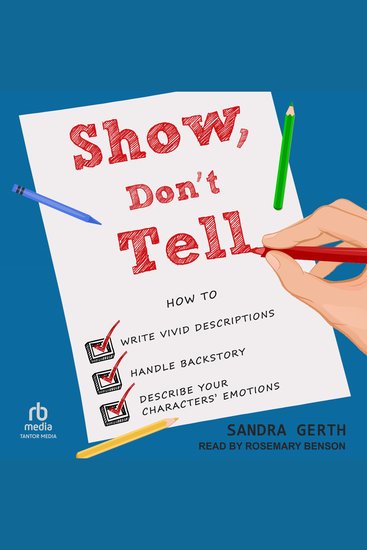
  • Show Don't Tell - cover

    Show Don't Tell

    Sandra Gerth

    • 0
    • 0
    • 0
    Show, don't tell is probably the single most-important piece of advice given to writers. But many writers struggle to understand this powerful principle or have difficulty applying it to their own work. Even experienced authors sometimes don't grasp the finer nuances of showing and telling. 


    In this book, Sandra Gerth draws on her experience as an editor and a best-selling author to show you how to show and tell you when to tell. 


    Each chapter includes concrete examples and exercises that will hone your writing skills. 


    Whether you're a novice writer working on your first story or an established author who has already learned the basics of showing and telling, this book will help you to: 


    ● Grasp the difference between showing and telling. 


    ● Understand why showing is such a powerful tool. 


    ● Spot telling in your own manuscript.
    Show book
  • Improve Communication in Your Marriage - Build a Deeper Connection With Your Spouse Stop Being Defensive and Bring Back Intimacy - cover

    Improve Communication in Your...

    Amanda Bourn

    • 0
    • 0
    • 0
    Do you feel like your spouse doesn't truly hear you anymore? 
    Are you tired of conversations that quickly spiral into arguments? 
    Does it seem like you're both speaking different languages when trying to resolve conflicts? 
    Have you noticed the emotional distance growing between you and your partner? 
    Do you miss the deep connection and intimacy you once shared? 
    Do simple disagreements often escalate into hurtful exchanges? 
    Are you longing for the closeness you felt early in your relationship? 
    I understand how frustrating and lonely this can feel. Marriage shouldn't be this hard. 
    Here's what you'll discover inside: 
    •	The hidden communication patterns silently destroying your connection and how to replace them with bridges to deeper intimacy 
    •	Powerful techniques to stop defensiveness before it derails your conversations 
    •	The surprising truth about why your spouse misinterprets your words (and what to do about it) 
    •	A proven 4-step method for discussing sensitive topics without triggering arguments 
    •	How to recognize and express your emotional needs in ways your partner can truly hear 
    •	Simple daily practices that rebuild trust and strengthen your emotional bond 
    •	The art of healing conversations that repair past hurts instead of reopening old wounds 
    •	Practical intimacy exercises that reconnect you physically and emotionally 
    •	The sensate focus approach that has transformed thousands of disconnected marriagesYour marriage deserves more than just survival. Don't let another day of disconnection pass. Take the first step toward the marriage you've always dreamed of.
    Show book
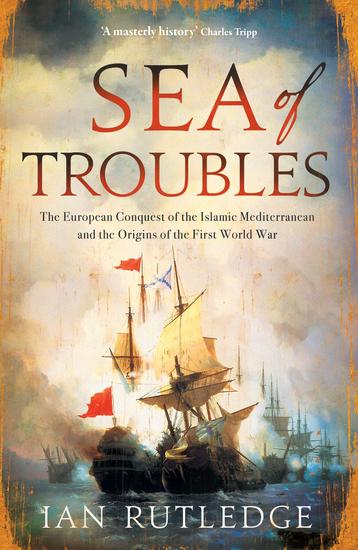
  • Sea of Troubles - The European Conquest of the Islamic Mediterranean and the Origins of the First World War - cover

    Sea of Troubles - The European...

    Ian Rutledge

    • 0
    • 0
    • 0
    In the mid-eighteenth century, most of the Mediterranean coastline and its hinterlands were controlled by the Ottoman Empire, a vast Islamic power regarded by Christian Europe with awe and fear. By the end of the First World War, however, this great civilisation had been completely subjugated, and its territories occupied by European powers. Sea of Troubles is the definitive account of the European conquest of the Levant and North Africa over three centuries. Ian Rutledge reveals the intense imperial rivalry between six European powers - Britain, France, Italy, Spain, Austria-Hungary and Russia - who all jostled for control of the trade, lands and wealth of the Islamic Mediterranean. The competition between these states made their conquest a far more difficult and extended task than they encountered elsewhere in the world. Yet, as new contenders entered the contest, and as rivalries intensified in the early twentieth century, events would spiral out of control as the continent headed towards the First World War.
    Show book
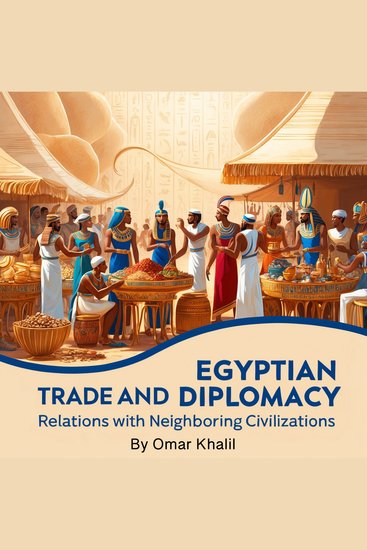
  • Egyptian Trade and Diplomacy - Relations with Neighboring Civilizations - cover

    Egyptian Trade and Diplomacy -...

    Omar Khalil

    • 0
    • 0
    • 0
    Ancient Egypt’s prosperity and cultural richness were significantly shaped by its early trade networks and exchanges with neighboring regions. From the very beginnings of Egyptian civilization, trade played a crucial role in building economic strength and fostering diplomatic relationships. The development of trade networks allowed Egypt not only to obtain essential resources but also to influence and be influenced by surrounding cultures. 
    The origins of Egyptian trade practices can be traced back to the Predynastic period, when local communities exchanged goods such as pottery, beads, and tools. As Egyptian society evolved and centralized under powerful pharaohs, trade became more organized, enabling long-distance interactions. By the time of the Old Kingdom, Egypt had established a network of trade routes that stretched beyond its borders, connecting it to various civilizations across the ancient world. 
    One of the earliest and most vital trade routes was the Nile River, serving as a natural highway that facilitated the movement of goods and people. The Nile connected southern and northern Egypt while also linking the civilization to Nubia and further into sub-Saharan Africa. This route allowed the exchange of gold, ivory, ebony, and exotic animal products, which were crucial to the Egyptian economy and the creation of luxury goods. Additionally, maritime trade across the Red Sea connected Egypt to the Arabian Peninsula and even the distant lands of Punt, where incense, spices, and other valuable commodities were sourced.
    Show book
  • Kierkegaard - Existentialism and the Leap of Faith - cover

    Kierkegaard - Existentialism and...

    Hector Davidson

    • 0
    • 0
    • 0
    Søren Kierkegaard, often regarded as the father of existentialism, was born on May 5, 1813, in Copenhagen, Denmark. His early life was marked by tragedy, as his mother died when he was just a child, and his father, a deeply religious man, instilled in him a sense of guilt and the weight of existential questioning. Kierkegaard’s relationship with his father deeply influenced his philosophical development, particularly in his exploration of faith, despair, and the individual's relationship with God. 
    Kierkegaard’s intellectual journey began at the University of Copenhagen, where he studied theology and philosophy. He was deeply influenced by the works of philosophers such as Immanuel Kant and Friedrich Hegel, yet he sought to diverge from the systematic and rational approaches of these thinkers. Instead, he focused on the subjective aspects of human experience, emphasizing personal choice, individual responsibility, and the need for authentic existence. Kierkegaard believed that philosophy should not merely be an abstract pursuit but should directly address the real, lived experiences of individuals. 
    One of Kierkegaard's most significant contributions to philosophy was his critique of the established norms of society and religion. He believed that individuals often live in a state of "inauthenticity," blindly following social conventions and doctrines without truly reflecting on their own beliefs. For Kierkegaard, true existence could only be achieved through the individual’s leap of faith—an existential act that transcends reason and embraces the paradoxical nature of human life.
    Show book
  • Che Commemorating The 50th Anniversary Of His Martyrdom - cover

    Che Commemorating The 50th...

    Daniel Dos Santos

    • 0
    • 0
    • 0
    “The revolution is not an apple that falls when it is ripe. You have to make it fall.""The life of a single human being is worth a million times more than all the property of the richest man on earth.""I am not a liberator. Liberators do not exist. The people liberate themselves.” CHE GUEVARAIn this unique audio primer and celebration of the inspirational life and great work of revolutionary and social reformer Commandante Ernesto Rafael 'Che" Guevara de la Serna Lynch. Ernesto was born June 14, 1928, in Rosario, Argentina, in a family with aristocratic roots but strong socialistic ideals. In June of 1955 young Ernesto met Raul Castro. On July 8th Fidel Castro arrived in Mexico to join his brother and Ernesto. When Fidel met Che "he was already an educated revolutionary.” Remembers Castro. The great Cuban revolution against tyranny soon followed and was won chiefly because of the dedication of the Castros and Dr. Guevara. On October 8, 1967, in the village La Higuera, Bolivia, Che, and two comrades fell into the hands of the army. A Bolivian colonel and the representatives of the CIA arrived by helicopter. It was decided to murder Che and his comrades Willy Cuba and Juan Pablo Chang immediately. A nervous, young low-level Bolivian soldier did the job, Che, the icon and hero of all hearts and minds, however, live forever!
    Show book