Join us on a literary world trip!
Add this book to bookshelf
Grey
Write a new comment Default profile 50px
Grey
Subscribe to read the full book or read the first pages for free!
All characters reduced
Democracy in America - Insights into American democracy: societal political and cultural analysis - cover

Democracy in America - Insights into American democracy: societal political and cultural analysis

Alexis de Tocqueville

Translator Henry Reeve

Publisher: Good Press

  • 0
  • 0
  • 0

Summary

In "Democracy in America," Alexis de Tocqueville undertakes an ambitious exploration of American society and its democratic principles during the early 19th century. Through a keen sociopolitical lens, Tocqueville employs a blend of empirical observation and philosophical inquiry, illustrated by his rich prose and analytical depth. The work manifests a unique literary style that intertwines narrative with profound reflections on equality, individualism, and the emerging social conditions of a nation grappling with the ideals of democracy, revealing both the strengths and inherent contradictions of the political system at that time. Tocqueville, a French aristocrat, was profoundly influenced by the tumultuous democratic movements in Europe and sought to comprehend the successful democratic experiment in the United States. His own background and experiences as a member of the French aristocracy under the specter of revolution provided him with a distinctive vantage point from which to scrutinize the dynamics of class, politics, and society. These insights culminate in a work that not only examines the American experience but also invites deeper contemplation of democracy as a global phenomenon. "Democracy in America" is an essential read for anyone interested in political science, sociology, or American history. Tocqueville's foresight into the challenges and possibilities of democratic governance remains strikingly relevant today, making this seminal text a cornerstone for understanding contemporary democratic societies. Engaging and thought-provoking, it prompts readers to reflect on the nature of equality, freedom, and the future of democracy.
Available since: 12/18/2023.
Print length: 797 pages.

Other books that might interest you

  • The Psychology of Misinformation - cover

    The Psychology of Misinformation

    Sander van der Linden, Jon...

    • 0
    • 0
    • 0
    King Charles III is Dracula's distant cousin. Governments are hiding information about UFOs. COVID-19 came from outer space. These sound like absurd statements, but some are true, and others are misinformation. But what exactly is misinformation? Who believes and spreads things that aren't true, and why? What solutions do we have available, and how well do they work? This book answers all these questions and more. Tackling the science of misinformation from its evolutionary origins to its role in the internet era, this book translates rigorous research on misleading information into a comprehensive and jargon-free explanation. Whether you are a student, researcher, policymaker, or changemaker, you will discover an accessible analysis on human belief in today's world and expert advice on how to prevent deception.
    Show book
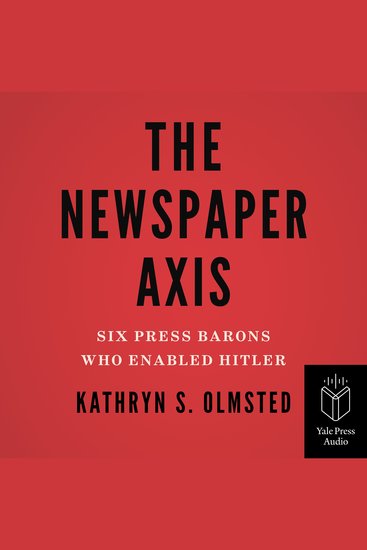
  • The Newspaper Axis - Six Press Barons Who Enabled Hitler - cover

    The Newspaper Axis - Six Press...

    Kathryn S. Olmsted

    • 0
    • 0
    • 0
    How six conservative media moguls hindered America and Britain from entering World War II 
    How six conservative media moguls hindered America and Britain from entering World War II 


    “A landmark in the political history of journalism.”—Michael Kazin, author of What It Took to Win: A History of the Democratic Party 


    As World War II approached, the six most powerful media moguls in America and Britain tried to pressure their countries to ignore the fascist threat. The media empires of Robert McCormick, Joseph and Eleanor Patterson, and William Randolph Hearst spanned the United States, reaching tens of millions of Americans in print and over the airwaves with their isolationist views. Meanwhile in England, Lord Rothermere’s Daily Mail extolled Hitler’s leadership and Lord Beaverbrook’s Daily Express insisted that Britain had no interest in defending Hitler’s victims on the continent. 


    Kathryn S. Olmsted shows how these media titans worked in concert—including sharing editorial pieces and coordinating their responses to events—to influence public opinion in a right-wing populist direction, how they echoed fascist and anti‑Semitic propaganda, and how they weakened and delayed both Britain’s and America’s response to Nazi aggression.
    Show book
  • The Rise of Socialism - 1884-1918 - cover

    The Rise of Socialism - 1884-1918

    William Morris, Annie Besant,...

    • 0
    • 0
    • 0
    The birth of liberation movements in the C19th saw a rise in fighting for the rights of workers.William Morris believed decries the belief “not that Commerce was made for man, but that man was made for Commerce”, with the profit motive that renders all work miserable when “It is right and necessary that all men should have work to do which shall be worth doing, and be of itself pleasant to do; and which should be done under such conditions as would make it neither over-wearisome nor over-anxious.”Edward Carpenter demands of those whose only question is “Does It Pay?” to know why any action is undertaken. On starting a farm, he found, “that if I was happy in the life..., and if we were cultivating genuine and useful products… that it might really pay me better to get 1%, than 10% with jangling and wrangling.”Annie Besant attacks a reactionary appeal to the ‘natural’ role of men and women by pointing out that it is equality of opportunity and representation that women want.Eduard Bernstein confronts a misunderstanding that people still have today. Marx and Engels realized in their lifetimes that society was further away than they initially thought from a genuine socialism – that many small revolutions would be necessary, and that a single grand rewriting of society could not work. The next writer also refers to it, in saying that “A few.. only know what Socialism is, and they are Socialists. The rest are opposed to it because the little they know about it is not true.”Eugene Debs rails against the approach government takes in promoting “equality” between capitalist and labourer.We end with Debs' response to being sentenced to ten years imprisonment, for the crime of “opposing a social order in which it is possible for one man who does absolutely nothing that is useful to amass a fortune, while millions work all the days of their lives secure barely enough for a wretched existence. .”
    Show book
  • The Communist Manifesto - cover

    The Communist Manifesto

    Karl Marx, Friedrich Engels

    • 0
    • 0
    • 0
    The Communist Manifesto, originally the Manifesto of the Communist Party (German: Manifest der Kommunistischen Partei), is an 1848 political document by German philosophers Karl Marx and Friedrich Engels. Commissioned by the Communist League and originally published in London just as the Revolutions of 1848 began to erupt, the Manifesto was later recognised as one of the world's most influential political documents. It presents an analytical approach to the class struggle (historical and then-present) and the conflicts of capitalism and the capitalist mode of production, rather than a prediction of communism's potential future forms.The Communist Manifesto summarises Marx and Engels' theories concerning the nature of society and politics, namely that in their own words "the history of all hitherto existing society is the history of class struggles". It also briefly features their ideas for how the capitalist society of the time would eventually be replaced by socialism. In the last paragraph of the Manifesto, the authors call for a "forcible overthrow of all existing social conditions", which served as a call for communist revolutions around the world. In 2013, The Communist Manifesto was registered to UNESCO's Memory of the World Programme along with Marx's Capital, Volume I.
    Show book
  • Black Evidence - A History and a Warning - cover

    Black Evidence - A History and a...

    Candis Watts Smith

    • 0
    • 0
    • 0
    A fierce exposé of American resistance to believing Black people and its devastating effects throughout history. 
     
    From Reconstruction to redemption, civil rights to the Southern strategy, the multiracial protests of 2020 for social justice to the swift elimination of policies etching out a more inclusive, equitable society, Americans regularly experience periods of racial reckoning followed by walloping retrenchment. This pattern is a result of an American pastime: creating and implementing tactics to deny Black truth. Candis Watts Smith explores how Black voices have been prevented from contributing ideas to break these cycles. Distilling four centuries of critical moments in US history, this careful curation of vignettes provides a warning of what happens when Black testimony is subject to exclusion, when Black communities are terrorized, when Black children are transformed into adults, and when Black resistance is pathologized. Black Evidence shows how the ugly legacy of the past continues into our present and prescribes a cure—listen to the veracity of Black voices and amplify it.
    Show book
  • The Neoliberal Revolution - How Neoliberalism Transformed Global Economies - cover

    The Neoliberal Revolution - How...

    Arlo Holders

    • 0
    • 0
    • 0
    Neoliberalism is a term widely used to describe a set of economic policies and ideas that emphasize the importance of free markets, deregulation, privatization, and limited government intervention. Emerging in the mid-20th century, neoliberalism represented a distinct shift away from the welfare state and Keynesian economics, which had dominated Western economies in the post-World War II era. At its core, neoliberalism advocates for the belief that markets, if left to operate freely, will create wealth, drive economic growth, and improve human well-being. This chapter introduces the key tenets of neoliberal thought and traces its rise to prominence. 
    The intellectual origins of neoliberalism can be traced back to economists and thinkers such as Friedrich Hayek, Milton Friedman, and Ludwig von Mises, who were critical of state intervention in the economy. They argued that government efforts to regulate markets, redistribute wealth, and promote social welfare were inefficient and counterproductive. Instead, they believed that economic freedom, unencumbered by regulation or state control, would lead to more prosperous societies. These ideas gained traction in the 1970s when the world was facing economic stagnation, inflation, and high unemployment, a period often referred to as the “stagflation” crisis. 
    As a response to these challenges, neoliberalism became the intellectual and policy framework that justified sweeping changes in global economic practices. It was championed by leaders such as British Prime Minister Margaret Thatcher and U.S. President Ronald Reagan, who implemented reforms based on neoliberal principles. These included reducing taxes, privatizing state-owned industries, cutting social welfare programs, and embracing global free trade. The goal was to increase individual freedom and market efficiency by minimizing the role of the state in economic affairs.
    Show book