Join us on a literary world trip!
Add this book to bookshelf
Grey
Write a new comment Default profile 50px
Grey
Subscribe to read the full book or read the first pages for free!
All characters reduced
Jules Pascin: Art and intrigue - cover

Jules Pascin: Art and intrigue

Alexandre Dupouy

Publisher: Parkstone International

  • 0
  • 0
  • 0

Summary

Jules Mordecai Pincas (1885–1930) was a Bulgarian artist who settled down in Paris in 1905, after a detour via Munich. There he started painting signing Pascin, and soon became part of the École de Montparnasse and its cosmopolitan blend of outstanding names. 
His canvases are as turbulent as his lifestyle, and he still stands out as a bad boy. Pascin hang himself on June 2nd, 1930, despite the first fruits of success his work had collected. This book aims at taking a more comprehensive approach on his work and style than critics usually do.
Available since: 10/15/2024.
Print length: 46 pages.

Other books that might interest you

  • Urban Environment and Health - Sustaining Life in the City (3 in 1) - cover

    Urban Environment and Health -...

    Lyric Vale

    • 0
    • 0
    • 0
    In the rapidly urbanizing world of the 21st century, cities have emerged as the defining habitat for human existence—complex ecosystems where built environments, natural systems, social dynamics, and human health are inextricably intertwined. As urban populations continue to expand globally, the relationship between metropolitan environments and human wellbeing has become one of the most critical frontiers in our collective pursuit of sustainable, equitable development. This comprehensive exploration delves into the multifaceted domains of Urban Environmental Studies, Urban Health, and City Livability—examining how the physical, social, and ecological dimensions of urban spaces fundamentally shape population health outcomes, quality of life, and environmental sustainability. 
    The narrative of urban environmental health transcends traditional disciplinary boundaries; it encompasses the intricate connections between urban design, ecological systems, public health infrastructure, and social determinants that collectively define the healthfulness of city living. By examining the complex interplay between environmental exposures, built environment characteristics, healthcare access, and community resilience, this book illuminates how cities can function either as amplifiers of health inequities or as platforms for promoting wellbeing across diverse populations. Readers will journey through the multidimensional landscapes where urban health manifests—from the microscale of indoor air quality and neighborhood walkability to the macroscale of urban heat islands and metropolitan food systems—while exploring innovative approaches that cities worldwide are adopting to create more livable, healthy, and environmentally sustainable urban futures.
    Show book
  • The Actor's Mindset - Acting as a Craft Discipline and Business - cover

    The Actor's Mindset - Acting as...

    Craig Archibald, Constance Wu

    • 0
    • 0
    • 0
    The Actor's Mindset: Acting as a Craft, Discipline, and Business uniquely prepares actors to live full, successful lives as performing artists. While most acting books focus on either the art or the business of entertainment, Archibald looks at the entire picture of what it means to be an actor, focusing on the foundations of both the artist and the entrepreneur to guarantee a complete and fully functioning approach to a career. 


    The Actor's Mindset is divided into three distinct parts: "The Craft," "The Discipline," and "The Business." 


    Archibald's unique experience as both an actor and a coach gives him an unparalleled perspective on the current industry landscape. While classic method texts still circulate, and there are actors who have written books that address craft, none have Archibald's depth of knowledge and experience in coaching, nor approach the art from a professional standpoint instead of solely an instructional one. The success of Craig's approach is exemplified by the success of his clients, a roster that includes Constance Wu, John Slattery, and two-time Academy Award nominee Dan Futterman.
    Show book
  • Greatest Mystery Shows Volume 1 - Ten Classic Shows from the Golden Era of Radio - cover

    Greatest Mystery Shows Volume 1...

    Various Various

    • 0
    • 0
    • 0
    OASIS AUDIO CLASSIC RADIO SHOWCASE SERIES   Oasis Audio has gone into the vaults and dusted off the very earliest form of audio book, old time radio shows, for our listeners. Introduced episode by episode by Jim Engel, old time radio authority and board member of the Museum of Broadcast Communications in Chicago, this series of classic radio shows is sure to have something for everyone. Celebrity casts and top-notch writers made the 1920s through the early 1950s, the golden era of radio. The series features seven exciting themes with 100 episodes in each. That is 700 classic radio programs in all.   Greatest Mystery Shows   Before TV’s The Twilight Zone, there was radio’s The Inner Sanctum Mystery, Lights Out!, The Weird Circle, and so many other great mysteries starring Orson Welles, Jane Wyman, Dana Andrews, Edmond O’Brien, James Cagney and more. 100 great Mystery classics in ten volumes. Volume 1 Adv. Of Sherlock Holmes 12-31-45 Iron Box with Basil Rathbone & Nigel BruceAdv. Of Sherlock Holmes 1-14-46 Murder Beyond the Mountains with Basil RathboneAdv. Of Sherlock Holmes 2-11-46 Guidelines Gypsy with Basil Rathbone & Nigel BruceAdv. Of Sherlock Holmes 3-18-46 The Blarney Stone with Basil Rathbone & Nigel BruceAdv. Of Sherlock Holmes 4-22-46 Tankerville Club with Basil Rathbone & Nigel BruceAdv. Of Sherlock Holmes 4-29-46 Waltz of Death with Basil Rathbone & Nigel BruceAdv. Of Sherlock Holmes 5-6-46 The Man with the Twisted Lip with Basil Rathbone & Nigel BruceAdv. Of Sherlock Holmes 5-13-46 Uneasy Easy Chair with Basil Rathbone & Nigel BruceThe Black Museum 1950s A Lady’s Shoe with Orson WellesThe Black Museum 1950s Raincoat with Orson Welles
    Show book
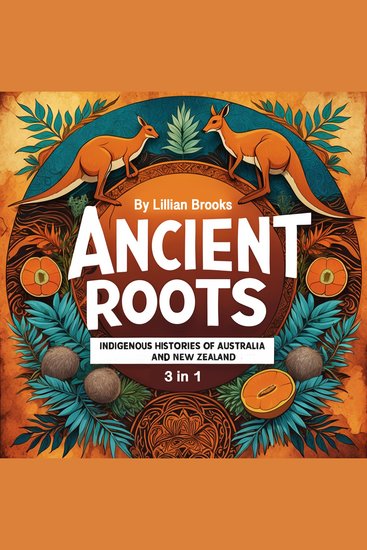
  • Ancient Roots - Indigenous Histories of Australia and New Zealand (3 in 1) - cover

    Ancient Roots - Indigenous...

    Lillian Brooks

    • 0
    • 0
    • 0
    This book bundle offers a captivating journey through the rich and ancient histories of the Indigenous peoples of Australia and New Zealand. This three-part volume explores the deep cultural, spiritual, and historical roots that have shaped these lands long before European settlement.  
    The first section, Ancient Australia, delves into the 65,000-year history of Australia's First Nations, examining their deep connection to the land, complex social structures, and enduring cultural traditions.  
    The second section, Aotearoa New Zealand, explores the history of the Māori people, their migration to New Zealand, the development of powerful iwi (tribes), and their unique social, spiritual, and political systems.  
    The final section, The Dreamtime and Beyond: Aboriginal and Māori Myths, brings to life the vibrant oral traditions of both cultures, sharing the powerful creation stories, ancestral legends, and spiritual teachings that have been passed down through generations. Together, these three perspectives offer a profound understanding of the ancient foundations of Australia and New Zealand, celebrating the resilience, wisdom, and rich heritage of their Indigenous peoples.  
    This book is an essential resource for those seeking to uncover the deep-rooted histories and cultural legacies of these remarkable lands.
    Show book
  • Mozart in Words and Music - cover

    Mozart in Words and Music

    Davinia Caddy

    • 0
    • 0
    • 0
    Tchaikovsky declared that Mozart was 'full of divine beauty', and Schubert's wonder at the 'countless images of a brighter and better world' that Mozart was able to conjure up through his music knew no bounds. Many of us carry the image of Mozart as a transcendent genius, but what do we really know about his life and career, and indeed his music? This entertaining and informative biography takes us from Mozart's beginnings as a child prodigy to his greatest successes and cruellest setbacks. The narrative is illustrated with music from each stage of Mozart's intense career, including the 'Jupiter' Symphony, Clarinet Concerto, Coronation Mass, Requiem, Don Giovanni, The Magic Flute, The Marriage of Figaro and many more.
    Show book
  • Mughal Empire - The Taj Mahal Legacy - cover

    Mughal Empire - The Taj Mahal...

    Rolf Hedger

    • 0
    • 0
    • 0
    The Mughal Empire emerged as one of the most powerful and influential dynasties in Indian history, leaving a lasting impact on culture, architecture, and governance. Its foundation was laid by Babur, a descendant of both Timur and Genghis Khan, who established Mughal rule in the early 16th century. Babur's military prowess and strategic vision enabled him to defeat the Delhi Sultanate in the First Battle of Panipat in 1526. This victory marked the beginning of Mughal dominance in the Indian subcontinent. However, Babur’s reign was short-lived, and it was his grandson, Akbar, who truly solidified the empire’s foundation. 
    Akbar ascended the throne at a young age and quickly proved himself to be an exceptional leader. His reign, which lasted from 1556 to 1605, was marked by territorial expansion, administrative reforms, and a commitment to cultural and religious harmony. Unlike previous rulers, Akbar recognized the diversity of India and sought to integrate different communities into his empire. He abolished the jizya tax on non-Muslims, promoted interfaith dialogue, and appointed talented individuals from various backgrounds to key positions in his administration. His policy of religious tolerance and inclusive governance earned him the loyalty of many, contributing to the stability and prosperity of the empire. 
    One of Akbar’s most remarkable achievements was the establishment of an efficient administrative system. He divided his empire into provinces, each governed by appointed officials who reported directly to the central authority. This system ensured effective governance and facilitated tax collection, trade, and law enforcement. Additionally, Akbar introduced a standardized revenue system that helped regulate the economy and promote agricultural growth. His emphasis on merit-based appointments created a well-organized bureaucracy that endured long after his reign.
    Show book