Join us on a literary world trip!
Add this book to bookshelf
Grey
Write a new comment Default profile 50px
Grey
Subscribe to read the full book or read the first pages for free!
All characters reduced
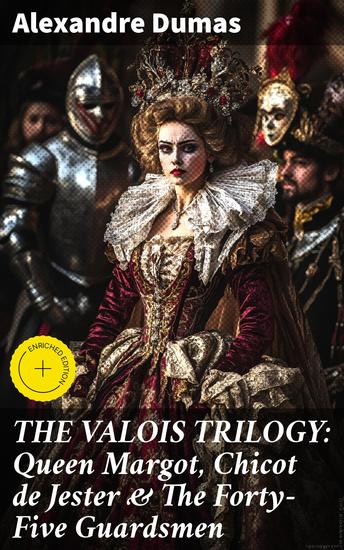
THE VALOIS TRILOGY: Queen Margot Chicot de Jester & The Forty-Five Guardsmen - Enriched edition Historical Novels set in the Time of French Wars of Religion - cover

THE VALOIS TRILOGY: Queen Margot Chicot de Jester & The Forty-Five Guardsmen - Enriched edition Historical Novels set in the Time of French Wars of Religion

Alexandre Dumas

Publisher: Good Press

  • 0
  • 0
  • 0

Summary

The Valois Trilogy, comprising Queen Margot, Chicot the Jester, and The Forty-Five Guardsmen, immerses the reader in the tumultuous world of 16th-century France, where political intrigue, religious strife, and personal betrayals collide. Dumas employs a vibrant narrative style, rich with luxurious descriptions and dynamic characterizations, creating a gripping tapestry of historical fiction that is both entertaining and enlightening. The prose's dramatic flair evokes the intensity of the Wars of Religion, offering readers insight into the complex social hierarchies and the influential interplays of power that marked the era, while Dumas's masterful storytelling invites comparisons with his contemporaries and later novelists of the historical genre. Alexandre Dumas, a towering figure in the realm of literature, draws upon his background'—being the son of a French nobleman and an enslaved African woman'—to approach themes of identity and justice in a society rife with conflict. His deep interest in history propelled him to explore the lives of the Valois, allowing him to interweave real historical figures with fictional plotlines that highlight the human experience amidst grand political machinations. Fans of historical fiction and rich storytelling alike will find The Valois Trilogy a captivating journey through a pivotal period in French history. Dumas's exceptional character development and intricate plotlines ensure that this series not only entertains but also provokes thought about the legacies of power, love, and sacrifice, making it a must-read for anyone intrigued by the complexities of human nature.

In this enriched edition, we have carefully created added value for your reading experience:
- A comprehensive Introduction outlines these selected works' unifying features, themes, or stylistic evolutions.
- The Author Biography highlights personal milestones and literary influences that shape the entire body of writing.
- A Historical Context section situates the works in their broader era—social currents, cultural trends, and key events that underpin their creation.
- A concise Synopsis (Selection) offers an accessible overview of the included texts, helping readers navigate plotlines and main ideas without revealing critical twists.
- A unified Analysis examines recurring motifs and stylistic hallmarks across the collection, tying the stories together while spotlighting the different work's strengths.
- Reflection questions inspire deeper contemplation of the author's overarching message, inviting readers to draw connections among different texts and relate them to modern contexts.
- Lastly, our hand‐picked Memorable Quotes distill pivotal lines and turning points, serving as touchstones for the collection's central themes.
Available since: 01/11/2024.
Print length: 945 pages.


Other books that might interest you

  • Murder at the Masked Ball - A 1920s Historical Cozy Mystery - cover

    Murder at the Masked Ball - A...

    Magda Alexander

    • 0
    • 0
    • 0
    Amateur sleuth Kitty Worthington once more investigates when a noble lord plummets to his death, and a dear friend is suspected of murder. 


    London. 1923. When an invitation arrives to the Duchess of Brightwell's Midsummer Masked Ball, Kitty Worthington does not even think of declining. Not with a mother on the hunt for a noble husband for her. But no sooner does she curtsy to her hostess at the ball than tragedy strikes. A very dead earl is found at the bottom of a staircase, and it's clearly the work of foul play. 


    Having proven himself a dab hand at dealing with the nobility, Scotland Yard Detective Inspector Robert Crawford is soon asked to investigate. In no time at all he hones in on Lord Newcastle, a friend of Kitty who'd earlier pummeled the earl for sorely abusing his wife. 


    Afraid her friend may wrongfully pay with his life, Kitty once more organizes her ace team, including her maid, two noble lords, a beloved sister, a lady, and Sir Winston, her still flatulent Basset Hound. From the seediest parts of London, to the fancy mansions of Mayfair, they fearlessly pursue the truth. For if they fail to find the killer, their dear friend may dance one last jig at the end of a rope.
    Show book
  • The Short Stories of Kenneth Grahame - Known for Wind in the Willows but wrote impressive stories for adults too as you can hear in this collection - cover

    The Short Stories of Kenneth...

    Kenneth Grahame

    • 0
    • 0
    • 0
    Kenneth Grahame was born on 8th March 1859 in Edinburgh. 
     
    At age 5 his mother succumbed to puerperal fever.  His father, who had a drinking problem, now sent his 4 children to live with their grandmother at her large house in Cookham, Berkshire. Here the children lived in large open grounds next to the river.  These early experiences would in later years, be retold in his writing through a myriad of characters. 
     
    Grahame loved being a pupil at St Edward's School, Oxford and wanted to enroll at the university there but his guardian demurred on account of the cost. 
     
    Instead, a banking career was chosen for him, starting in 1879 at the Bank of England, where he rose steadily to the rank of its Secretary until retiring, with a pension, in 1908 due to ill health. 
     
    Alongside his commercial career Grahame had written and published various stories and essays in several periodicals. Some were anthologized as ‘Pagan Papers’ in 1893, and two years later ‘The Golden Age’ and later still ‘Dream Days’ and its masterpiece ‘The Reluctant Dragon’ became part of many home libraries.  His ability to view life through the lens of a young and curious child was superb, enabling the reader to easily identify with the character.   
     
    Grahame married Elspeth Thomson in 1899 and they had one child; Alastair, born semi-blind and plagued by health problems.  In a heart-rending tragedy he would later take his own life whilst attending Oxford University in 1920.   
     
    In 1908 Grahame reworked many of the bedtime stories he had fashioned for his son into the enduring favourite; ‘The Wind in the Willows’, describing the heart-warming adventures of Mr Toad and his friends.   
     
    Kenneth Grahame died in Pangbourne, Berkshire, on 6th July 1932. 
    01 - Kenneth Grahame - A Short Story Collection - An Introduction 
    02 - A Saga of the Seas by Kenneth Grahame 
    03 - Dies Irae by Kenneth Grahame 
    04 - The Magic Ring by Kenneth Grahame 
    05 - Mutabile Semper by Kenneth Grahame 
    06 - The Inquity of Oblivion by Kenneth Grahame
    Show book
  • Forgotten Authors The - Volume 9 - Rina Ramsay to James Stephens - cover

    Forgotten Authors The - Volume 9...

    Rina Ramsay, William Pett Ridge,...

    • 0
    • 0
    • 0
    Throughout the long centuries of human history is the want, and the need, to share information, to exchange ideas and for that knowledge and experience, for curiosity and learning, to be the basis of a civil society. 
    In literature the ambition is much narrower.  In order to be known, to be popular, you had to be published.  And for that people had to know you existed and your ideas worth reading.  Obviously for most of humanity’s time people couldn’t read and texts couldn’t be published in any great number. 
    In the 15th Century Gutenberg’s printing press began the revolution to address the second and by the 19th century had gathered pace with startling speed and mass distribution.  Education for the many was brought in to help people understand more of their world and, with new skills, how to have a better place within it.  Now, if the powers that owned the presses and means of distribution agreed an audience would now be able to avail themselves of your ideas, your printed words.  
    Sadly, in the thirst for the new, the recent and the past fell from sight, relegated to dark corners and dusty shelves.   
    But the printed word is rarely without someone, somewhere busying themselves through piles of papers and books rediscovering what a good story is, whatever its age. 
    Sadly, in the thirst for the new, the recent and the past fell from sight, relegated to dark corners and dusty shelves.    
    But the printed word is rarely without someone, somewhere busying themselves through piles of papers and books rediscovering what a good story is, whatever its age. 
    In this volume we offer up a small selection of those talents whose time has now come again.
    Show book
  • The Scarlet Pimpernel - cover

    The Scarlet Pimpernel

    Emmuska Orczy

    • 0
    • 0
    • 0
    "The Scarlet Pimpernel" by Baroness Orczy is a captivating historical novel crafted in the early 20th century. Set against the swirling chaos of the French Revolution, the narrative follows the elusive Englishman known only as the Scarlet Pimpernel, who undertakes audacious rescues of aristocrats ensnared in the deadly clutches of the guillotine. This protagonist, cloaked in secrecy, juggles his dual identity, creating an electrifying tension as he maneuvers through the perilous political landscape. The novel poignantly explores themes of bravery, loyalty, and the profound cost of sacrifice. 
    As the story unfolds, the grim atmosphere of the Reign of Terror in Paris is palpably felt. The air is thick with the stench of fear and bloodshed as the relentless guillotine claims countless souls, its blade gleaming ominously in the sunlight. The bloodthirsty crowd, swelling with fervor, eagerly anticipates the next execution, their excitement palpable like a hungry predator awaiting its prey. At the heart of this mayhem stands Sergeant Bibot, a proud sentinel at the barricades, relishing his role in thwarting the desperate escape attempts of fleeing aristocrats. 
    Amidst the growing turmoil, whispers of a clandestine group of Englishmen begin to circulate, their leader—the enigmatic Scarlet Pimpernel—launching daring rescues that confound the authorities and thwart death's grasp. The narrative vividly paints the harrowing fear and desperation of those on the run, contrasting it with the zealous exhilaration of citizens intoxicated by their newfound power and thirst for vengeance. This sets the stage for a gripping tale of unwavering heroism amidst a world spiraling into chaos.
    Show book
  • I Am Meena - cover

    I Am Meena

    SarahWilliams

    • 0
    • 0
    • 0
    None of the faces looking at me are kind. Not even that of my mother. I will not marry Aboona. My mate, his brother, was so kind and gentle. Strong and protective. His brother is none of those things. I am pregnant with the child of my late husband, Manoosh   This tribe, not the tribe of my birth, will allow me to stay until my child is born. Then I must leave. Leaving my child behind. This I will not allow. I will leave. There is nothing for me here. Tonight, I will begin my journey.
    Show book
  • Tales of Empire - A Short Story Collection - Across the Imperial Landscape are tales of ghosts gods and the human spirit - cover

    Tales of Empire - A Short Story...

    Rudyard Kipling, Bithia Mary...

    • 0
    • 0
    • 0
    Empires have been a fact of life for many thousands of years in all corners of the globe.  Some have lasted a mere generation, others for a millennia.  Some have defenders that cite advancements and security but detractors rail at the imposition of one culture upon defeated societies for no greater reason than conquest. 
     
    In this volume we put together stories from a wide range of classic authors, including Rudyard Kipling, Joseph Conrad, Talbot Mundy, Letitia Elizabeth Landon, H Rider Haggard and many others to view the British Empire both from the inside as subjects and from the outside as writers through engrossing narratives.  These literary leviathans could observe, sample, question and report as part of an Empire upon which the sun never set and who’s morals were sometimes good, but often bad, as it bestrode the world as Imperial policeman and bully-in-chief grabbing the profits of others as it imposed a Pax Britannica that was in reality only of real benefit to the elite at home. 
     
    Times may have changed yet these stores offer a fascinating insight into the world as it was. 
     
    1 - Tales of Empire - A Short Story Collection - An Introduction 
    2 - The Man Who Would Be King - Part 1 by Rudyard Kipling 
    3 - The Man Who Would Be King - Part 2 by Rudyard Kipling 
    4 - Long Odds by H Rider Haggard 
    5 - The Indian Orphan. A Tale by Letitia Elizabeth Landon 
    6 - The Lagoon by Joseph Conrad 
    7 - Those Who Wait by Ethel Dell 
    8 - The Metropolitian Emigrant by John Galt 
    9 - His Unconquerable Enemy by W C Morrow 
    10 - The Soul of a Regiment by Talbot Mundy 
    11 - An Outcast of the People by Bithia Mary Croker 
    12 - The Spectre Bridegroom by William Hunt 
    13 - The Maltese Cat by Rudyard Kipling
    Show book