Join us on a literary world trip!
Add this book to bookshelf
Grey
Write a new comment Default profile 50px
Grey
Subscribe to read the full book or read the first pages for free!
All characters reduced
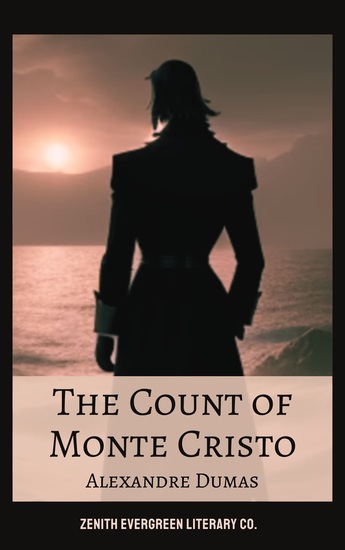
The Count of Monte Cristo - Alexandre Dumas' Epic Tale of Revenge and Redemption - cover

The Count of Monte Cristo - Alexandre Dumas' Epic Tale of Revenge and Redemption

Alexandre Dumas, Zenith Evergreen Literary Co.

Publisher: Zenith Evergreen Literary Co.

  • 0
  • 0
  • 0

Summary

🌟 Embark on a journey of betrayal, vengeance, and triumph
Alexandre Dumas' The Count of Monte Cristo is a timeless masterpiece that takes readers on an unforgettable journey through love, betrayal, revenge, and redemption. The story follows Edmond Dantès, a man unjustly imprisoned due to a sinister conspiracy. Stripped of everything he holds dear, Edmond escapes and transforms himself into the enigmatic Count of Monte Cristo to seek justice against those who wronged him.

📚 Set against the vivid backdrop of 19th-century France, Dumas weaves an intricate plot brimming with suspense, intrigue, and dramatic twists. This sweeping narrative explores themes of justice, loyalty, and the power of forgiveness, leaving readers enthralled by its depth and complexity.

🎭 With larger-than-life characters, richly imagined settings, and a gripping tale of transformation, The Count of Monte Cristo stands as one of the most celebrated works of literature. Whether you're captivated by Edmond's cunning strategies or moved by his emotional journey, this novel offers something extraordinary for every reader.

🏆 Widely hailed as a literary masterpiece, this epic story has inspired countless adaptations and continues to be adored by readers across the world. Dive into Dumas' magnificent work and discover why The Count of Monte Cristo is considered one of the greatest novels ever written.

📖 Don't wait to experience the brilliance of Alexandre Dumas. Click "Buy Now" to own this remarkable tale of revenge and redemption.
Available since: 04/09/2025.
Print length: 1315 pages.
Other books that might interest you

  • 200Th Anniversary Collection 2 - cover

    200Th Anniversary Collection 2

    Charles Dickens

    • 0
    • 0
    • 0
    Here is the second volume; the first volume of short works - fiction, essays, poetry and speeches celebrating Dickens' birthday on February 7th 2012. 
     
    The wonder of Charles Dickens resides in his unparalleled ability to transport readers into the vivid tapestry of Victorian England. With an uncanny knack for illuminating both the harsh realities of life in the 19th century and the enduring resilience of the human spirit, Dickens crafted stories that transcend time and place. His characters, from the indomitable Oliver Twist to the enigmatic Miss Havisham, are etched into the collective memory of literature, their plights and triumphs offering a profound mirror to our own experiences. Dickens' narrative prowess lay in his knack for conjuring intricate, multi-layered plots that captivate, inspire, and, at times, even elicit a tear or a hearty chuckle. The vivid streets of London, the trials of orphans, and the ghostly visitations in A Christmas Carol all come to life through his words, inviting readers to explore the multifaceted world he so masterfully crafted. 
     
    But the wonder of Charles Dickens goes beyond his storytelling. He was, in every sense, a social critic of his era. His works, whether through the depiction of child labor, the stark conditions of the poor, or the intricacies of the legal system, shed light on the injustices of Victorian society. With a pen as his sword, Dickens championed social reform and illuminated the darkness of his time. His legacy endures as a testament to the power of literature to challenge the status quo and inspire change. Even today, his writings remain a source of wonder, inspiring generations to appreciate the beauty of language and the enduring resilience of the human spirit, and reminding us of the timeless relevance of his timeless tales. 
     
    With narration by Emmy Award-nominated actor Geoffrey Giuliano.
    Show book
  • A Diagnosis of Death - From their pens to your ears genius in every story - cover

    A Diagnosis of Death - From...

    Ambrose Bierce

    • 0
    • 0
    • 0
    Ambrose Gwinnett Bierce was born on 24th June 1842 at Horse Cave Creek in Meigs County, Ohio. His parents were poor but they introduced him to literature at an early age, instilling in him a deep appreciation of books, the written word and the elegance of language.  
    Growing up in Koscuisko County, Indiana poverty and religion were defining features of his childhood, and he would later describe his parents as “unwashed savages” and fanatically religious, showing him little affection but always quick to punish. He came to resent religion, and his introduction to literature appears to be their only positive effect. 
    At age 15 Bierce left home to become a printer’s devil, mixing ink and fetching type at The Northern Indian, a small Ohio paper. Falsely accused of theft he returned to his farm and spent time sending out work in the hopes of being published. 
    His Uncle Lucius advised he be sent to the Kentucky Military Institute. A year later he was commissioned as an Officer.  As the Civil War started Bierce enlisted in the 9th Indiana Infantry Regiment.  
    In April 1862 Bierce fought at the Battle of Shiloh, an experience which, though terrifying, became the source of several short stories. Two years later he sustained a serious head wound and was off duty for several months. He was discharged in early 1865.  
    A later expedition to inspect military outposts across the Great Plains took him all the way to San Francisco. He remained there to become involved with publishing and editing and to marry, Mary Ellen on Christmas Day 1871.  They had a child, Day, the following year.  
    In 1872 the family moved to England for 3 years where he wrote for Fun magazine. His son, Leigh, was born, and first book, ‘The Fiend’s Delight’, was published.  
    They returned to San Francisco and to work for a number of papers where he gained admiration for his crime reporting. In 1887 he began a column at the William Randolph Hearst’s San Francisco Examiner.  
    Bierce’s marriage fell apart when he discovered compromising letters to his wife from a secret admirer. The following year, 1889 his son Day committed suicide, depressed by romantic rejection. 
    In 1891 Bierce wrote and published the collection of 26 short stories which included ‘An Occurrence at Owl Creek Bridge’.  Success and further works including poetry followed.  
    Bierce with Hearst’s resources helped uncover a financial plot by a railroad to turn 130 million dollars of loans into a handout. Confronted by the railroad and asked to name his price Bierce answered “my price is $130 million dollars. If, when you are ready to pay, I happen to be out of town, you may hand it over to my friend, the Treasurer of the United States”.  
    He now began his first foray as a fabulist, publishing ‘Fantastic Fables’ in 1899.  But tragedy again struck two years later when his second son Leigh died of pneumonia relating to his alcoholism.  
    He continued to write short stories and poetry and also published ‘The Devil’s Dictionary’.  
    At the age of 71, in 1913 Bierce departed from Washington, D.C., for a tour of the battlefields where he had fought during the civil war. At the city of Chihuahua he wrote his last known communication, a letter to a friend. It’s closing words were “as to me, I leave here tomorrow for an unknown destination,” Ambrose Bierce then vanished without trace.
    Show book
  • Northanger Abbey - cover

    Northanger Abbey

    Jane Austen

    • 0
    • 0
    • 0
    *Northanger Abbey* is a delightful coming-of-age novel that playfully critiques the conventions of Gothic literature. At the heart of the story is the endearingly naïve Catherine Morland, a seventeen-year-old who hails from a modest country parsonage. During a few enchanting weeks spent in the bustling spa town of Bath, Catherine forms a captivating connection with the charming Henry Tilney, who graciously invites her to experience the grandeur of his family estate, Northanger Abbey. 
    Upon her arrival at the Abbey, an ancient mansion steeped in mystery and echoes of the past, Catherine's imagination runs wild. Captivated by her passion for Gothic thrillers, she begins to perceive an eerie atmosphere that fuels her burgeoning suspicions. Whispers of dark secrets swirl around her thoughts: What truly lies behind the untimely death of Henry’s mother? Is there a hidden malevolence lurking within the elegant, shadowy chambers of the Abbey? Can she place her trust in the enigmatic Henry, or could he himself be entangled in a sinister plot?  
    As her vivid imagination spirals, Catherine interprets mundane happenings as ominous omens, her heart racing with each twist of her thoughts. However, it is Henry’s gentle encouragement that ultimately guides her to discern the line between fiction and reality, reminding her that life, with all its unpredictability, can often be far stranger than art. 
    Filled with spirited charm and insightful commentary, *Northanger Abbey* offers a lighthearted yet astute exploration of love, marriage, and the perils of letting one's imagination run wild.
    Show book
  • Captain Rogers - From their pens to your ears genius in every story - cover

    Captain Rogers - From their pens...

    W Jacobs

    • 0
    • 0
    • 0
    William Wymark Jacobs was born on 8th September 1863 in Wapping, East London.  
    He was educated at a private school and then Birkbeck Literary and Scientific Institution, now part of the University of London. 
    In 1879, Jacobs began work as a clerk in the civil service, in the Post Office Savings Bank.  In 1885 his first short story was published but it was not until almost the turn of the century that he would abandon his post office career to that as a full-time writer. By then he was a very popular author, his collections selling extremely well and with an excellent income. 
    His best-known work is the macabre ‘The Monkey's Paw’ and he is also highly regarded for his ghost stories although much of his remaining short story output is streaked with humour.  His characters are immediately identifiable and we all know that life will take chunks out of them in no time at all.  
    Jacobs married the noted suffragette Agnes Eleanor Williams in 1900 at West Ham, Essex. They went on to have two daughters and three sons as they settled down to life.  
    By the outbreak of the First World War his literary output had declined and he now mainly spent his time rewriting his earlier stories for the stage.  In all he wrote 18 plays. 
    W W Jacobs died on 1st September 1943 at Hornsey Lane, Islington in London. He was 79.
    Show book
  • Miss Brill - cover

    Miss Brill

    Katherine Mansfield

    • 0
    • 0
    • 0
    "Miss Brill" is a short story by Katherine Mansfield (1888-1923). It was first published in Athenaeum on 26 November 1920, and later reprinted in The Garden Party and Other Stories.
    Miss Brill is an English teacher living near the Public Gardens in a French town. The narrative follows her on a regular Sunday afternoon, which she spends walking about and sitting in the park.
    Show book
  • The Schoolboy's Story - cover

    The Schoolboy's Story

    Charles Dickens

    • 0
    • 0
    • 0
    The Schoolboy's Story is a short stories by Charles Dickens. Charles John Huffam Dickens (7 February 1812 – 9 June 1870) was an English writer and social critic. He created some of the world's most memorable fictional characters and is generally regarded as the greatest novelist of the Victorian period. During his life, his works enjoyed unprecedented fame, and by the twentieth century his literary genius was broadly acknowledged by critics and scholars. His novels and short stories continue to be widely popular. Born in Portsmouth, England, Dickens was forced to leave school to work in a factory when his father was thrown into debtors' prison.
    Being rather young at present--I am getting on in years, but still I am rather young--I have no particular adventures of my own to fall back upon. It wouldn't much interest anybody here, I suppose, to know what a screw the Reverend is, or what a griffin SHE is, or how they do stick it into parents--particularly hair-cutting, and medical attendance. One of our fellows was charged in his half's account twelve and sixpence for two pills--tolerably profitable at six and threepence a-piece, I should think--and he never took them either, but put them up the sleeve of his jacket.
    Show book