Join us on a literary world trip!
Add this book to bookshelf
Grey
Write a new comment Default profile 50px
Grey
Subscribe to read the full book or read the first pages for free!
All characters reduced
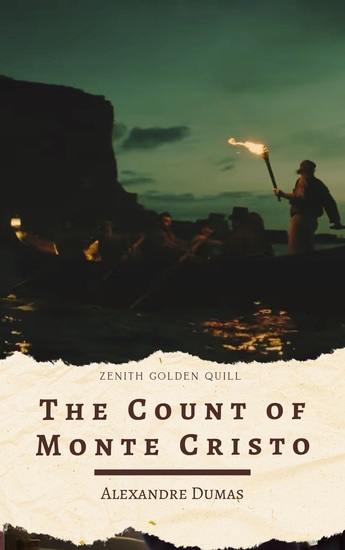
The Count of Monte Cristo - A Timeless Tale of Betrayal Revenge and Redemption by Alexandre Dumas - cover

The Count of Monte Cristo - A Timeless Tale of Betrayal Revenge and Redemption by Alexandre Dumas

Alexandre Dumas, Zenith Golden Quill

Publisher: Zenith Golden Quill

  • 0
  • 0
  • 0

Summary

Imprisoned for a crime he didn't commit. Reborn as a mysterious nobleman. Driven by justice—and vengeance.

The Count of Monte Cristo is Alexandre Dumas's thrilling epic of betrayal, escape, transformation, and revenge. Falsely accused and locked away in the notorious Château d'If, Edmond Dantès spends years plotting his return and retribution. When he finally emerges as the enigmatic Count of Monte Cristo, no one who wronged him is safe.

Rich with themes of justice, loyalty, romance, and the devastating cost of vengeance, this enduring classic is a cornerstone of world literature and one of the most gripping stories ever told.

📘 This Edition Includes:
✔ The complete, unabridged novel
✔ Kindle-optimized formatting with active table of contents
✔ Perfect for fans of epic historical fiction, classic literature, and intricate plots

💬 What Readers Say:
"A literary masterpiece that blends action, emotion, and intrigue."
"The greatest revenge story ever written."
"Impossible to put down—a true classic for all generations."

📥 Download The Count of Monte Cristo today and uncover the ultimate story of justice and redemption.
Available since: 05/05/2025.
Print length: 1575 pages.

Other books that might interest you

  • Frankenstein - cover

    Frankenstein

    Mary Shelley

    • 0
    • 0
    • 0
    Brought to life by YouTube superstar David Dobrik, Frankenstein is one of the earliest examples of science fiction, introducing the prototypical “mad scientist” who creates a monster who destroys everyone and everything that is dear to him. The scientist is the eponymous character of the novel but the name, Frankenstein, has become popularly attached to the creature itself, who has become one of the best-known monsters in the history of motion pictures and a constant reference point in popular culture. The novel has spoken to technological and cultural anxieties from the Enlightenment to the age of Big Tech as it engages with the ethics of technology and scientific discovery, and the power of knowledge. Perhaps its most lasting legacy, however, is that the monster comes to represent anyone who doesn't fit into societal norms; the creature experiences forms of alienation that are oddly relatable to modern life. 
     
    Cover illustrated by: James Jeffers 
    James Jeffers is a queer illustrator whose work explores the delightful world of the fantastique through colors, shapes, and whimsy.
    Show book
  • A Dialogue Among Clever People - From their pens to your ears genius in every story - cover

    A Dialogue Among Clever People -...

    Leo Tolstoy

    • 0
    • 0
    • 0
    Leo Tolstoy was born in 1828 in the Russian province of Tula to a wealthy noble family. As a child, he had private tutors but he showed little interest in any formal education. When he went to the University of Kazan in 1843 to study oriental languages and law, he left without completing his courses.  Life now was relaxed and idle but with some writing also taking place.  Gambling debts forced an abrupt change of path and he joined the army to fight in the Crimean War.  He was commended for his bravery and promoted but was appalled at the brutality and loss of life.  He recorded these and other earlier experiences in his diaries which formed the basis of several of his works. 
    In 1852 ‘Childhood’ was published to immediate success and was followed by ‘Boyhood’ and ‘Youth’. 
    His experience in the army and the horrors he witnessed resulted in ‘The Cossacks’ in 1862 and the trilogy ‘Sevastopol Tales’. After the war he travelled around Europe, visiting London and Paris and meeting such luminaries as Victor Hugo and Charles Darwin.  
    It was now that Tolstoy began his masterpiece, ‘War and Peace’. Published in 1869 it was an epic work that changed literature. He quickly followed this with ‘Anna Karenina’.  
    These successes made Tolstoy rich and helped him accomplish many of his dreams but also brought problems as he grappled with his faith and the lot of the oppressed poor. These revolutionary views became so popular that the authorities now kept him under surveillance.  
    He led a life of asceticism and vegetarianism and put his socialist ideals into practice by establishing numerous schools for the poor and food programmes. He also believed in giving away his wealth, which caused much discord with his wife.  
    His writing continued to bring forth classics such as ‘The Death of Ivan Ilyich’ and many brilliant and incisive short stories such as ‘How Much Land Does A Man Need’.  
    In 1901 Tolstoy was excommunicated from the Church and controversially deselected for the Nobel Prize for Literature. 
    Whilst undertaking a pilgrimage by train in October 1910 with his daughter Aleksandra he caught pneumonia in the nearby town of Astapovo.  Leo Tolstoy died on November 9th, 1910, he was 82.
    Show book
  • My Platonic Sweetheart - cover

    My Platonic Sweetheart

    Mark Twain

    • 0
    • 0
    • 0
    My Platonic Sweetheart is a short dream narrative that was originally titled "The Lost Sweetheart" and written during 1898. It was published posthumously and is believed to be based on a recurring dream that Twain had for most of his life.
    
    Through five dreams the narrative depicts the main character seeing the same woman recurring throughout his dreams. Her appearance and name are continually changing, but they are always seventeen and fifteen and the two characters never fail to recognize each other. A short story of love lost and found and an example of how dreams can stay with us and weave a rich tapestry of experience and characters.
    Show book
  • The Complete Oz Collection - cover

    The Complete Oz Collection

    L. Frank Baum

    • 0
    • 0
    • 0
    Noted as one of the most popular series in American literature, the works of L. Frank Baum have been brought together in this singular collection that ensures the fun never stops! Embark on the journey that has capitated audiences for over a century. This collection contains the following: The Wonderful Wizard of Oz The Marvelous Land of Oz Ozma of Oz Dorothy and the Wizard of Oz The Road to Oz The Emerald City of Oz The Patchwork Girl of Oz Tik-Tok of Oz The Scarecrow of Oz Rinkitink of Oz The Lost Princess of Oz The Tin Woodman of Oz The Magic of Oz Glinda of Oz
    Show book
  • What is Coming? - A Forecast of Things After the War (Unabridged) - cover

    What is Coming? - A Forecast of...

    H. G. Wells

    • 0
    • 0
    • 0
    Prophecy may vary between being an intellectual amusement and a serious occupation; serious not only in its intentions, but in its consequences. For it is the lot of prophets who frighten or disappoint to be stoned. But for some of us moderns, who have been touched with the spirit of science, prophesying is almost a habit of mind.
    Show book
  • The Threat and Other Stories - cover

    The Threat and Other Stories

    Saki Saki

    • 0
    • 0
    • 0
    Sir Lulworth Quayne discusses with his nephew the threat posed by the suffragette movement in this satirical short story by Saki. This collection of stories also includes "Tea", "The Wolves of Cernogratz" and "The Penance", which were first published in 1919 in The Toys of Peace and Other Papers.
    Show book