Join us on a literary world trip!
Add this book to bookshelf
Grey
Write a new comment Default profile 50px
Grey
Subscribe to read the full book or read the first pages for free!
All characters reduced
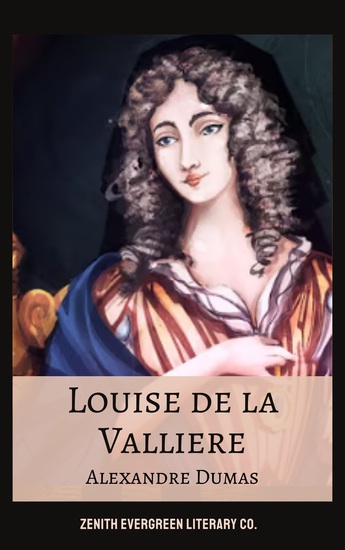
Louise de la Valliere - A Captivating Tale of Love and Intrigue by Alexandre Dumas - cover

Louise de la Valliere - A Captivating Tale of Love and Intrigue by Alexandre Dumas

Alexandre Dumas, Zenith Evergreen Literary Co.

Publisher: Zenith Evergreen Literary Co.

  • 0
  • 0
  • 0

Summary

🌟 Enter a world of passion, betrayal, and royal intrigue
In Louise de la Vallière, Alexandre Dumas takes readers on a mesmerizing journey through the glories and pitfalls of love within the dazzling court of King Louis XIV. This enthralling tale is the third installment in the d'Artagnan Romances, following the exploits of the famed Musketeers as they navigate political schemes, heartfelt romances, and daring adventures.

📚 At the heart of the story lies Louise de la Vallière, a woman whose tenderness and vulnerability clash with the ruthless ambitions surrounding her. Dumas paints a vivid picture of her romance with King Louis XIV, weaving an unforgettable tapestry of loyalty, love, and sacrifice. Meanwhile, the Musketeers face their own dilemmas, taking readers on thrilling escapades that combine Dumas' masterful storytelling with his unmatched ability to craft complex characters.

🎭 This novel is rich with emotional depth and historical drama, offering readers both action and romance in equal measure. Dumas captures the grandeur of the 17th-century French court while exploring themes of power, loyalty, and human frailty.
🏆 A literary masterpiece, Louise de la Vallière remains a cherished part of Dumas' legacy, captivating readers across generations with its thrilling plot and vivid characters.

📖 Don't miss this timeless classic that combines adventure, romance, and intrigue in one extraordinary tale. Click "Buy Now" to delve into the enchanting world of Alexandre Dumas.
Available since: 04/09/2025.
Print length: 412 pages.

Other books that might interest you

  • The Montezuma Emerald - cover

    The Montezuma Emerald

    Rodrigues Ottolengui

    • 0
    • 0
    • 0
    Rodrigues Ottolengui was an American writer and pioneering dentist born in Charleston, SC, who lived most of his life in New York City. Ottolengui was one of the first dentists to use X-rays and was a specialist in orthodontics and root canal therapy. In the 1890s, Ottolengui published four novels and a collection of detective short stories, including The Montezuma Emerald. 
    A seasoned stage actor, Raymond Stottlemyre was born and raised in Pelican Rapids, MN. He has worked in local radio, narrated audio programs, and has performed in hundreds of plays over the decades.
    Show book
  • A Fight with a Cannon - From their pens to your ears genius in every story - cover

    A Fight with a Cannon - From...

    Victor Hugo

    • 0
    • 0
    • 0
    Victor Marie Hugo was born on 26th February 1802 in Besançon, France.   
    There can be no doubt that Hugo is ranked as the greatest of French authors and poets. In addition to this he fought against social injustice throughout his life and from his frequent elections to the French Assembly. 
    Hugo published his first novel, Han d’Islande (1823), the year after his marriage and so began an immense canon of fiction and poetry not only for France but to World literature.  
    He was elected to the Académie Française in 1841 and the same year came a peerage and entrance to the Higher Chamber as a pair de France, where he spoke against the death penalty, social injustice and in favour of press freedom.  
    In the years leading up to the Revolution of 1848 Hugo began to lean towards Republicanism and greater freedoms.  With the formation of the Second Republic, he was again elected to the Assembly. 
    When Napoleon III seized power in 1851, and established an anti-parliamentary constitution, Hugo openly declared him a traitor to France. This, of course, meant exile where he remained until 1870.  In exile he published his greatest work ‘Les Misérables’, and further widely honoured collections of poetry. 
    Returning home he was again elected to the National Assembly and the Senate.  It was the time of the Franco-Prussian war and with Paris under siege and food ever more scarce, he wrote in his diary that he was now "eating the unknown". 
    Later he was instrumental in strengthening the rights of artists and copyright, steps which led to the international protections of the Berne Convention.  
    Victor Hugo died on 22nd May 1885, aged 83.
    Show book
  • The Red Shoes - cover

    The Red Shoes

    H. C. Andersen

    • 0
    • 0
    • 0
    Classic short story by H. Ch. Andersen, about a little girl losing control over her red shoes.
    Show book
  • The Rubaiyat of Omar Khayyam - cover

    The Rubaiyat of Omar Khayyam

    Omar Khayyam, Edward FitzGerald

    • 0
    • 0
    • 0
    The Rubaiyat of Omar Khayyam is a collection of quatrains (four-line verses) attributed to the 12th-century Persian poet, mathematician, and astronomer, Omar Khayyam. While the original Persian text is complex and open to interpretation, it is the English translation by Edward Fitzgerald that popularized the work in the Western world. 
    Fitzgerald's translation portrays a world view that is often characterized as: 
    Carpe Diem: Seize the day, emphasizing the fleeting nature of life and the importance of enjoying the present moment. 
    Skepticism: Questioning traditional beliefs and religious dogma, particularly in relation to the afterlife. 
    Epicureanism: Focusing on pleasure and the senses as the primary goods in life. 
    Fatalism: Accepting one's fate and the inherent unpredictability of existence.
    Show book
  • Tale of Two Cities A (Book the Second: The Golden Thread) - cover

    Tale of Two Cities A (Book the...

    Charles Dickens

    • 0
    • 0
    • 0
    Book 2: The Golden Thread: A Tale of Two Cities is an 1859 historical novel by Charles Dickens, set in London and Paris before and during the French Revolution. The novel tells the story of the French Doctor Manette, his 18-year-long imprisonment in the Bastille in Paris and his release to live in London with his daughter Lucie, whom he had never met. The story is set against the conditions that led up to the French Revolution and the Reign of Terror.
    Dickens' best-known work of historical fiction, A Tale of Two Cities is regularly cited as the best-selling novel of all time. In 2003, the novel was ranked 63rd on the BBC's The Big Read poll. The novel has been adapted for film, television, radio, and the stage, and has continued to have an influence on popular culture.
    Show book
  • The Encantadas - cover

    The Encantadas

    Herman Melville

    • 0
    • 0
    • 0
    "The Encantadas, or Enchanted Isles" is a novella by American author Herman Melville. First published in Putnam's Magazine in 1854, it consists of ten philosophical "Sketches" on the Encantadas, or Galápagos Islands. It was collected in The Piazza Tales in 1856. The Encantadas was a success with the critics, and contained some of Melville's "most memorable prose".
    An anonymous narrator unites the ten disparate "Sketches", each of which begin with a few lines of poetry, mostly taken from Edmund Spenser's The Faerie Queene. All of the stories are replete with symbolism reinforcing the cruelty of life on the Encantadas. "Sketch First" is a description of the islands; though they are the Enchanted Isles they are depicted as desolate and hellish. "Sketch Second" is a meditation on the narrator's encounter with ancient Galápagos tortoises, while "Sketch Third" concerns the narrator's trip up the enormous tower called the Rock Rodondo. "Sketch Fourth" details the narrator's musings from atop the tower, and his recollection of the islands' accidental discovery by Juan Fernández. "Sketch Fifth" describes the USS Essex' encounter with a phantom British ship near the area during the War of 1812.
    Show book