Join us on a literary world trip!
Add this book to bookshelf
Grey
Write a new comment Default profile 50px
Grey
Subscribe to read the full book or read the first pages for free!
All characters reduced
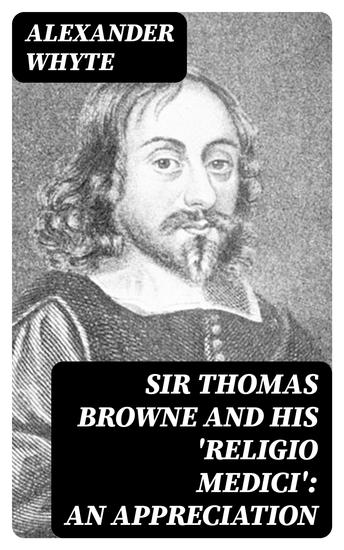
Sir Thomas Browne and his 'Religio Medici': An Appreciation - cover

Sir Thomas Browne and his 'Religio Medici': An Appreciation

Alexander Whyte

Publisher: DigiCat

  • 0
  • 0
  • 0

Summary

In "Sir Thomas Browne and his 'Religio Medici': An Appreciation," Alexander Whyte offers a profound exploration of Browne's seminal work, which uniquely intertwines philosophy, religion, and science. The literary style is characterized by its rich, meditative prose that reflects Browne's intellectual curiosity and spiritual depth. Whyte analyzes the historical and cultural contexts of the 17th century, highlighting how Browne's reflections on faith and existence resonate with the tumultuous intellectual climate of his time, especially in the wake of the Renaissance and Reformation, where inquiry into the human condition was paramount. Whyte, a distinguished Scottish theologian and author, drew on his extensive knowledge of religious literature to produce this appreciation of Browne. His own background in the intricacies of faith and philosophy deeply informs his analysis, as he seeks not just to evaluate Browne's work, but to uncover the rich implications of its themes. Whyte's nuanced understanding of the relationship between science and spirituality sheds light on Browne's humanistic perspective in an era defined by conflict and uncertainty. This book is an essential read for anyone interested in the intersection of literature and spirituality, providing remarkable insights into Browne's timeless inquiry into the nature of belief and existence. Whyte's eloquence and depth make this work a compelling addition to the scholarship surrounding Browne, rendering it a valuable text for both literary enthusiasts and theological scholars.
Available since: 09/16/2022.
Print length: 42 pages.

Other books that might interest you

  • Time to Escape - cover

    Time to Escape

    Raphael Terra

    • 0
    • 0
    • 0
    This audiobook has been recorded using Text to speech (TTS). 
     
    This is a mad, mad world. A world full of crazy humans. Our species is growing at an alarming rate; the globe is warming out of control; our food sources are being depleted; a massive energy crisis is looming and the pressure on each and every one of us to earn more, compete with our peers and look cool is so great that suicide rates are growing faster than ever. 
     
    Marry, have two children, hold down a good job, fight for your country, pay your mortgage and drive a petrol guzzling car. What about creativity, freedom, emotions? We are sold to, manipulated by marketing and propaganda, told what and who to believe. We are born and thrown into a bewildering world of control with no options and no purpose other than to feed the machine. 
     
    For many it all becomes too much and the pressure forces suicide. But is this the only way to live? No it is not. There are ways to escape the madness of human society. To escape the Queen Bee of capitalism and control. To no longer be a drone. 
     
    It is time to jump off.
    Show book
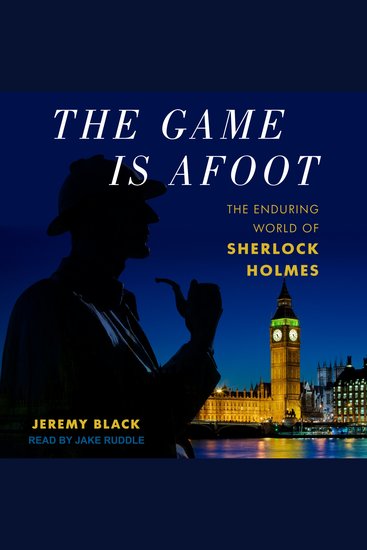
  • The Game Is Afoot - The Enduring World of Sherlock Holmes - cover

    The Game Is Afoot - The Enduring...

    Jeremy Black

    • 0
    • 0
    • 0
    Through the enduring eye of Sherlock Holmes, noted historian Jeremy Black traces how Holmes and his milieu evolved in Sir Arthur Conan Doyle's books and how Holmes continues to resonate today. Black explores the context of Doyle's ideas and stories and why they struck such a chord with readers in London, and ultimately the world. He portrays a complex man with eclectic interests, from soccer to spiritualism, from cricket to divorce law reform. Standing twice for Parliament, Doyle was a committed meritocrat whose political experiences and values were expressed through his writings. Reading the Holmes stories through the lens of Doyle's multifaceted career, Black throws fresh light on the values expressed in them and how Holmes would have been perceived at the time. He traces the imperial strand in the Holmes stories and Doyle's treatment of America and Europe. 


    Drawing on a masterful knowledge both of Doyle's era and his writings, this entertaining and wide-ranging book uses the Holmes stories to bring Victorian England to vibrant life, a world where crimes large and small abound and where dark corners and well-lit drawing rooms alike hide villainy. Holmes was a hero and an inspiration for many a character who redefined the idea of detection and the detective, a private man of great public importance. Here is his story.
    Show book
  • The Eurasian Century - Hot Wars Cold Wars and the Making of the Modern Century - cover

    The Eurasian Century - Hot Wars...

    Hal Brands

    • 0
    • 0
    • 0
    We often think of the modern era as the age of American power. In reality, we're living in a long, violent Eurasian century. That giant, resource-rich landmass possesses the bulk of the global population, industrial might, and potential military power. Eurasia is a strategic prize without equal—which is why the world has been roiled, reshaped, and nearly destroyed by clashes over the supercontinent. 


    Since the early twentieth century, autocratic powers have aspired for dominance by seizing commanding positions in the world's strategic heartland. Offshore sea powers, namely the United Kingdom and America, have sought to make the world safe for democracy by keeping Eurasia in balance. America's rivalries with China, Russia, and Iran are the next round in this geopolitical game. If this new authoritarian axis succeeds in enacting a radically revised international order, America and other democracies will be vulnerable and insecure. 


    Hal Brands argues that a better understanding of Eurasia's strategic geography can illuminate the contours of rivalry and conflict in today's world. The Eurasian Century explains how revolutions in technology and warfare, and the rise of toxic ideologies of conquest, made Eurasia the center of twentieth-century geopolitics—with pressing implications for the struggles that will define the twenty-first.
    Show book
  • A Realistic Path to Peace - From Genocide to Global War and How We Can Stop It 2025 Edition - cover

    A Realistic Path to Peace - From...

    Dee Charles Knight

    • 0
    • 0
    • 0
    This book delves into genocide in Palestine, and the war crisis in eastern Europe, West Asia and East Asia. It examines the role of the Big Lie in blunting popular opposition, and describes ways countries around the world and the general public are pressing for peace.  
    The world is in a crisis now. As its empire declines toward collapse, the United States leadership is making a series of disastrous errors. The “neocons” in Washington, DC, are determined to maintain U.S. global domination regardless of what it might take. The stakes are high for them. They seem to believe that if they “allow” any other country to challenge their global leadership, their whole system could fall apart. 
    So they are prepared to do whatever it takes. Supporting genocide in Israel—by providing weapons, money, and a bizarre “moral justification” for horrific genocidal bombing—is a sign of what it takes. Blowing up the Nord Stream pipeline was another sign of what it can take. 
    Western European leaders have been rounded up and bludgeoned into a unified NATO alliance against Russia, and in support of Israeli genocide against Palestinians. This alliance—originally composed of “north Atlantic” countries under U.S. leadership at the end of World War II—is now also being extended to Asia. It’s a quest to curb China’s historic economic success, which threatens Western domination of global trade. 
    A new peace movement is emerging. It faces enormous obstacles, including a gigantic wave of war hysteria engineered in Washington, magnified exponentially by a captive mainstream media that seems to have abandoned all pretense of critical journalistic independence and objectivity. But as facts emerge and truth surfaces, the movement for peace will intensify. 
    Combined with the horrific results of sanctions and war, these facts and truths can be expected to bring ever greater waves of opposition and resistance into the fray.
    Show book
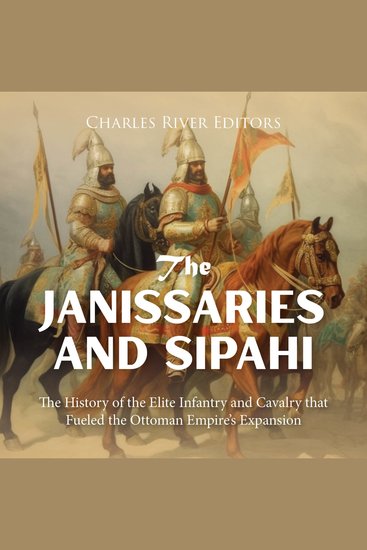
  • Janissaries and Sipahi The: The History of the Elite Infantry and Cavalry that Fueled the Ottoman Empire’s Expansion - cover

    Janissaries and Sipahi The: The...

    Editors Charles River

    • 0
    • 0
    • 0
    In terms of geopolitics, perhaps the most seminal event of the Middle Ages was the successful Ottoman siege of Constantinople in 1453. The city had been an imperial capital as far back as the 4th century, when Constantine the Great shifted the power center of the Roman Empire there, effectively establishing two almost equally powerful halves of antiquity’s greatest empire. Constantinople would continue to serve as the capital of the Byzantine Empire even after the Western half of the Roman Empire collapsed in the late 5th century. Naturally, the Ottoman Empire would also use Constantinople as the capital of its empire after their conquest effectively ended the Byzantine Empire, and thanks to its strategic location, it has been a trading center for years and remains one today under the Turkish name of Istanbul.  
    	In the wake of taking Constantinople, the Ottoman Empire would spend the next few centuries expanding its size, power, and influence, bumping up against Eastern Europe and becoming one of the world’s most important geopolitical players. It was a rise that would not truly start to wane until the 19th century. 
    Among those who were responsible for the projection of Ottoman power, few deserve as much credit as the Janissaries. Established by Murad I, the Janissaries became an elite infantry force that was loyal only to the sultan. Their mission was to protect only him and in battles they were always the closest to him, forming a human shield.  
    Civilizations across the steppes and the Middle East relied heavily on cavalry, and the Sipahi were elite cavalry units during medieval times for a couple of powers. That said, they were a massive contributor to the success of Ottoman warfare, and during good times for the empire, the Sipahi were rewarded, to the extent that they became their own social class, much like the Janissaries. 
    Show book
  • The Opium Queen - cover

    The Opium Queen

    Gabrielle Paluch

    • 0
    • 0
    • 0
    Olive Yang was a widely mythologized genderqueer lesbian opium-pioneer in the 1950s heyday of the Golden Triangle. After escaping an arranged marriage with a noble cousin, Olive felt that she had no choice but to lead a life of banditry with an anti-communist rebel army supported by the CIA. As her smuggling empire grew, she became so powerful and infamous that novelists were inspired to write about her evil ruthlessness and beauty. Yet, Olive’s real life and identity remained a mystery to many. Opium Queen is a journey to uncover the true story behind the propaganda and legends. Declassified intelligence documents portray Olive as a critical operator in one of the most important fronts of the clandestine Cold War against China. Through extensive interviews with the Yang family, Olive emerges as a complex anti-hero, searching for a way to live as an open homosexual in an era when such a lifestyle was considered deeply shameful in Burma. The great military alliances that facilitate narcotics traffic in Myanmar today are Olive’s lasting legacy in the Golden Triangle, as is the disenfranchisement of the people of Kokang. Through the story of Olive’s formidable life, Opium Queen examines historic events that underpinned critical diplomatic relationships between the U.S., Myanmar, and China and were at the root of Myanmar’s current political crisis.
    Show book