Join us on a literary world trip!
Add this book to bookshelf
Grey
Write a new comment Default profile 50px
Grey
Subscribe to read the full book or read the first pages for free!
All characters reduced
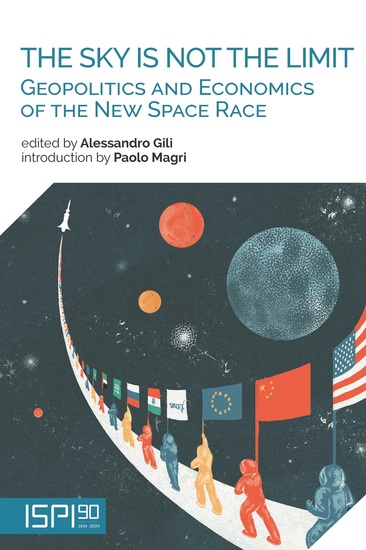
The Sky Is Not the Limit - Geopolitics and Economics of the New Space Race - cover

The Sky Is Not the Limit - Geopolitics and Economics of the New Space Race

Alessandro Gili

Publisher: Ledizioni

  • 0
  • 0
  • 0

Summary

Space is a contested domain for its very nature and today it is evidently becoming an increasingly important enabler of economic and military power. An increasing number of actors, infrastructures and technologies deployed in space also raises concerns for safety and security, especially in cyberspace. Many countries are striving to achieve space capabilities and autonomous access to space, and this is
having a tremendous geopolitical impact, especially since space is emerging as an increasingly critical military and strategic domain. The development of the new space economy, which is increasingly involving the private sector and many industrial actors and services, will also be a game changer for the international economy. The space race likewise implies disruptive technologies that could contribute massively to the energy and digital transitions, accelerating solutions that could benefit humanity. A new international governance system for space is therefore needed urgently, considering that the current rules are no longer able to respond to a sector evolving at such a rapid pace. Which actors are leading the race? Which economic sectors could benefit the most and what could the new space economy mean for the world? How is space emerging as a military domain against a backdrop of increasing international tensions? What would a new system of global governance for space look like?
Available since: 06/07/2024.
Print length: 323 pages.

Other books that might interest you

  • Political wisdom - A future for Christian politics - cover

    Political wisdom - A future for...

    Rob Nijhoff, Tido J. Mooibroek

    • 0
    • 0
    • 0
    Does faith belong in politics? According to Rob Nijhof it most certainly does. Everyone has some deep convictions that shape the way in which one conducts politics. People can be inspired to political wisdom from different sources. That diversity presents a good reason to listen to each other. It remains useful to draw from the broad Christian tradition that gave the Netherlands and Europe a unique constitutional and democratic character. This tradition traces its roots back to before the Renaissance or the Reformation. This book argues for a politics where ones values are acknowledged and where all players in the 'field strive together for wisdom and the general good for society. Churches can be relevant in this. The Political efforts of Christians normally proceed via the diverse political parties. However, the current network society offers Christians the chance to engage in alliances to act as a broad movement. Christian parties can give this movement a political face. It would be good if Christians would also across the borders of political parties seek to cooperate in a network. At European level this is happening in the European Christian Political Movement (ECPM). This book originally was published (in Dutch) in 2016 by the Mr. G. Groen van Prinsterer Stichting, the scientiffic Institute of the ChristenUnie political party which affter the 2017 election again took part in a coalition government, together with VVD, CDA and D66.
    Show book
  • The Invisible Hand - Economic Intelligence And Industrial Espionage - cover

    The Invisible Hand - Economic...

    Davis Truman

    • 0
    • 0
    • 0
    "The Invisible Hand" delves deep into the clandestine world of economic intelligence and industrial espionage, where the forces shaping global economies are often unseen and unknown. 
    In this riveting exploration, author Davis Truman unveils the intricate web of intrigue that underpins modern capitalism. From covert operations to sophisticated cyber espionage, this book reveals how nations and corporations deploy their resources relentlessly for competitive advantage. 
    Drawing from real-life examples and historical case studies, "The Invisible Hand" exposes governments' and businesses' shadowy tactics to gain insight into their rivals' strategies, steal trade secrets, and manipulate markets. 
    Show book
  • The Integration Policies of Belarus and Ukraine vis-à-vis the EU and Russia - A Comparative Case Study Through the Prism of a Two-Level Game Approach - cover

    The Integration Policies of...

    Victoria Leukavets

    • 0
    • 0
    • 0
    Leukavets applies here Putnam’s two-level game-theoretical approach in combination with findings from Europeanization literature and democracy promotion studies.
    Show book
  • Totalitarianism Unmasked - Understanding the Mechanics of Absolute Political Control - cover

    Totalitarianism Unmasked -...

    Arlo Holders

    • 0
    • 0
    • 0
    Totalitarianism is a political system in which the state holds total control over every aspect of public and private life, leaving no room for opposition or individual freedoms. Unlike other forms of governance, where political competition and individual rights are somewhat preserved, totalitarianism demands absolute loyalty and conformity. The concept of totalitarianism emerged in the early 20th century, though its roots can be traced back to ancient and medieval periods. In its modern form, it is most closely associated with dictatorial regimes that arose in the aftermath of World War I and throughout the 20th century. 
    The term "totalitarian" was popularized by political theorists in the 1920s and 1930s, notably in relation to regimes like those of Mussolini in Italy and Hitler in Germany. These regimes, alongside those of Stalin in the Soviet Union and others in Asia and Eastern Europe, showcased the terrifying potential of absolute political control. A hallmark of totalitarian states is the extensive centralization of power in the hands of a single leader or party. This centralization permeates every part of governance, from the military to the legal system, and extends into the social and cultural spheres, where the government seeks to dictate values, beliefs, and behaviors. 
    One of the key distinguishing features of totalitarianism is the suppression of political opposition. Under totalitarian rule, political pluralism is eradicated, and those who challenge the ruling authority are subject to imprisonment, torture, or execution. This is often achieved through the use of secret police, military forces, and legal systems designed to stifle dissent and maintain control. Another significant aspect is the pervasive use of propaganda to control the population's beliefs and perceptions.
    Show book
  • Puzzles and Conundrums - The Ultimate Historical Riddles Explained (4 in 1) - cover

    Puzzles and Conundrums - The...

    John Harpoon

    • 0
    • 0
    • 0
    This book is a bundle of several titles which are: 
    - Dawn's Dilemma: Waking up in the morning is supposed to be a fresh start—a chance to begin anew, to seize the day. But for many, it is instead a moment of resistance, a time when the comfort of the bed feels more appealing than the promise of a productive day ahead. This paradox, where the desire to be productive and successful clashes with the reluctance to rise from sleep, is at the heart of what I call the "Awakening Paradox." 
    - The Ultimate Enigma: The story of this enigma begins with a seemingly ordinary event that spiraled into an extraordinary mystery, captivating the minds of people across the globe. What started as an unexplained disappearance soon transformed into one of the most perplexing and widely discussed mysteries in recorded history. The vanishing of this individual—or object, depending on the version of the story one hears—left behind only traces of confusion, a scattering of evidence, and no clear answers. 
    - The Emperor's Edge: Napoleon Bonaparte's journey from a modest Corsican background to one of history's greatest military leaders is nothing short of remarkable. Born on August 15, 1769, in Ajaccio, Corsica, a French territory that had only recently been acquired from the Genoese, Napoleon’s early years were shaped by the turbulent political climate of his homeland.  
    - The Shadow Agents: Covert operations are a cornerstone of modern intelligence and national security strategies. They are defined by their secrecy and the fact that they are often conducted in a manner that prevents any overt acknowledgment of their existence. In essence, covert operations are activities undertaken by government agencies, intelligence services, or other organizations to influence events or gather information while keeping their involvement hidden from the public eye.
    Show book
  • Digital Liberty - Power Wealth and the Influence Machine - cover

    Digital Liberty - Power Wealth...

    Matt Stroud

    • 1
    • 1
    • 0
    Digital Liberty explores the imminent convergence of three pivotal themes: data, artificial intelligence and society's intricate social graph, and wars of a looming crisis that threatens to challenge the very foundations of liberal democracies.
    Show book