Join us on a literary world trip!
Add this book to bookshelf
Grey
Write a new comment Default profile 50px
Grey
Subscribe to read the full book or read the first pages for free!
All characters reduced
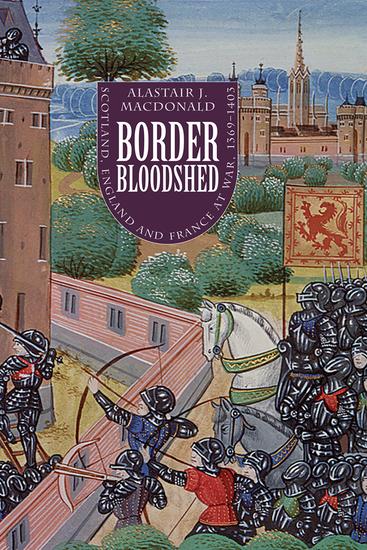
Border Bloodshed - Scotland and England at War 1369-1403 - cover

Border Bloodshed - Scotland and England at War 1369-1403

Alastair J. Macdonald

Publisher: John Donald

  • 0
  • 0
  • 0

Summary

Scottish military offensives against England from 1369 were largely the product of government policy, were launched with careful timing and, in the reign of Robert II, involved close co-operation with France. They succeeded militarily, encouraging the Scots to the point where they were willing to engage in attacks on England beyond the ambition of their French allies. However, diplomatic gains fell well short of forcing English recognition of Scottish independence.
Hopes of achieving this by military means were ended in the reign of Robert III when the Scots were heavily defeated in 1402. War was not solely fought with political objectives in mind or other 'rational' factors such as the quest for financial gain. The Scots went to war for emotive reasons too, such as hatred of the English, the search for renown and the sheer enjoyment of fighting. All these factors inspired the Scots to launch a series of bloody, brutal and ultimately futile offensives against England.
Available since: 12/16/2022.
Print length: 288 pages.

Other books that might interest you

  • Augosto Pinochet - Biography of a Modern Chilean Dictator - cover

    Augosto Pinochet - Biography of...

    Kelly Mass

    • 0
    • 0
    • 0
    Augusto José Ramón Pinochet Ugarte was a Chilean military officer and politician who dominated Chilean politics as a military dictator from 1973 to 1990. His rise to power marked a pivotal and controversial chapter in the nation’s history. Initially serving as the leader of the Military Junta of Chile from 1973 to 1981, he was declared President of the Republic by the junta in 1974, consolidating his role as Chile's de facto head of state. With the approval of a new constitution in 1981, his presidency was formalized, making him the de jure leader of the country until 1990. 
    Pinochet’s military career set the stage for his rise to power. After steadily climbing the ranks of the Chilean Army, he achieved the position of General Chief of Staff in 1972. In an unexpected turn, President Salvador Allende, leader of the democratically elected left-wing Unidad Popular government, appointed Pinochet as Commander-in-Chief of the Chilean Army on August 23, 1973, just weeks before his eventual ouster. This appointment would prove consequential as Pinochet played a central role in the coup that toppled Allende's government on September 11, 1973. Supported by the United States, the coup ended civilian rule in Chile and marked the beginning of Pinochet’s authoritarian regime.
    Show book
  • Building Champions - Paths to Success in Women's Tennis - cover

    Building Champions - Paths to...

    Molly McElwee

    • 0
    • 0
    • 0
    Featuring a foreword by Billie Jean King.
    Since the turn of the century, women's tennis has established itself as one of the world's most unpredictable sports. With 36 different Grand Slam champions from 2000 to 2024, upsets have become the norm and underdog triumphs are almost guaranteed.
    These young winners are not all serve bots or baseline bruisers hailing from the tennis academy system. Instead, their origin stories differ considerably. A generation of Czech talent eclipsing the richest tennis nations; child prodigies like Coco Gauff modelled by her parents; Kim Clijsters defying the odds to become a comeback champion after giving birth; and Emma Raducanu crafting a coaching rotation system to achieve her fairytale in New York.
    This book maps out the complex, remarkable blueprints followed by champions from across the globe, as told by those in their inner circle, and explores what this generation of women can tell us about the future of the game.
    Show book
  • Speed of Advance - cover

    Speed of Advance

    Marty Groover

    • 0
    • 0
    • 0
    Speed of Advance (SOA): the speed of a ship anticipated along an intended track; the average speed required to arrive at a destination at a specified time.In the navy, nothing is left to chance. Every strategy is tested, every resource utilized with minimal excess and remarkable efficiency. This streamlined convergence of people, process, and technology is the pinnacle of productivity—and its benefits resonate far beyond military endeavors.As a surface warfare officer, Marty Groover spent more than two decades leading an intricate operational symphony of communications processes, computer systems, and weapons programs. Now, in Speed of Advance, Marty shares what he experienced in the navy firsthand: how to harness the power of technology to drive untouchable results. By eliminating damaging silos and increasing skill sets, Marty shows you how to create an enhanced, synchronized system between technology and the people who use it—a process that will lead you into the Fourth Industrial Revolution.Lean. Impactful. Intersected. These are the businesses that will thrive in the challenges of Industry 4.0. This book will show you how to take the first step in the right direction, not by replacing people with machines but by learning how to truly work as one.
    Show book
  • Stories Dice and Rocks That Think - How Humans Learned to See the Future–and Shape It - cover

    Stories Dice and Rocks That...

    Byron Reese

    • 0
    • 0
    • 0
    What makes the human mind so unique? And how did we get this way? 


    This fascinating tale explores the three leaps in our history that made us what we are—and will change how you think about our future. 


    Look around. Clearly, we humans are radically different from the other creatures on this planet. But why? Where are the Bronze Age beavers? The Iron Age iguanas? In Stories, Dice, and Rocks That Think, Byron Reese argues that we owe our special status to our ability to imagine the future and recall the past, escaping the perpetual present that all other living creatures are trapped in. 


    Envisioning human history as the development of a societal superorganism he names Agora, Reese shows us how this escape enabled us to share knowledge on an unprecedented scale, and predict—and eventually master—the future. 


    Thoughtful and witty, this must-listen book unravels our history as an intelligent species in three acts. A fresh new look at the history and destiny of humanity, listeners will come away from Stories, Dice, and Rocks That Think with a new understanding of what they are—not just another animal, but a creature with a mastery of time itself.
    Show book
  • The Mind and Society - Volume One - cover

    The Mind and Society - Volume One

    Vilfredo Pareto

    • 0
    • 0
    • 0
    A classic of Sociology, "The Mind and Society" is 1916 book by the Italian economist Vilfredo Pareto (1848–1923). In this book Pareto presents the first sociological cycle theory, centered on the concept of an elite social class.
    Show book
  • Crusoe Castaways and Shipwrecks in the Perilous Age of Sail - cover

    Crusoe Castaways and Shipwrecks...

    Mike Rendell

    • 0
    • 1
    • 0
    “Fascinating” stories of real-life people and events that inspired the author of the classic adventure novel Robinson Crusoe (Historical Novel Society).   This book looks at some of the stories that inspired Daniel Defoe, author of Robinson Crusoe—stories of bravery, determination, and good fortune, as well as human negligence, sheer stupidity, and bad luck. In addition to an overview of Defoe’s life and his monumentally successful novel, it also considers some of the reasons why people found themselves cast away—as a result of being wrecked, abandoned as a punishment, or marooned by pirates, or even out of deliberate choice.   Major hurricanes in the eighteenth century causing huge damage to shipping and loss of life are also covered, along with catastrophes when ships were lost, and astonishing tales of survival in the face of adversity—down in the Falklands, in the Caribbean, and off the coast of Australia. It looks at how being cast away brings out the best in some—and in others the very worst. And it examines perhaps the most astonishing story of them all—sixty slaves abandoned on a desolate treeless island in the Indian Ocean and left there for fifteen years, some of whom survived against all odds.
    Show book