Join us on a literary world trip!
Add this book to bookshelf
Grey
Write a new comment Default profile 50px
Grey
Subscribe to read the full book or read the first pages for free!
All characters reduced
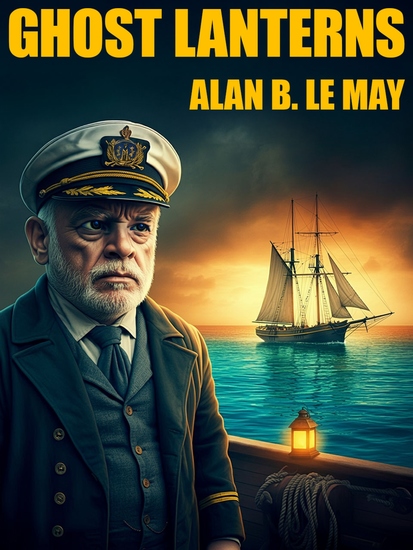
Ghost Lanterns - cover

Ghost Lanterns

Alan B. Le May

Publisher: Wildside Press

  • 0
  • 0
  • 0

Summary

Aboard the schooner Terrapin, seven men set sail, but only three remain after three days in the stifling doldrums. In the oppressive heat and eerie calm of the open sea, one by one, crew members vanish without a trace, leaving nothing but cryptic clues: a trailing rope and ghostly lanterns. As tension rises and paranoia grips the survivors, the truth unravels—a cunning plot to trap a ruthless shipowner and reclaim control of the small-port trade. But even the best-laid plans carry an air of dread in these cursed waters.
 
ABOUT THE AUTHOR
 
Alan Le May (June 3, 1899 – April 27, 1964) was an American novelist, screenwriter, and film director best known for his Westerns. Born in Indianapolis, Indiana, Le May graduated from the University of Chicago before embarking on a successful writing career. His most famous works include The Searchers (1954) and The Unforgiven (1957), both of which were adapted into iconic films. In addition to his novels, Le May wrote screenplays for numerous Westerns, contributing significantly to the genre in both literature and film.
Available since: 10/22/2024.
Print length: 15 pages.
Other books that might interest you

  • Cape Cod Stories - cover

    Cape Cod Stories

    Joseph Crosby Lincoln

    • 0
    • 0
    • 0
    This book (eleven short stories) was also published under the title of “The Old Home House”. Joseph Crosby Lincoln (1870 – 1944) was an American author of novels, poems, and short stories, many set in a fictionalized Cape Cod. Lincoln's work frequently appeared in popular magazines such as the Saturday Evening Post and The Delineator.... Lincoln claimed that he was satisfied "spinning yarns" that made readers feel good about themselves and their neighbors. Two of his stories have been adapted to film. Lincoln's literary career celebrating "old Cape Cod" can partly be seen as an attempt to return to an Eden from which he had been driven by family tragedy. His literary portrayal of Cape Cod can also be understood as a pre-modern haven occupied by individuals of old Yankee stock which was offered to readers as an antidote to an America that was undergoing rapid modernization, urbanization, immigration, and industrialization.... Lincoln died in 1944, at the age of 73, in Winter Park, Florida. (Summary by Wikipedia and David Wales)
    Show book
  • The Striding Place - From their pens to your ears genius in every story - cover

    The Striding Place - From their...

    Gertrude Atherton

    • 0
    • 0
    • 0
    Gertrude Franklin Horn was born on October 30th, 1857, in San Francisco, California. Her parents separated in 1860 when she was two years old, and she was raised by her maternal grandfather, Stephen Franklin, a devout Presbyterian. He insisted she be well read, and was a great influence on her.  
    She attended St. Mary's Hall high school in Benicia, California, and, briefly, the Sayre School in Lexington, Kentucky. 
    In Kentucky, the rebellious Gertrude met George H.B. Atherton, who was courting her mother. His attentions wandered to Gertrude and, after she accepted his sixth proposal, they eloped on February 15th, 1876.  
    She went to live with him and his domineering Chilean mother. Gertrude found life stultifying. As a result of her disappointment she began to develop an independent life. But two tragedies changed her life dramatically: her son George died of diphtheria, and her husband died at sea. She was left with their daughter Muriel but and needed to support herself. Her mother-in-law agreed to raise Muriel. 
    Her first publication was ‘The Randolphs of Redwood: A Romance’, and serialised in The Argonaut in 1882. When she told her family, she was ostracized.  
    Gertrude’s first novel, ‘What Dreams May Come’, was published in 1888 under the pseudonym Frank Lin. 
    With the death of her grandfather and her mother-in-law she returned to California to resume care of Muriel. In 1891, while writing a weekly column for The San Francisco Examiner, she met Ambrose Bierce, with whom she carried on a love-hate relationship. 
    She wrote ‘Doomswoman’ in 1892, it was published in Lippincott's Monthly Magazine and as a book in 1893. The story focuses on Chonita Moncada y Iturbi and her love of Diego Estenega, as he dreams of modernizing California.  
    In 1892, Atherton left for New York to write for the New York World. She wrote letters to Bierce, confiding her loneliness, her dismay at freelance writing and her dislike of eastern literary circles. Whilst there though she published another California novel, ‘Before the Gringo Came’ (1894). 
    Following this was ‘Patience Sparhawk and Her Times’ (1897), but it proved to be controversial. Its rejection encouraged her to leave for London.  
    In 1898, she completed ‘The Californians’, her first novel set in the post-Spanish era. Critics received this much more positively: The Spectator said "The novel fairly establishes her claim to be considered as one of the most vivid and entertaining interpreters of the complex characters of emancipated American womanhood."  
    Further works followed, many from her California series dealing with the social history of California.  
    Gertrude wrote several stories of supernatural horror, including ‘Death and the Woman’, and ‘Crowned with One Crest’, as well as ‘The Foghorn’, and the much anthologised ‘The Striding Place’.  
    She was an early feminist well acquainted with the plight of women although she spoke against its militancy. Add to this her strong-will, independent-mind, and sometimes her oversteps into controversy, especially over anti-communism and its easy to identify why her novels had such sharp and strong characters. 
    Gertrude Atherton died on June 14th, 1948. She is buried in Cypress Lawn cemetery in Colma, California.
    Show book
  • Marrying the Mountain Man - cover

    Marrying the Mountain Man

    Hallie Bennett

    • 0
    • 0
    • 0
    Cole 
    He's the "too nice" handy mountain man whom women overlook. 
    Shannon 
    She's the curvy girl next door engaged to marry another man. 
    But when the two meet on her wedding day, will heart sparks win in the end?
    Show book
  • Mtdox - By Mtdox - cover

    Mtdox - By Mtdox

    Mtdox

    • 0
    • 0
    • 0
    In the heart of Mtdox where dreams intertwine with destiny, love finds its way through the corridors of youthful ambition and secret yearnings. Mtdox  follows the journey of Emma, a spirited and determined student with a passion for art, and Lucas, the enigmatic school heartthrob with a hidden talent for music. As their paths cross in unexpected ways, they discover that their seemingly different worlds are more connected than they ever imagined.
    Show book
  • The Romance of Certain Old Clothes - From their pens to your ears genius in every story - cover

    The Romance of Certain Old...

    Henry James

    • 0
    • 0
    • 0
    Henry James was born 15th April 1843 in New York City. 
    His youth was spent travelling with his family receiving what was an "extraordinarily haphazard and promiscuous" education as they journeyed through London, Paris, Geneva, Boulogne-sur-Mer and Newport, Rhode Island, according to the father's current interests and publishing ventures. James studied primarily with tutors and only briefly attended schools.    
    Undoubtedly the quality of his writing has ensured his name is enshrined in the American literary tradition.  
    James was a committed Anglophile and spent most of his adult life as an expatriate in Europe.  Many of his novels juxtapose the Old World with the New World. Classics such as ‘The Portrait of a Lady’, ‘Daisy Miller’ and ‘The Ambassadors’, display the entanglement between American and European cultures and mentalities. They highlight the differences between the two worlds through following the experiences of American expatriates in Europe.  
    A prolific author he was able to easily move across genres to create vivid and totally real worlds and situations and to offer sophisticated observations of human relations as well as realistic, social criticism.  
    As a critic James was unafraid to venture into reviews and essays of those other literary giants around him.  These together with his short stories and, of course, classic novels, make Henry James an author to be not only admired but read, and read often.  
    In 1915 Henry James became a British citizen. 
    On 28th February 1916, at the age of 72, Henry James died in Chelsea, London. 
    He was nominated for the Nobel Prize in Literature in 1911, 1912 and 1916. He never won.
    Show book
  • A Diagnosis of Death - From their pens to your ears genius in every story - cover

    A Diagnosis of Death - From...

    Ambrose Bierce

    • 0
    • 0
    • 0
    Ambrose Gwinnett Bierce was born on 24th June 1842 at Horse Cave Creek in Meigs County, Ohio. His parents were poor but they introduced him to literature at an early age, instilling in him a deep appreciation of books, the written word and the elegance of language.  
    Growing up in Koscuisko County, Indiana poverty and religion were defining features of his childhood, and he would later describe his parents as “unwashed savages” and fanatically religious, showing him little affection but always quick to punish. He came to resent religion, and his introduction to literature appears to be their only positive effect. 
    At age 15 Bierce left home to become a printer’s devil, mixing ink and fetching type at The Northern Indian, a small Ohio paper. Falsely accused of theft he returned to his farm and spent time sending out work in the hopes of being published. 
    His Uncle Lucius advised he be sent to the Kentucky Military Institute. A year later he was commissioned as an Officer.  As the Civil War started Bierce enlisted in the 9th Indiana Infantry Regiment.  
    In April 1862 Bierce fought at the Battle of Shiloh, an experience which, though terrifying, became the source of several short stories. Two years later he sustained a serious head wound and was off duty for several months. He was discharged in early 1865.  
    A later expedition to inspect military outposts across the Great Plains took him all the way to San Francisco. He remained there to become involved with publishing and editing and to marry, Mary Ellen on Christmas Day 1871.  They had a child, Day, the following year.  
    In 1872 the family moved to England for 3 years where he wrote for Fun magazine. His son, Leigh, was born, and first book, ‘The Fiend’s Delight’, was published.  
    They returned to San Francisco and to work for a number of papers where he gained admiration for his crime reporting. In 1887 he began a column at the William Randolph Hearst’s San Francisco Examiner.  
    Bierce’s marriage fell apart when he discovered compromising letters to his wife from a secret admirer. The following year, 1889 his son Day committed suicide, depressed by romantic rejection. 
    In 1891 Bierce wrote and published the collection of 26 short stories which included ‘An Occurrence at Owl Creek Bridge’.  Success and further works including poetry followed.  
    Bierce with Hearst’s resources helped uncover a financial plot by a railroad to turn 130 million dollars of loans into a handout. Confronted by the railroad and asked to name his price Bierce answered “my price is $130 million dollars. If, when you are ready to pay, I happen to be out of town, you may hand it over to my friend, the Treasurer of the United States”.  
    He now began his first foray as a fabulist, publishing ‘Fantastic Fables’ in 1899.  But tragedy again struck two years later when his second son Leigh died of pneumonia relating to his alcoholism.  
    He continued to write short stories and poetry and also published ‘The Devil’s Dictionary’.  
    At the age of 71, in 1913 Bierce departed from Washington, D.C., for a tour of the battlefields where he had fought during the civil war. At the city of Chihuahua he wrote his last known communication, a letter to a friend. It’s closing words were “as to me, I leave here tomorrow for an unknown destination,” Ambrose Bierce then vanished without trace.
    Show book