Join us on a literary world trip!
Add this book to bookshelf
Grey
Write a new comment Default profile 50px
Grey
Subscribe to read the full book or read the first pages for free!
All characters reduced
What Makes a Terrorist - Economics and the Roots of Terrorism - cover

What Makes a Terrorist - Economics and the Roots of Terrorism

Alan B. Krueger

Publisher: Princeton University Press

  • 0
  • 0
  • 0

Summary

Why we need to think more like economists to successfully combat terrorismIf we are to correctly assess the root causes of terrorism and successfully address the threat, we must think more like economists do. Alan Krueger’s What Makes a Terrorist, explains why our tactics in the fight against terrorism must be based on more than anecdote, intuition, and speculation.Many popular ideas about terrorists  are fueled by falsehoods, misinformation, and fearmongering. Many believe that poverty and lack of education breed terrorism, despite a wealth of evidence showing that most terrorists come from middle-class and often college-educated backgrounds. Krueger closely examines the factors that motivate individuals to participate in terrorism, drawing inferences from terrorists’ own backgrounds and the economic, social, religious, and political environments in the societies from which they come. He describes which countries are the most likely breeding grounds for terrorists, and which ones are most likely to be their targets. Krueger addresses the economic and psychological consequences of terrorism and puts the threat squarely into perspective, revealing how our nation’s sizable economy is diverse and resilient enough to withstand the comparatively limited effects of most terrorist strikes. He also calls on the media to be more responsible in reporting on terrorism.Bringing needed clarity to one of the greatest challenges of our generation, this 10th anniversary edition of What Makes a Terrorist features a new introduction by the author that discusses the lessons learned in the past decade from the rise of ISIS and events like the 2016 Pulse nightclub attack in Orlando, Florida.
Available since: 01/16/2018.
Print length: 224 pages.

Other books that might interest you

  • On the Duty of Civil Disobedience - cover

    On the Duty of Civil Disobedience

    Henry David Thoreau

    • 0
    • 0
    • 0
    Henry David Thoreau's essay, On the Duty of Civil Disobedience, is a masterful exploration of the moral imperative to resist unjust laws and unjust governmental systems. By deploying a carefully crafted philosophical argument, Thoreau contends that citizens have an obligation to disobey any law that violates their conscience or enshrines injustice. Read in English, unabridged.
    Show book
  • American Illuminati - cover

    American Illuminati

    Raphael Terra

    • 0
    • 0
    • 0
    This audiobook has been recorded using Text to speech (TTS). 
     
    This is the tale of how the illuminati invaded and took control of the United States of America. This is the real history of America as you've never seen before. 
     
    Using new evidence we will reveal how this massive secret origanization infiltrated the religious groups, political parties, Universities and corporations. How they placed their own people in positions of power and authority. How they manipulated the minds of the masses and hid it all from view. 
     
    This group embraces what is known as the esoteric, the so-called spiritual truth hidden from the rest of us. Over a vast period of time, this secretive organization turned slowly to the dark side of these esoteric truths and utilized them for power and control. 
     
    They take their orders from the International Secret Council of Nine. They are collectively called the Confederation of Initiates. They are under the strict control of their masters and to oppose them means punishment worse than death. It has been this way for thousands of years and they are working slowly but surely towards their ultimate goal of a one world government with the Nine in control. 
     
    We reveal their plans and schemes. We show how the so-called land of the free is not free at all. How it is under the yoke of a very large, very powerful and very secret organization. This is the illuminati of America.
    Show book
  • The Jewish Diaspora - How Global Migration Shaped Jewish Culture - cover

    The Jewish Diaspora - How Global...

    Joseph Arston

    • 0
    • 0
    • 0
    The origins of the Jewish Diaspora trace back to the ancient period, particularly during the Babylonian Exile in the 6th century BCE. This event marked the beginning of a prolonged period of Jewish displacement, which would stretch over thousands of years and shape Jewish history, culture, and identity. The early history of the Jewish Diaspora is rooted in the geopolitical conflicts of the ancient world, where empires and kingdoms frequently clashed, leading to the forced relocation of populations. 
    In 586 BCE, the Babylonian Empire, under King Nebuchadnezzar II, destroyed the First Temple in Jerusalem and exiled a large portion of the Jewish population to Babylon, modern-day Iraq. This marked the first significant moment of Jewish displacement and established the foundation of the Jewish Diaspora. While some Jews returned to Jerusalem after the Babylonian Empire fell to the Persians in 539 BCE, a large number chose to remain in Babylon, where they were able to build communities and maintain their religious practices. This shift from a centralized community in Jerusalem to a more dispersed existence set the stage for future Jewish migrations. 
    The period following the destruction of the First Temple saw the rise of Jewish communities in the Persian Empire. The Jewish population in Babylon continued to grow, while new communities were established in Persia, Egypt, and other parts of the empire. In these areas, Jews were able to maintain their cultural and religious identities, particularly through their synagogues and study of the Torah. The influence of Jewish scholars and religious leaders during this period helped to solidify Jewish traditions and practices that would endure throughout the centuries.
    Show book
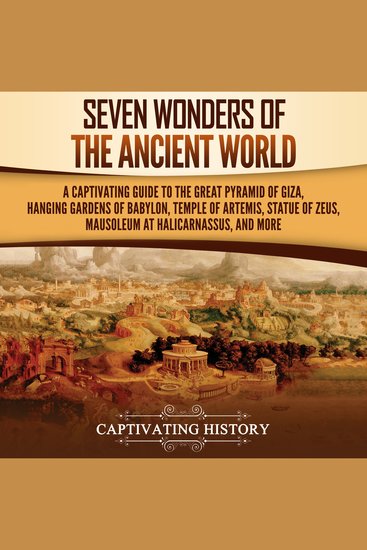
  • Seven Wonders of the Ancient World: A Captivating Guide to the Great Pyramid of Giza Hanging Gardens of Babylon Temple of Artemis Statue of Zeus Mausoleum at Halicarnassus and More - cover

    Seven Wonders of the Ancient...

    Captivating History

    • 0
    • 0
    • 0
    You probably have heard of the Seven Wonders of the Ancient World. But how much do you really know about it? 
    The ancient world was home to some of the greatest civilizations in history. The Egyptians, the Greeks, the Babylonians, and others wanted to leave their mark on history so others would remember their greatness. And what better way to explore that greatness than to examine some of the greatest wonders the world has ever known? 
    Most people can list a few of the wonders of the top of their head. But few know that the Hanging Gardens of Babylon might never have existed or that the remains of the Mausoleum of Halicarnassus were used by the Knights Hospitaller. 
    This audiobook uncovers the history behind the Seven Wonders of the Ancient World in easy-to-read language. Your eyes will be open to a new side of history after reading this introductory guide! 
    In this audiobook, you will learn the answers to the following questions:How many of the wonders are still around today?Were all of these wonders actually real, or are they more mythical in nature?Why were these wonders built in the first place?What happened to them? Did they fall apart over time, or did something catastrophic happen?How big do historians think these wonders were?And so much more! 
    Scroll up and click the “add to cart” button to begin learning about the amazing background of the Seven Wonders of the Ancient World!
    Show book
  • The Traumatic Stress Recovery Workbook - 40 Brain-Changing Techniques You Can Use Right Now to Treat Symptoms of PTSD and Start Feeling Better - cover

    The Traumatic Stress Recovery...

    PsyD Jennifer Sweeton

    • 0
    • 0
    • 0
    If you've experienced trauma, you may feel emotionally numb. You may have moments where you can't "calm down," or get to sleep. You might replay the traumatic event over in your mind.  And you may even isolate yourself from others. You should know that you are not alone. Many people will live through a potentially traumatic event at some point in their lives, and some will even develop symptoms of post-traumatic stress disorder (PTSD). If you're struggling with symptoms, you need effective relief—right now. This workbook can help you find it. 


    In The Traumatic Stress Recovery Workbook, trauma and neuroscience expert Jennifer Sweeton provides forty brain-changing techniques for overcoming PTSD that you can begin using right away to build resilience, boost self-confidence, and develop self-efficacy. You'll learn what happens in your brain after experiencing trauma, and why it reacts in ways that cause even more distress. You'll also discover evidence-based strategies grounded in cutting-edge neuroscience to manage psychological and physical—or somatic—symptoms—so you can get back to your life. 


    Using the practical and integrative approach in this workbook, you can address symptoms at your own pace. And by making small lifestyle changes, you'll carve new neural pathways in your brain and jump-start the healing process.
    Show book
  • Voyagers - Biographies about Ernest Shackleton Marco Polo the Pilgrims and Vasco de Gama (4 in 1) - cover

    Voyagers - Biographies about...

    Kelly Mass

    • 0
    • 0
    • 0
    This book consists of 4 books that are about the following topics: 
    Ernest Shackleton - Sir Ernest Henry Shackleton was an Anglo-Irish polar explorer whose remarkable journeys cemented his place among the most important figures of the Heroic Age of Antarctic Exploration. Shackleton's story is one of daring, leadership, and resilience, traits that made him a legendary figure in the annals of exploration. 
    Marco Polo - Marco Emilio Polo, born in Venice, was a Venetian merchant, explorer, and writer who became renowned for his extraordinary travels across Asia between 1271 and 1295. His journey, which spanned much of the Silk Road, was chronicled in The Travels of Marco Polo, also known as Book of the Marvels of the World and Il Milione (circa 1300). 
    The Pilgrims - The Pilgrims, also known as the Pilgrim Fathers, were a group of English settlers who made the historic journey across the Atlantic on the Mayflower and founded the Plymouth Colony in what is now Plymouth, Massachusetts. The colony was named after the port of Plymouth in England, which had been the final departure point for their voyage. The Pilgrims were part of a religious movement rooted in the Puritan faith, but with distinct beliefs that set them apart from other Puritans at the time. 
    Vasco da Gama - Vasco da Gama, the 1st Count of Vidigueira, is widely celebrated as the first European to reach India by sea. His landmark journey, which took place from 1497 to 1499, was groundbreaking in that it provided the first direct oceanic connection between Europe and Asia. By navigating around the Cape of Good Hope, located at the southern tip of Africa, da Gama linked the Atlantic and Indian Oceans for the first time, thereby bridging the Western world and the Eastern world. This achievement is considered a pivotal moment in history, marking the beginning of an era of global exploration and the rise of maritime multiculturalism.
    Show book