Join us on a literary world trip!
Add this book to bookshelf
Grey
Write a new comment Default profile 50px
Grey
Subscribe to read the full book or read the first pages for free!
All characters reduced
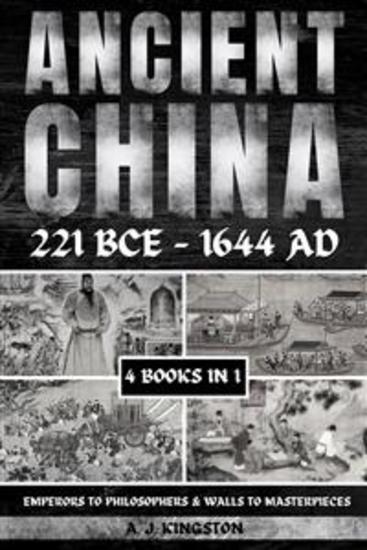
Ancient China 221 BCE - 1644 AD - Emperors To Philosophers & Walls To Masterpieces - cover

Ancient China 221 BCE - 1644 AD - Emperors To Philosophers & Walls To Masterpieces

A.J. A.J.Kingston

Publisher: A.J.Kingston

  • 0
  • 0
  • 0

Summary

Uncover the Majesty of Ancient China: Emperors to Philosophers & Walls to Masterpieces
Are you ready to embark on a captivating journey through the heart of Ancient China, a civilization that spans over two millennia? Introducing our exclusive book bundle, "Ancient China 221 BCE - 1644 AD: Emperors to Philosophers & Walls to Masterpieces." This carefully curated collection consists of four mesmerizing volumes that will transport you to a world of emperors, philosophers, engineering marvels, and artistic treasures.
Book 1 - Emperors of the Silk Road: Ancient China's Dynastic Saga (221 BCE - 220 CE): Dive into the epic dynastic saga of Ancient China, from the visionary Qin Shi Huang's unification of warring states to the golden era of the Han Dynasty. Witness the rise and fall of emperors, the expansion of territories, and the intricate dance of power and diplomacy along the Silk Road.
Book 2 - Confucianism: The Moral Compass of Ancient China (551 BCE - 479 BCE): Enter the realm of philosophy and ethics as we explore the teachings of Confucius, the sage whose moral compass guided generations. Discover the profound impact of Confucianism on Chinese culture, governance, and the intricate web of human relationships.
Book 3 - The Great Wall: Engineering Marvel of Ancient China (7th Century BC - 17th Century AD): Journey through time and explore one of the world's most iconic engineering feats—the Great Wall of China. Trace its evolution from early defensive structures to the monumental wonder that spans centuries, offering insights into the challenges faced by its builders and the significance of its existence.
Book 4 - Ming Dynasty Treasures: Art and Culture in Ancient China (1368 - 1644): Immerse yourself in the opulent world of the Ming Dynasty, where art, culture, and craftsmanship thrived. Witness the creation of exquisite blue and white porcelain, stroll through magnificent imperial gardens, and delve into a cultural renaissance that continues to captivate hearts.
This book bundle weaves together the grand tapestry of Ancient China, where emperors, philosophers, engineers, and artists collectively crafted a civilization that transcends time. It's a civilization that left an indelible mark on the world, shaping the course of humanity.
Join us on this extraordinary odyssey through Ancient China—a journey through time and imagination that awaits your discovery. Whether you're a history enthusiast, an admirer of philosophical wisdom, an engineering aficionado, or an art connoisseur, this bundle promises an immersive experience like no other.
Don't miss the opportunity to uncover the majesty of Ancient China. Get your hands on this exclusive book bundle today and embark on an adventure through empires, ethics, walls, and masterpieces.
 
Available since: 09/27/2023.

Other books that might interest you

  • The Life of Ancient Romans - cover

    The Life of Ancient Romans

    Francis Caputo

    • 0
    • 0
    • 0
    In 27 BC, when Augustus turned into the first sovereign of the Roman Empire, introducing the supreme period, the country he governed was more than 700 years of age. Rome's rulers had controlled an immense region that stretched out into northern Europe, parts of Africa, and Asia for quite a long time. The city of Rome was the most delightful and refined on the planet. It was filled with parks and gardens, marble curves and sculptures, lavish royal residences, immense amphitheaters, and rambling colleges. All were connected by an unpredictable organization of streets furthermore water-bearing reservoir conduits. Rome was a focal point of world culture as the capital of the most impressive country on Earth. By AD 98, majestic Rome arrived at its most extreme size, becoming the most significant realm ever. The vast domain contained around 60 million individuals, or around one-fourth of Earth's populace. Romans, who spoke Latin, alluded to their properties as the imperium sine fine, or "domain without end." The realm extended through the advanced countries of Spain, France, England, Netherlands, and Germany. It incorporated quite a bit of eastern Europe, including Slovenia, Romania, Armenia, and what's more, Croatia. The domain without end spread across North Africa from Morocco to Egypt and east into Turkey, Syria, and Iraq. Every one of the regions was joined under the Roman principle, wherever the official language was Latin. All over the place, installments were made in sestertii (Roman brass coins). All over, there was just a single law: Roman law.Most Roman subjects lived in separated ancestral networks where life had changed minimally in millennia. Provincial Romans chased, fished, developed small harvests, and tended domesticated animals. During the royal period, London and Paris were minimal more than a few military stations with less than 8,000 individuals. A considerable lot of the inhabitants were Roman officers called legionnaires. In any case, the realm a
    Show book
  • The Dangerous Life and Ideas of Diogenes The Cynic - cover

    The Dangerous Life and Ideas of...

    Jean-Manuel Roubineau

    • 0
    • 0
    • 0
    The ancient philosopher Diogenes—nicknamed "The Dog" and decried by Plato as a "Socrates gone mad"—was widely praised and idealized as much as he was mocked and vilified. A favorite subject of sculptors and painters since the Renaissance, his notoriety is equally due to his eccentric behavior, scorn of conventions, and biting aphorisms, and to the role he played in the creation of the Cynic school, which flourished from the 4th century B.C. to the Christian era. Jean-Manuel Roubineau paints a new portrait of an atypical philosopher whose life left an indelible mark on the Western collective imagination and whose philosophy courses through various schools of thought well beyond antiquity. 


    Roubineau sifts through the many legends and apocryphal stories that surround the life of Diogenes. Was he a counterfeiter? Did he meet Alexander the Great? Was he an apologist for incest, patricide, and anthropophagy? How did he actually die? Roubineau retraces the known facts of Diogenes' existence. 


    Beyond the rehashed clichés, this book inspires us to rediscover Diogenes' philosophical legacy—whether it be the challenge to the established order, the detachment from materialism, the choice of a return to nature, or the formulation of a cosmopolitan ideal strongly rooted in the belief that virtue is better revealed in action than in theory.
    Show book
  • Churchill's D-Day - The British Bulldog’s Fateful Hours During the Normandy Invasion - cover

    Churchill's D-Day - The British...

    General Sir Richard Dannatt,...

    • 0
    • 0
    • 0
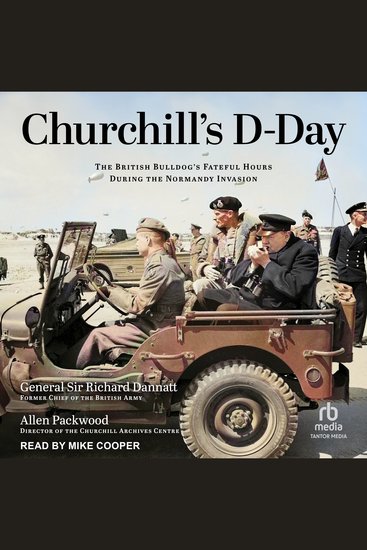
    In Churchill's D-Day, Allen Packwood and Richard Dannatt narrate and analyze Sir Winston Churchill's emotional turmoil and epic decision-making before, during, and after the world-defining action of D-Day. Culled from the official Churchill Papers at the Churchill Archives Centre, the book features historical documents, letters, and more, for a Churchillian experience of D-Day leadership, military strategy, and humanity. 


    As dawn breaks on June 6th, 1944, the landings from the greatest armada of ships ever assembled begins at 0630hrs. Overnight paratroopers from the British 6th Airborne Division secure the eastern flank of the landing zone with the U.S. 82nd and 101st Airborne Division securing the western flank to reduce the risk of German counter attacks. 


    While Churchill is aware of the huge responsibility he bears for the British soldiers and French civilians, no one else in the world is aware of the conversations, innermost thoughts, deliberations, and decisions he's been making and will continue to make on this day. 


    Churchill's D-Day provides an unprecedented opportunity for listeners to experience the Invasion of Normandy as the British Bulldog experienced it himself.
    Show book
  • Express yourself & heal your inner child Coaching Session & Meditations No more guilt & shame - inner child healing be your childlike self open creative portal soul integration speaking up - cover

    Express yourself & heal your...

    LoveAndBloom

    • 0
    • 0
    • 0
    When you were a child, you are not afraid to express your emotions & creativity. You do not afraid to speak up and sing “awfully” or draw “ugly pictures”. As time passes by, limiting thoughts beliefs, and childhood traumas may hinder your ability to express yourself and be creative. 
    The inner child is an expression of your inner creative self. No matter how old you are, the little inner child resides in your heart. He or she wants to play and have fun. There is no limitation, shame, or guilt to expressing your creativity and emotions. 
    In this course, we willRelease any guilt in expressing yourselfHeal your shameDeeply accept who you areIntegrate all parts of yourselfConnect to your inner childUnleash your creative selfAffirm your loving qualitiesRaise your self-esteemAnd much more 
    It is time for you to start loving yourself to express your deepest lovable self
    Show book
  • Ratels on the Lomba - The Story of Charlie Squadron - cover

    Ratels on the Lomba - The Story...

    Leopold Scholtz

    • 0
    • 0
    • 0
    “We destroyed a whole enemy brigade (47 Brigade) on the Lomba. History will prove it to be one of the most glorious and successful actions that South African forces ever took part in.” – General Jannie Geldenhuys, as quoted in Cuito Cuanavale 
     
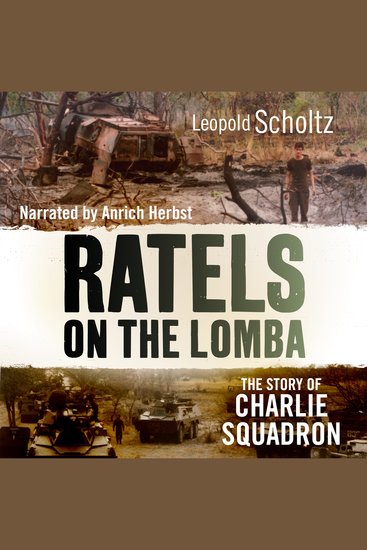
    On 3 October 1987 Charlie Squadron – the iron fist of 61 Mechanised Battalion Group – led the way in a decisive battle on the Lomba River in southern Angola, as part of the South African Defence Force’s Operation Moduler.  
    Although SADF tactical doctrine dictated that the tanks of the Angolan 47 Brigade be countered with tanks, the young conscripts of Charlie Squadron were forced to face their enemy in vastly inferior Ratels, significantly handicapped by the vehicles’ thin armour and low-velocity guns. Not only were they facing a force far superior in terms of weaponry, but they were also hugely outnumbered and had to deal with terrain so dense that their sight was severely impaired and their movement restricted. 
    Through interviews with veterans of the battle and diary entries from the time, Leopold Scholtz recreates the drama of this David vs Goliath battle, taking the reader straight to the heart of the action. A deeply human story, Ratels on the Lomba tells of how individuals react in the face of death, and reveals how the war never left these men, not even when they returned home.
    Show book
  • History for Kids: Sacagawea and the Lewis & Clark Expedition - cover

    History for Kids: Sacagawea and...

    Editors Charles River

    • 0
    • 0
    • 0
    *Perfect for ages 7-10 
    In Charles River Editors’ History for Kids series, your children can learn about history’s most important people and events in an easy, entertaining, and educational way. Pictures help bring the story to life, and the concise but comprehensive book will keep your kid’s attention all the way to the end. 
    It is the most fabled and storied journey in American history. From 1804-1806, the first expedition across the North American continent was commissioned by President Thomas Jefferson, who had recently bought a vast swath of territory from France. Though he knew he had bought a huge amount of land, Jefferson wasn’t entirely sure of what he had bought, so he asked a team led by Meriwether Lewis and William Clark to traverse the continent until they reached the Pacific, studying everything from the ecology to geography along the way to get an understanding of the country’s new region. 
    Lewis and Clark would find far more than they bargained for. The 33 members who made the trip came into contact with about two dozen Native American tribes, many of whom helped the men survive the journey. Though they suffered deaths on their way west, the group ultimately reached the Pacific coast and got back to St. Louis in 1806, having drawn up nearly 150 maps and giving America a good idea of much of what lay west. 
    As a young woman who was married to a French trapper from Quebec, Sacagawea happened to be in the right place at the right time for the legendary Lewis and Clark expedition, which set off for the Pacific coast after President Thomas Jefferson negotiated the Louisiana Purchase with France. The young Shoshone girl acted as a guide and interpreter for the expedition, helping it safely travel thousands of miles west from North Dakota to the Pacific over unfamiliar ground and amongst unfamiliar peoples. Put simply, the expedition could not have succeeded without her.
    Show book