Join us on a literary world trip!
Add this book to bookshelf
Grey
Write a new comment Default profile 50px
Grey
Subscribe to read the full book or read the first pages for free!
All characters reduced
Recyclable Car Materials - cover

Recyclable Car Materials

Aiden Feynman

Translator A AI

Publisher: Publifye

  • 0
  • 0
  • 0

Summary

Recyclable Car Materials explores the shift toward sustainable automotive manufacturing, driven by environmental concerns and the need for a circular economy. The book examines how car manufacturers are increasingly using recycled plastics and plant-based materials to reduce the environmental impact of vehicles. It highlights the transformation required in material science, supply chains, and manufacturing processes to support this shift. The book uniquely analyzes the entire value chain, from material sourcing to vehicle recycling, offering a solutions-oriented approach. One key insight is the economic viability of sustainable practices, challenging the traditional reliance on non-renewable resources. The book addresses the ongoing debate between material performance, cost, and environmental impact, presenting evidence from various perspectives, and emphasizes the role of recycling in the automotive industry. Structured in three parts, the book begins with fundamental concepts, then examines case studies of successful implementations, and concludes with broader implications. It connects to fields like environmental science and economics, providing a holistic view for automotive engineers, policymakers, and anyone interested in the future of the green automotive industry.
Available since: 03/12/2025.
Print length: 95 pages.

Other books that might interest you

  • Stop Fear of Heights Sleep Hypnosis Meditation - cover

    Stop Fear of Heights Sleep...

    Harmooni

    • 0
    • 0
    • 0
    Are you tired of missing out on breathtaking views and thrilling experiences because your fear of heights keeps you grounded? Do you find yourself wondering if there's a way to conquer your vertigo and embrace the world from new heights? Can you envision a future where you confidently stand atop mountains, gaze down from skyscrapers, and explore elevated vistas without a hint of fear? 
    The path to overcoming your fear of heights and unlocking a world of adventure begins with the Stop Fear of Heights Sleep Hypnosis Meditation. 
    Can you picture a night where you peacefully drift into a deep slumber, leaving behind the fear and anxiety that heights trigger? This transformative audio book is meticulously crafted to guide you into a state of profound relaxation, allowing you to reprogram your subconscious mind to respond to heights with calm and courage. 
    Say farewell to the sweaty palms, racing heart, and paralyzing fear, and welcome a future where you stand tall and fearless in the face of elevation. This audio book isn't just a guide; it's your companion on the path to a life unburdened by fear. 
    As you embark on this journey, you'll gain the tools to manage anxiety, boost self-confidence, and embrace the world from new perspectives. Imagine a future where you relish the thrill of heights, exploring the world's beauty with unshakable confidence. 
    The Stop Fear of Heights Sleep Hypnosis Meditation is your ticket to a life free from the limitations of acrophobia. Don't let your fear of heights keep you earthbound any longer – take the first step toward fearless elevation tonight.
    Show book
  • But Whose Fault? - The AK-47 Found - cover

    But Whose Fault? - The AK-47 Found

    AMOS ASEMONE

    • 0
    • 0
    • 0
    Do you keep an eye on world events through mainstream media? If so, chances are you have missed out on many essential news stories from countries around the world. 
    While many news outlets will cover European, U.K., and U.S. news in great detail, they often leave out essential news from other continents, especially Africa. 
    And yet, that doesn’t mean that newsworthy events occur there every day, just like in the UK. 
    In fact, some of the most newsworthy stories have occurred in Africa in recent years. 
    If you want to learn more about the conflicts of African communities, you have come to the right place. 
    Introducing, But, Whose Fault? Part One, a true story based in Ghana, where two AK-47s mysteriously vanished before reappearing without ammunition. 
    Not only does this book shed light on an incident that is still to be answered to this day, but it also highlights one of the many conflicts that African communities go through and are never displayed on the big screen. 
    In many ways, the conflict surrounding the missing rifles is a point of convergence of the exploitation of Africa and the negligence shown toward the local people and their value to the world. 
    It is one of the main reasons it continues to go unnoticed in many countries, yet it is a story that must be told. 
    Inside, But, Whose Fault? Part One, discover: 
    ●	essential background information about the local people and community 
    ●	the political context behind the events that unfolded 
    ●	the initial factors that influenced the confrontation 
    ●	the company behind the Nguvu mining project 
    ●	the disappearance, search, and fallout from the missing rifles 
    If you are at all interested in the rich history and real-life stories of Africa, this book is a must-read. 
    Grab a copy of But, Whose Fault? Part One today!
    Show book
  • The Fantastic Book of Chemistry Jokes: - For Everyone not Just Chemists - cover

    The Fantastic Book of Chemistry...

    Shane Van

    • 0
    • 0
    • 0
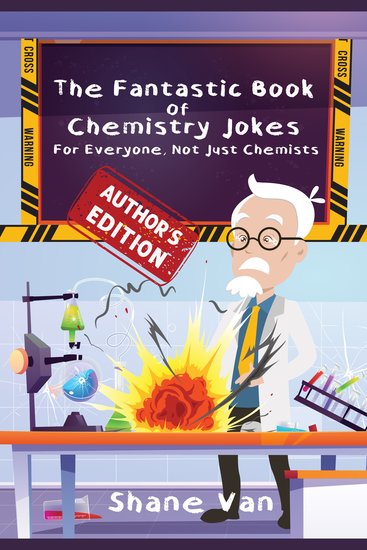
    Welcome, welcome! With so many people slapping their neon The Fantastic Book of Chemistry Jokes, this author’s edition has been released. No matter your understanding of chemistry, I am sure you'll get a reaction, because the jokes within, are sodium funny. These jokes have been accumulated through years of interactions with fellow scientists and teachers and lots of drinking in strange bars late at night. A word of caution must be had, some jokes are innocent, and some are rude & lewd, but none are meant to offend. As studies have shown, the darker your sense of humour, the more intelligent you are. With that being said, sit back, put your feet up and wait for the nerdy fluorine, uranium, nitrogen-filled laughs to tickle your fancy. 
    “Chemistry can be a good and bad thing. Chemistry is good when you make love with it. Chemistry is bad when you make crack with it.” 
    -Adam Sandler
    Show book
  • Harnessing Off-Grid Solar Power - Sustainable Solutions for Remote Areas - cover

    Harnessing Off-Grid Solar Power...

    Jackson Brooks

    • 0
    • 0
    • 0
    "Harnessing Off-Grid Solar Power: Sustainable Solutions for Remote Areas" is a must-read for anyone who wants to use solar energy in areas that are hard to reach or don't have access. This book thoroughly examines how solar power can be used effectively in places where regular grid links aren't possible or aren't available. It goes over the whole process, from evaluating the spot to installing, maintaining, and managing off-grid solar systems for a long time. 
    Readers will learn about the main parts of solar technology, like solar panels, batteries, and inverters, and how to put them together in a way that works in remote areas through detailed descriptions and useful tips. The book talks about the money side of solar projects, including how to analyze costs, make budgets, and determine the return on investment. This helps people make smart choices and get the most out of their investments. 
    "Harnessing Off-Grid Solar Power" is a useful book for people who plan energy use, lead communities, or are interested in finding green energy solutions. It gives people the skills and information they need to use solar power successfully, which helps remote areas move toward cleaner, more reliable energy systems.
    Show book
  • The Tech Coup - How to Save Democracy from Silicon Valley - cover

    The Tech Coup - How to Save...

    Marietje Schaake

    • 0
    • 0
    • 0
    Under the cover of "innovation," technology companies have successfully resisted regulation and have even begun to seize power from governments themselves. Facial recognition firms track citizens for police surveillance. Cryptocurrency has wiped out the savings of millions and threatens the stability of the global financial system. Spyware companies sell intelligence tools to anyone who can afford them. This new reality—where unregulated technology has become a forceful instrument for autocrats worldwide—is terrible news for democracies and citizens. 


    In The Tech Coup, Marietje Schaake explains how technology companies crept into nearly every corner of our lives and our governments. She takes us beyond the headlines to high-stakes meetings with human rights defenders, business leaders, computer scientists, and politicians to show how technologies have gone from being heralded as utopian to undermining the pillars of our democracies. To reverse this existential power imbalance, Schaake outlines solutions to empower elected officials and citizens alike. Democratic leaders can—and must—resist the influence of corporate lobbying and reinvent themselves as dynamic, flexible guardians of our digital world. Schaake offers a frightening look at our modern tech-obsessed world—and a clear-eyed view of how democracies can build a better future before it is too late.
    Show book
  • Introduction to Quantum Mechanics - Basic Principles and Applications - cover

    Introduction to Quantum...

    Mark Hedges

    • 0
    • 0
    • 0
    Quantum mechanics arose in the early 20th century to explain phenomena that classical physics could not. Observations at the atomic scale revealed that matter and energy exhibit discrete and probabilistic behaviors, leading to the development of a new theoretical framework. The necessity for quantum mechanics became evident through several key experiments and discoveries. 
    One of the earliest quantum breakthroughs came from Max Planck’s study of blackbody radiation. Classical physics predicted an infinite energy output at short wavelengths, known as the ultraviolet catastrophe. Planck resolved this by proposing that energy is emitted in discrete packets called quanta, introducing the idea that energy levels are not continuous. This marked the birth of quantum theory. 
    Albert Einstein extended this concept with his explanation of the photoelectric effect, where light ejects electrons from a metal surface. Classical wave theory could not explain why light below a certain frequency fails to release electrons, regardless of intensity. Einstein proposed that light consists of photons, with energy proportional to their frequency. This established the particle-like nature of light and won him the Nobel Prize in 1921. 
    Louis de Broglie later proposed wave-particle duality, suggesting that particles like electrons also behave as waves. His hypothesis was experimentally confirmed by the Davisson-Germer experiment, which demonstrated electron diffraction. This showed that matter exhibits both wave and particle properties, depending on how it is measured.
    Show book