Join us on a literary world trip!
Add this book to bookshelf
Grey
Write a new comment Default profile 50px
Grey
Subscribe to read the full book or read the first pages for free!
All characters reduced
Codebreakers War - cover

Codebreakers War

Aiden Feynman

Translator A AI

Publisher: Publifye

  • 0
  • 0
  • 0

Summary

"Codebreakers War" explores the pivotal role of cryptography and codebreaking during World War II, highlighting how the Allies' decryption efforts significantly influenced the war's trajectory. Readers will discover how the ability to decipher enemy communications, especially the Enigma and Lorenz ciphers, provided a decisive advantage in military strategy and intelligence gathering.

 
The book emphasizes the evolution of encryption technologies used by the Axis powers and the corresponding development of codebreaking techniques by the Allies, showcasing the blend of technology and intellect that became crucial in modern warfare. The book progresses from an introduction to cryptography's basic principles to an in-depth look at Bletchley Park and the contributions of figures like Alan Turing.

 
By using intercepted messages and historical records, "Codebreakers War" connects military history with technology and mathematics, offering a balanced view of the codebreaking war, acknowledging both successes and failures. Readers gain insight into how the Allied codebreaking efforts, particularly in cracking the German Enigma and Lorenz ciphers, shortened the conflict and altered its course.

 
The book culminates in an analysis of the strategic and tactical impact of codebreaking in major battles.
Available since: 02/17/2025.
Print length: 64 pages.


Other books that might interest you

  • The Spiritual Enlightenment of an Engineer - cover

    The Spiritual Enlightenment of...

    Martin K. Ettington

    • 0
    • 0
    • 0
    I’ve written quite a few books about spirituality and my experiences and beliefs in our abilities to expand our consciousness through spiritual development practices, meditation, and the paranormal.This book includes my experiences with paranormal abilities acquired from the spiritual development process and different enlightenment experiences.Having been raised in a technical family and gone to engineering school my perspective is pretty unique since I developed both traditional technical knowledge of the world while I was also going through the spiritual development and enlightenment process.There are many engineers and scientists who are also religious but I’ve found that technical people who are as deeply into spiritual enlightenment practices and paranormal experiences are pretty rare.What I’ve found is that this dual background has given me more clarity about the world we live in and better objectivity in many cases regarding strange or unusual phenomena.The theme of this book is to review how I went through this dual track system of learning in my life to become both a traditional engineer and to have fairly adept knowledge of spiritual and paranormal experiences.
    Show book
  • Africa Is Not a Country - Notes on a Bright Continent - cover

    Africa Is Not a Country - Notes...

    Dipo Faloyin

    • 0
    • 0
    • 0
    So often, Africa has been depicted simplistically as a uniform land of famines and safaris, poverty and strife, stripped of all nuance. In this bold and insightful book, Dipo Faloyin offers a much-needed corrective, weaving a vibrant tapestry of stories that bring to life Africa's rich diversity, communities, and histories. 


    Starting with an immersive description of the lively and complex urban life of Lagos, Faloyin unearths surprising truths about many African countries' colonial heritage and tells the story of the continent's struggles with democracy through seven dictatorships. With biting wit, he takes on the phenomenon of the white savior complex and brings to light the damage caused by charity campaigns of the past decades. Entering into the rivalries that energize the continent, Faloyin engages in the heated debate over which West African country makes the best jollof rice and describes the strange, incongruent beauty of the African Cup of Nations. With an eye toward the future promise of the continent, he explores the youth-led cultural and political movements that are defining and reimagining Africa on their own terms. 


    Africa Is Not a Country celebrates the energy and particularity of the continent's different cultures and communities, treating Africa with the respect it deserves.
    Show book
  • Christmas Truce - A History from Beginning to End - cover

    Christmas Truce - A History from...

    Hourly History

    • 0
    • 0
    • 0
    When World War I began in August 1914, the British confidently predicted that it would be "over by Christmas." In Berlin, Kaiser Wilhelm II told his soldiers that they would be "home before the leaves fall." But by late December, it was clear not only that the war was far from over, but also that this would be a more destructive and deadly conflict than any that had come before. 
    On the Western Front, British troops faced the Germans across two opposing lines of trenches. Almost two million troops had been killed or wounded, and men on both sides became resigned to living in muddy trenches under almost unimaginable circumstances made even more desperate by the bitter cold of winter. Notions of war as an adventure—or even as a brief escape from the mundane reality of day-to-day life—were replaced by the reality of almost unendurable horror with no end in sight. 
    Then, on Christmas Eve 1914, British troops saw strange lights appearing in the German positions opposite. Bracing for an attack, they instead heard an unfamiliar sound drifting across No-Man's Land. German troops were singing a Christmas carol, "Stille nacht, heilige nacht" (“Silent Night”), and the lights in the German trenches were improvised Christmas decorations. Thus began one of the strangest stories from World War I: the Christmas Truce of 1914.
    Show book
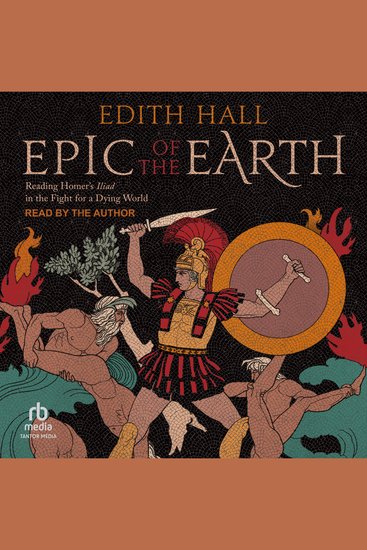
  • Epic of the Earth - Reading Homer's "Iliad" in the Fight for a Dying World - cover

    Epic of the Earth - Reading...

    Edith Hall

    • 0
    • 0
    • 0
    The roots of today's environmental catastrophe run deep into humanity's past. Through this unprecedented reading of Homer's Iliad, the award-winning classicist Edith Hall examines how this foundational text both documents the environmental practices of the ancient Greeks and betrays an awareness of the dangers posed by the destruction of the natural landscape. Underlying Homer's account of brutal military operations, alliances, and cataclysmic struggle is a palpable understanding that the direction in which humanity was headed could create a world that was uninhabitable. 


    Hall provides unparalleled insight into the ancient origins of climate change and argues that the Iliad exposes the deepest contradictions behind the environmental problems we have created. Indeed, it is possible that some of the violence done to the environment throughout history has been authorized, if not exacerbated, by the celebration of the exploitation of nature in Homer's poem. Drawing compelling analogies to contemporary poetry, literature, and film, Hall demonstrates that the Iliad, as a priceless document of the mindset of early humans, can help us understand the long history of ecological degradation and inspire activism to rescue our planet from disaster.
    Show book
  • End of World War II in Europe The: The History of the Final Campaigns that Led to Nazi Germany’s Surrender - cover

    End of World War II in Europe...

    Editors Charles River

    • 0
    • 0
    • 0
    After the successful amphibious invasion on D-Day in June 1944, the Allies began racing east toward Germany and liberating France along the way. It was Hitler’s belief that by splitting the Allied march across Europe in their drive toward Germany, he could cause the collapse of the enemy armies and cut off their supply lines. Part of Hitler’s confidence came as a result of underestimating American resolve, but with the Soviets racing toward Berlin from the east, this final offensive would truly be the last gasp of the German war machine, and the month long campaign was fought over a large area of the Ardennes Forest, through France, Belgium and parts of Luxembourg. From an Allied point of view, the operations were commonly referred to as the Ardennes Offensive, while the German code phrase for the operation was Unternehmen Wacht am Rhein (“Operation Watch on the Rhine”), with the initial breakout going under the name of “Operation Mist.” Today, Americans know it best as the Battle of the Bulge. 
    After resisting the German attack, the Allied armies began advancing, and with that, the race to Berlin was truly on. In April 1945, the Allies were within sight of the German capital of Berlin, but Hitler refused to acknowledge the collapsed state of the German military effort even at this desperate stage, and he confined himself to his Berlin bunker where he met for prolonged periods only with those that professed eternal loyalty, even to the point of death. In his last weeks, Hitler continued to blame the incompetence of military officers for Germany’s apparent failings, and he even blamed the German people themselves for a lack of spirit and strength. As their leader dwelled in a state of self-pity, without remorse or mercy but near suicide, the people of Berlin were simply left to await their fate as Russians advanced from the east and the other Allies advanced from the west.
    Show book
  • Willem Jansz: A short biography - 5 Minutes: Short on time – long on info! - cover

    Willem Jansz: A short biography...

    5 Minutes, 5 Minute Biographies,...

    • 0
    • 0
    • 0
    Willem Jansz, Dutch explorer and discoverer of Australia: Life and work in a short biography! Everything you need to know, brief and concise. Infotainment, education and entertainment at its best!
    Show book