Join us on a literary world trip!
Add this book to bookshelf
Grey
Write a new comment Default profile 50px
Grey
Subscribe to read the full book or read the first pages for free!
All characters reduced
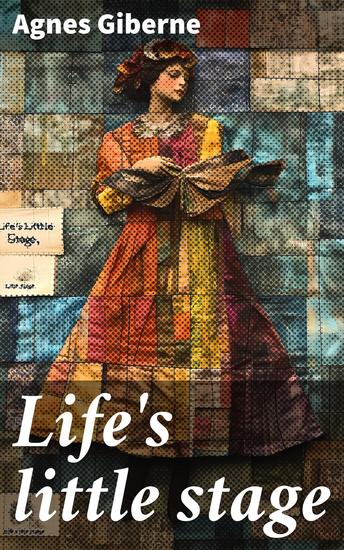
Life's little stage - cover

Life's little stage

Agnes Giberne

Publisher: Good Press

  • 0
  • 0
  • 0

Summary

In "Life's Little Stage," Agnes Giberne artfully navigates the intricacies of human experience through a tapestry of poignant narratives and reflective prose. Constructed as a series of vignettes, the book captures moments of joy, sorrow, and introspection, weaving together themes of family, society, and the passage of time. Giberne's eloquent yet accessible literary style draws upon the Victorian discourse, blending philosophical musings with the intricacies of personal stories, thus situating the work within the broader context of 19th-century literature that often grappled with the interplay of individualism and communal values. Agnes Giberne, a prolific author of her time, was deeply influenced by her background and the social climate of the late 19th century. Raised in an intellectually stimulating environment, she was exposed to a range of philosophical and literary ideas that undoubtedly shaped her nuanced perspectives on life. Giberne's engagement with both scientific thought and spiritual inquiries informs her work, allowing her to address universal themes in a compassionate and insightful manner. "Life's Little Stage" warrants a place on every reader's shelf for its profound exploration of life's complexities. It invites readers to reflect on their own experiences while encouraging empathy and understanding within the shared human narrative. Those seeking introspective literature that resonates on both emotional and intellectual levels will find Giberne's work a captivating journey.
Available since: 03/02/2025.
Print length: 200 pages.

Other books that might interest you

  • Above Ground - cover

    Above Ground

    Clint Smith

    • 0
    • 0
    • 0
    A New York Times bestselling poetry collection from Clint Smith, author of #1 bestseller and National Book Critics Circle Award winner How the Word Is Passed.  "A joyful embrace and legacy of bright language and poignant questions." —Aimee Nezhukumatathil, author of World of Wonders Clint Smith’s vibrant and compelling new collection traverses the vast emotional terrain of fatherhood, and explores how becoming a parent has recalibrated his sense of the world. There are poems that interrogate the ways our lives are shaped by both personal lineages and historical institutions. There are poems that revel in the wonder of discovering the world anew through the eyes of your children, as they discover it for the first time. There are poems that meditate on what it means to raise a family in a world filled with constant social and political tumult. Above Ground wrestles with how we hold wonder and despair in the same hands, how we carry intimate moments of joy and a collective sense of mourning in the same body. Smith’s lyrical, narrative poems bring the reader on a journey not only through the early years of his children’s lives, but through the changing world in which they are growing up—through the changing world of which we are all a part.Above Ground is a breathtaking collection that follows Smith's first award-winning book of poetry, Counting Descent. A Best Book of the Year 2023: TIME • NPR’s Best Books • New York Public Library • Electric Lit • The Root • NBC Today • Mother Jones
    Show book
  • A Piece of Work - cover

    A Piece of Work

    Felix Samual

    • 0
    • 0
    • 0
    a young woman's visit to a successful artist's gallery gets rather strange
    Show book
  • The Poetry of James Russell Lowell - Harvard graduate Lowell was one of the most prominent poets of the American Romantic movement he chose to use poetry for both beauty and social causes mainly abolishing slavery - cover

    The Poetry of James Russell...

    James Russell Lowell

    • 0
    • 0
    • 0
    James Russell Lowell was born on 22nd February 1819 in Cambridge, Massachusetts. 
     
    Lowell graduated from Harvard in 1838, and thence on to earn a law degree from Harvard Law School.  
     
    His literary life began in 1841 with his first published collection of poetry.  Three years later he married Maria White and they had several children although, sadly, only one was to survive childhood. 
     
    A consuming issue at the time was the abolition of slavery.  Lowell was a staunch supporter even going so far as to move to Philadelphia to edit an abolitionist newspaper.  His poems were fully in support of Emancipation and the ending of this terrible abomination.  His later views were milder and came in for some criticism.  
     
    His publication in 1848 of the long poem ‘A Fable for Critics’, satirising the poets and critics of the then current poetry scene caused an uproar.  That same year came ‘The Biglow Papers’, which increased his fame and his finances.  His use of the Yankee accent in his character’s dialogue was an inspiration for many. 
     
    Maria died in 1853 and Lowell decided to travel to Europe for some time before returning to Harvard to take up a professorship of languages.   In 1857 he re-married and also took on the editorship of that key periodical ‘The Atlantic Monthly’ whilst continuing to teach at Harvard. 
     
    Lowell wrote and published poetry and essay collections throughout his literary career and is acknowledged as one of the ‘Fireside Poets’, a group of New England poets that rivalled the popularity of British poets.  Their work was not controversial and suitable for whole families to enjoy hence their name and appeal.  Whilst Lowell’s own work does not now attract the same praise as his then contemporaries, he was their equal. 
     
    Towards the end of his life Lowell was appointed as ambassador to the Kingdom of Spain and later to the Court of St. James's.  
     
    His last years were a return home to his estate in Cambridge, Massachusetts.  By the summer of 1891 doctors had diagnosed cancer in his kidneys, liver and lungs.  There was nothing that they could do except prescribe opium for the pain. 
     
    James Russell Lowell died on the 12th of August 1891 on the Cambridge estate where he was also born.  He was 72. 
     
    01 - The Poetry of James Russell Lowell - An Introduction 
    02 - Columbus by James Russell Lowell 
    03 - George Washington by James Russell Lowell 
    04 - Abraham Lincoln by James Russell Lowell 
    05 - To H W L on His Birthday 27th February 1867 by James Russell Lowell 
    06 - To Charles Eliot Norton - Agro Dolce by James Russell Lowell 
    07 - Winter Evening Hymn To My Fire by James Russell Lowell 
    08 - The First Snowfall by James Russell Lowell 
    09 - Midnight by James Russell Lowell 
    10 - On A Portrait of Dante by Giotto by James Russell Lowell 
    11 - A Contrast by James Russell Lowell 
    12 - Above and Below by James Russell Lowell 
    13 - Of the Dawn of Freedom by James Russell Lowell 
    14 - On Board the 76 by James Russell Lowell 
    15 - Trial by James Russell Lowell 
    16 - Ode to France, February 1848 by James Russell Lowell 
    17 - Slaves by James Russell Lowell 
    18 - An Incident in a Railroad Car by Jamers Russell Lowell 
    19 - Threnodia by James Russell Lowell 
    20 - A Requiem by James Russell Lowell 
    21 - On the Death of a Friends Child by James Russell Lowell
    Show book
  • Escape Velocity - cover

    Escape Velocity

    Cate McNider

    • 0
    • 0
    • 0
    Cate McNider's poetry is a remarkable journey through the depths of the human experience. In Escape Velocity, she invites us to explore the uncharted territories of our inner selves and discover what lies beneath the surface. With each poem, she fearlessly confronts her own conditioning and strips away the layers of habit and illusion that obscure our true nature. 
    Her words are a profound meditation on the power of vulnerability and the transformative force of love and understanding. McNider takes us on a journey through the Void, the space within ourselves where we can find the answers to life's most profound questions. 
    Through her daring, honest, and often humorous approach, McNider reminds us that we are all the Source of our own reality. Her poetry is not just a reportage of her own transcendent process, but a call to action for each of us to undertake our own journey of self-discovery. 
    Escape Velocity is not just a collection of poems, but a profound work of art that challenges us to see ourselves and thus the world with new eyes. McNider's courage and insight will leave you potently aware, daring you to take the leap into the unknown and discover the truth that lies within.
    Show book
  • Short Poetry Collection 013 - cover

    Short Poetry Collection 013

    Various

    • 0
    • 0
    • 0
    Librivox’s Short Poetry Collection 013: a collection of 20 public-domain poems.
    Show book
  • The Armchair Detective and the Manor-House Mystery - cover

    The Armchair Detective and the...

    Ian Shimwell

    • 0
    • 0
    • 0
    A missing girl...  The manipulative aristocrat, Marcus Dreadbury.  A local gangster with a drug-dealing problem.  The Manor's locked room, with a dusty handle.  Stables, but with no sign of any horses.  A subterranean stream.  Marcus' madcap father.  And a Manor-House full of surprises.   Trench and Old Tom must somehow make the connection, if they are to succeed at playing find-the-lady...
    Show book