Join us on a literary world trip!
Add this book to bookshelf
Grey
Write a new comment Default profile 50px
Grey
Subscribe to read the full book or read the first pages for free!
All characters reduced
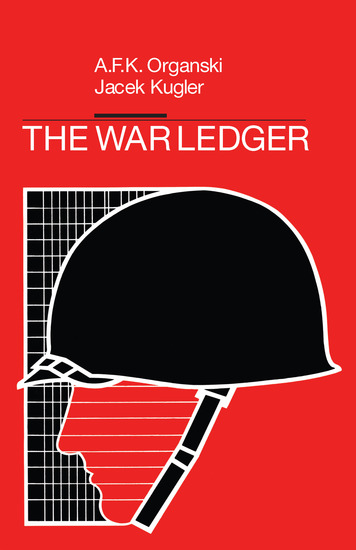
The War Ledger - cover

The War Ledger

A.F.K. Organski, Jacek Kugler

Publisher: The University of Chicago Press

  • 0
  • 0
  • 0

Summary

The War Ledger provides fresh, sophisticated answers to fundamental questions about major modern wars: Why do major wars begin? What accounts for victory or defeat in war? How do victory and defeat influence the recovery of the combatants? Are the rules governing conflict behavior between nations the same since the advent of the nuclear era? The authors find such well-known theories as the balance of power and collective security systems inadequate to explain how conflict erupts in the international system. Their rigorous empirical analysis proves that the power-transition theory, hinging on economic, social, and political growth, is more accurate; it is the differential rate of growth of the two most powerful nations in the system—the dominant nation and the challenger—that destabilizes all members and precipitates world wars. Predictions of who will win or lose a war, the authors find, depend not only on the power potential of a nation but on the capability of its political systems to mobilize its resources—the "political capacity indicator." After examining the aftermath of major conflicts, the authors identify national growth as the determining factor in a nation's recovery. With victory, national capabilities may increase or decrease; with defeat, losses can be enormous. Unexpectedly, however, in less than two decades, losers make up for their losses and all combatants find themselves where they would have been had no war occurred. Finally, the authors address the question of nuclear arsenals. They find that these arsenals do not make the difference that is usually assumed. Nuclear weapons have not changed the structure of power on which international politics rests. Nor does the behavior of participants in nuclear confrontation meet the expectations set out in deterrence theory.
Available since: 07/31/2015.
Print length: 299 pages.
Other books that might interest you

  • The Shocking Truth about Technology's Impact on Society - cover

    The Shocking Truth about...

    Zoey Fraisers

    • 0
    • 0
    • 0
    Technology has transformed every aspect of modern life, reshaping the way people communicate, work, learn, and even think. The rapid evolution of digital tools, artificial intelligence, and automation has created new opportunities for innovation and progress. At the same time, it has introduced complex challenges, raising questions about privacy, security, and the ethical implications of technological advancement. While some argue that technology is a force for good, improving efficiency and convenience, others warn of its unintended consequences, such as addiction, misinformation, and social disconnection.  
      
    The digital revolution has promised to connect the world like never before, making information more accessible and enabling instant communication across continents. However, the same tools that foster global connectivity also contribute to a decline in real-world interactions. Social media platforms, for example, offer a space for people to share ideas, but they have also been linked to mental health issues, cyberbullying, and the spread of false information. Additionally, concerns about surveillance and data privacy have grown, as companies and governments collect vast amounts of personal information, often without users' full awareness or consent.  
      
    Another major area of technological impact is the workforce. Automation and artificial intelligence are changing the job market, replacing certain human roles while creating new ones. While these advancements increase efficiency and reduce costs, they also raise concerns about job displacement and economic inequality. Many industries, from manufacturing to customer service, have seen a shift toward AI-driven processes, leaving workers struggling to adapt. At the same time, some experts believe that technology can enhance human capabilities rather than replace them, leading to a future where humans and machines collaborate rather than compete. 
    Show book
  • The Vote Collectors - The True Story of the Scamsters Politicians and Preachers behind the Nation's Greatest Electoral Fraud - cover

    The Vote Collectors - The True...

    Nick Ochsner, Michael Graff

    • 0
    • 0
    • 0
    In November 2018, Baptist preacher Mark Harris beat the odds, narrowly fending off a blue wave in the sprawling Ninth District of North Carolina. But word soon got around that something fishy was going on in rural Bladen County. At the center of the mess was a local political operative named McCrae Dowless. Dowless had learned the ins and outs of the absentee ballot system from Democrats before switching over to the Republican Party. Bladen County's vote-collecting cottage industry made national headlines, led to multiple election fraud indictments, toppled North Carolina GOP leadership, and left hundreds of thousands of North Carolinians without congressional representation for nearly a year. 


    Michael Graff and Nick Ochsner tell the story of the political shenanigans in Bladen County, exposing the shocking vulnerability of local elections and explaining why our present systems are powerless to monitor and prevent fraud. In their hands, this tale of rural corruption becomes a fascinating narrative of the long clash of racism and electioneering—and a larger story about the challenges to democracy in the rural South. 


    At a time rife with accusations of election fraud, The Vote Collectors shows the reality of election stealing in one southern county, where democracy was undermined the old-fashioned way: one absentee ballot at a time.
    Show book
  • Arthashastra or The Playbook of Material Gain - Pragmatic and amoral tips on how to gain defend and expand power from India’s greatest philosopher - cover

    Arthashastra or The Playbook of...

    Chanakya

    • 0
    • 0
    • 0
    Truly radical "Machiavellianism", in the popular sense of that word, is classically expressed in Indian literature in the Arthashastra of Kautilya (written long before the birth of Christ, ostensibly in the time of Chandragupta): compared to it, Machiavelli's The Prince is harmless.— Max Weber, Politics as a Vocation (1919)Chanakya's treatise, written while turning a farmhand into the emperor of the largest empire India had ever seen, focuses on how to manage an empire, covering everything from domestic policy and personal rights to assassination and the dirtier arts of politics. This is not, as with Plato’s Republic, a work of theory. Chanakya’s guidance is entirely practical, and is based on both his education and his experience building an empire. It lacks the philosophical ponderings and moralizing of its equivalent Western works (such as The Prince, The Republic or Leviathan) and instead focuses on how one deals with the messiness of the world in practice.People will occasionally refer to Chanakya as an Indian Machiavelli, but this does some discredit to Chanakya. The Prince is a satire, and focused around exposing the tactics and inhumanity of Cesare Borgia. Arthashastra is a manual for every aspect of statecraft, and while it deals in the unethical it does so only because that is, after all is said and done, one of the options available to a ruler.If you're after a totally pragmatic analysis of leadership, stripped of moralising and focused on what works and how to deal with real-world issues, this is the book for you.
    Show book
  • Volga Blues - A Journey into the Heart of Russia - cover

    Volga Blues - A Journey into the...

    Marzio G. Mian

    • 0
    • 0
    • 0
    Winner of the Estense Prize 
      
    A risky undercover reporting trip along Russia’s great mother-river, the Volga, reveals the tortuous history and frightening current fantasies of a nation. 
      
    Since the invasion of Ukraine and ban on foreign reporters, Russia seems to have sunk into an even deeper shadow than in the darkest times of the Soviet Union. Only by presenting himself as an historian was Italian journalist Marzio G. Mian able to penetrate the Russian heartland, leading to his groundbreaking cover story for Harpers’ Magazine, “Behind the New Iron Curtain.” 
      
    In Volga Blues, Russian history and literature inform every step of Mian’s revealing and perilous journey along Russia’s most culturally significant river, the fulcrum of its history, “the mother.” Along with Alessandro Cosmelli, his photographer; Vlad, their translator and fixer; and Katya, Vlad‘s girlfriend, Mian manages to gather firsthand accounts from ordinary Russians. They discuss not only the impact of the war, Western sanctions, and their country’s isolation, but how Russian culture has changed as a result. Stalin is back in favor, Lenin has been downgraded as a “Europeanized intellectual.” Newly sophisticated local and seasonal cuisine is all the rage. People cite centuries-old grievances to explain their fear of Western invasion, as they claim a willingness to accept nuclear apocalypse to save Russian pride. Talking with contemporary Russian intellectuals, entrepreneurs, priests, widows, mercenaries, and pacifists, Mian discovers how little the West knows about Russia and Russians. Deeply distrustful of democracy, yearning for the ideological and spiritual purity of the Orthodox Church, betrayed by and fearful of the West, and reassured by the brutal, fragile, ancient dream of an imperial civilization, they make clear that the Cold War has not yet ended. 
      
    In visceral prose, Mian takes us across the floodplains where the Russian Orthodox faith first took root, where the Soviet empire asserted itself, and where the neo-imperial project of Vladimir Putin’s post-Soviet autocracy is currently being consolidated. The result is a harrowing, haunting vision of today’s great clash of civilizations—between Russia and the West—including a United States that at times seems uncannily similar. 
      
    "Volga Blues blends history, myth, and comedy with the paranoia of a nation in which Stalin seems to be rising from the dead, minus the communism but with brutality intact. Marzio Mian is Alexis de Tocqueville in what has once again become a land of the czars, a Joan Didion for the new authoritarianism's absurdity and sorrow."—Jeff Sharlet, New York Times bestselling author of The Undertow: Scenes from a Slow Civil War
    Show book
  • The Rage of Replacement - Far Right Politics and Demographic Fear - cover

    The Rage of Replacement - Far...

    Michael Feola

    • 0
    • 0
    • 0
    The "Great Replacement" narrative, which imagines that historic white majorities are being intentionally replaced through immigration policies crafted by global elites, has effectively mobilized racist, nationalist, and nativist movements in the United States and Europe. The Rage of Replacement tracks how this narrative has shaped the politics and worldview of the far right, binding its various camps into a community of rage obsessed with nostalgia for a white-supremacist past. 


    Showing how the replacement narrative has found significant purchase in recent mainstream discourse, Michael Feola diagnoses the dangers this racist theory poses as it shapes the far-right imagination, expands through civil society, and deforms political culture. In particular, he tracks how the replacement narrative has given rise to malignant political strategies designed to "take back" the nation from its perceived enemies—by force if deemed necessary. 


    Feola shows how it has motivated a variety of dangerous political projects in pursuit of illiberal, antidemocratic futures. From calls for the creation of segregated white ethnostates to extremist violence such as the mass shootings in Christchurch, El Paso, and Buffalo, The Rage of Replacement makes clear that replacement theory poses a dire threat to democracy and safety.
    Show book
  • Race Marxism: Book Summary & Analysis - cover

    Race Marxism: Book Summary &...

    Briefly Summaries

    • 0
    • 0
    • 0
    This is a concise summary and analysis of Race Marxism, by James Lindsay.
     
    It is not the original book and is not affiliated with or endorsed by James Lindsay.
     
    Ideal those seeking a quick and insightful overview.
     
    Race Marxism explores the complex intersection of critical race theory (CRT) and Marxist ideology, offering a deep dive into how these frameworks influence modern discussions on race, politics, and society. The book examines CRT's origins, its relationship to Marxism, and its impact on culture, education, and institutions. With a critical lens, it questions the philosophical foundations and practical implications of these ideas, aiming to challenge prevailing narratives and encourage intellectual discourse on race and social justice.
    Show book