Join us on a literary world trip!
Add this book to bookshelf
Grey
Write a new comment Default profile 50px
Grey
Subscribe to read the full book or read the first pages for free!
All characters reduced
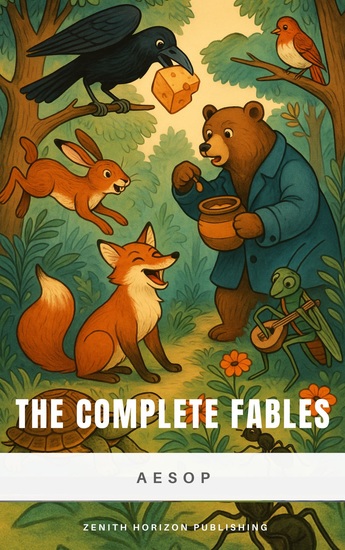
The Complete Fables of Aesop - Timeless Tales of Wisdom and Morality - cover

The Complete Fables of Aesop - Timeless Tales of Wisdom and Morality

Aesop Aesop, Zenith Horizon Publishing

Publisher: Zenith Horizon Publishing

  • 0
  • 0
  • 0

Summary

🐢🦊 Explore the origins of storytelling through the wit and wisdom of the ancient world.

The Complete Fables by Aesop gathers over 600 short tales that have shaped moral education and popular culture for over two millennia. From the cunning of the fox 🦊 to the perseverance of the tortoise 🐢, each fable delivers a powerful lesson wrapped in simplicity, charm, and unforgettable characters.

Perfect for both young minds and adult readers, these allegories remain profoundly relevant, teaching universal values like honesty, humility, patience, and justice. This definitive collection preserves the wit, humor, and enduring truths that have made Aesop's tales a foundation of world literature.

✨ Whether you're rediscovering childhood favorites or exploring them for the first time, this collection is a must-have for every bookshelf.

👉 Click "Buy Now" and enjoy these ageless stories of wisdom and virtue!
Available since: 06/24/2025.
Print length: 356 pages.
Other books that might interest you

  • A Thing That Glistened - From their pens to your ears genius in every story - cover

    A Thing That Glistened - From...

    Frank R. Stockton

    • 0
    • 0
    • 0
    Frank Richard Stockton was born in Philadelphia on 5th April 1834.  
    His father, a Methodist minister, discouraged Stockton’s literary career from an early age.  Feeling unable to go against those wishes it was for many years that Stockton’s income was maintained as a wood engraver.   
    His first work was published in 1867 and his first collection only appeared in 1870.  Despite this late arrival Stockton’s innovative and often far-fetched stories, with a gentle ‘poking fun’ humour were very popular.  Like his contemporary Mark Twain he avoided the scolding, hectoring and moral tones of many other authors and instead gently teased and cajoled his reader to open their eyes to the ills, the greed and the ambitions of the world around them.  His sci-fi stories in particular were far-seeing and inventive including a tale of negative gravity and a bloodless Anglo-US war won by technological feats.  
    Perhaps his most enduring tale though is ‘The Lady, or the Tiger?’ from 1882.  A condemned man is given a choice of being eaten alive or marrying his princess lover.  But he has to choose which door each is behind. 
    Frank R Stockton died in Washington, DC, on 20th April 1902, of a cerebral haemorrhage.  He is buried at The Woodlands in Philadelphia.
    Show book
  • The Call of the Wild - cover

    The Call of the Wild

    Jack London

    • 0
    • 0
    • 0
    The Call of the Wild by Jack London is an epic adventure that takes listeners into the rugged wilderness of the Yukon during the Klondike Gold Rush. This timeless classic follows Buck, a domesticated dog whose life takes a dramatic turn when he is stolen from his comfortable home and sold as a sled dog in the harsh, unforgiving North. Forced to confront his primal instincts, Buck must navigate a world filled with brutal challenges, hostile conditions, and the fierce struggle for survival. 
    As Buck adapts to his new environment, he experiences the call of his wild ancestry, gradually transforming from a tame pet into a leader of the pack. This powerful story explores the themes of resilience, instinct, and the transformative power of nature, capturing the essence of the wild and the spirit of adventure. 
    Narrated with intensity and emotion, this audiobook brings Jack London’s vivid descriptions and gripping storytelling to life. It’s perfect for those who love tales of survival, animal stories, and classics that stand the test of time. Whether you’re a long-time fan or a new listener, this audiobook will transport you to the frozen tundras and immerse you in Buck’s epic journey. 
    Start Listening to The Call of the Wild today and experience the thrilling journey of courage and self-discovery in the heart of the wilderness!
    Show book
  • 3 Stories About - Identity - A trio of classic tales perfect for a commute walk or quiet night in - cover

    3 Stories About - Identity - A...

    O Henry, Sherwood Anderson,...

    • 0
    • 0
    • 0
    There is something about the number 3.    
     
    The Ancient Greeks believed 3 was the perfect number, and in China 3 has always been a lucky number, and they know a thing or two.   
     
    Most religions also have 3 this and 3 that and, of course, in these more modern times, three’s a crowd may be too many, except when it’s a ménage à trois.  It seems good things usually come in threes. 
     
    Whatever history and culture says WE think 3, a hat-trick of stories, is a great number to explore themes and literary avenues that classic authors were so adept at creating. 
     
    From their pens to your your ears. 
     
    01 - 3 Stories About - Identity 
    02 - Hands by Sherwood Anderson 
    03 - My First Goose by Isaac Babel 
    04 - The Gift of the Magi by O Henry
    Show book
  • Aloysha the Pot - From their pens to your ears genius in every story - cover

    Aloysha the Pot - From their...

    Leo Tolstoy

    • 0
    • 0
    • 0
    Leo Tolstoy was born in 1828 in the Russian province of Tula to a wealthy noble family. As a child, he had private tutors but he showed little interest in any formal education. When he went to the University of Kazan in 1843 to study oriental languages and law, he left without completing his courses.  Life now was relaxed and idle but with some writing also taking place.  Gambling debts forced an abrupt change of path and he joined the army to fight in the Crimean War.  He was commended for his bravery and promoted but was appalled at the brutality and loss of life.  He recorded these and other earlier experiences in his diaries which formed the basis of several of his works. 
    In 1852 ‘Childhood’ was published to immediate success and was followed by ‘Boyhood’ and ‘Youth’. 
    His experience in the army and the horrors he witnessed resulted in ‘The Cossacks’ in 1862 and the trilogy ‘Sevastopol Tales’. After the war he travelled around Europe, visiting London and Paris and meeting such luminaries as Victor Hugo and Charles Darwin.  
    It was now that Tolstoy began his masterpiece, ‘War and Peace’. Published in 1869 it was an epic work that changed literature. He quickly followed this with ‘Anna Karenina’.  
    These successes made Tolstoy rich and helped him accomplish many of his dreams but also brought problems as he grappled with his faith and the lot of the oppressed poor. These revolutionary views became so popular that the authorities now kept him under surveillance.  
    He led a life of asceticism and vegetarianism and put his socialist ideals into practice by establishing numerous schools for the poor and food programmes. He also believed in giving away his wealth, which caused much discord with his wife.  
    His writing continued to bring forth classics such as ‘The Death of Ivan Ilyich’ and many brilliant and incisive short stories such as ‘How Much Land Does A Man Need’.  
    In 1901 Tolstoy was excommunicated from the Church and controversially deselected for the Nobel Prize for Literature. 
    Whilst undertaking a pilgrimage by train in October 1910 with his daughter Aleksandra he caught pneumonia in the nearby town of Astapovo.  Leo Tolstoy died on November 9th, 1910, he was 82.
    Show book
  • The Maltese Cat - Celebrated author of The Jungle Book Kipling brings another marvellous story from the perspective of an animal this time about a game of polo set in India during British rule - cover

    The Maltese Cat - Celebrated...

    Rudyard Kipling

    • 0
    • 0
    • 0
    Joseph Rudyard Kipling was born in Mumbai, India on 30th December 1865.   
     
    As was the custom in those days, he and his sister were sent back to England when he was 5.  The ill-treatment and cruelty by the Portsmouth couple they boarded with Kipling said contributed to the onset of his literary life.  
     
    At 16 he returned to India to work on a local paper where he was soon contributing and writing.  It also exposed him to the issues of identity and national allegiance which pervade much of his work.  
     
    In 1886, his ‘Departmental Ditties’, collection of verse appeared in print followed by 39 short stories for his newspaper over only 8 months.  These were then published as ‘Plain Tales from the Hills’, shortly after his 22nd birthday.  
     
    He continued his prolific pace of writing before being dismissed in a dispute and, taking his pay-off and the profits from the sale of some publishing rights, decided to return to London, travelling via Rangoon, Hong Kong, Japan and the United States, all the while writing articles, and arriving at Liverpool in October 1889. 
     
    Over the next two years he saw further works published as books and in magazines, as well as a nervous breakdown for which he was prescribed a sea voyage, to South Africa, Australia, New Zealand and India.  
     
    Happier times came with marriage to Caroline Starr Balestier in January 1892.  The honeymoon began in Vermont and ended in Yokahama where they heard their bank had failed.  They returned to Vermont and settled.  Caroline was now pregnant and he was planning the ‘Jungle Books’.  
     
    A failed arbitration between the US and England resulted in an argument between Caroline’s brother and Kipling, and then his arrest.  At the hearing he was mortified by the exposure of his private life and after settling the matter they returned to England and life in Torquay.  ‘Kim’ was published in 1902, and ‘Just So Stories for Little Children’, a year later.  
     
    In 1907 he was awarded the Nobel Prize for Literature with the citation “in consideration of the power of observation, originality of imagination, virility of ideas and remarkable talent for narration which characterise the creations of this world-famous author”.   
     
    When the Great War erupted, he scorned those who refused conscription.  His son enlisted and was killed at the Battle of Loos in September 1915, at 18, an exploding shell had ripped his face apart.  This death inspired Kipling’s writing thereafter, but the tragedy broke his life and by 1930 his prolific pen had almost ceased. 
     
    Rudyard Kipling died on 18th January 1936 from a perforated duodenal ulcer.  He was 70.  His ashes are buried at Poets’ Corner in Westminster Abbey. 
     
    In the Maltese Cat Kipling returns once more to India and the British Empire.  A polo match is being played.  The fierce competitive instincts of two social classes are fighting for dominance.  All told through the voice of the Maltese Cat, the most cunning of the horses.
    Show book
  • Problem IX Violet’s Own - A girl helps her sister rise from poverty to achieve her dreams - cover

    Problem IX Violet’s Own - A girl...

    Anna Katharine Green

    • 0
    • 0
    • 0
    Anna Katharine Green was born in Brooklyn, New York on November 11th, 1846. 
     
    Anna’s initial ambition was to be a poet. However that path failed to ignite any significant interest and she turned to fiction writing. She published her first―and most famous work in 1878―‘The Leavenworth Case’. Wilkie Collins praised it and it sold extremely well. 
     
    It led to Anna writing 40 novels and to becoming known as ‘the mother of the detective novel.’ 
     
    In helping to shape the genre she brought many other innovations including a series detective: her main character was detective Ebenezer Gryce of the New York Metropolitan Police Force, but in three novels he is assisted by the nosy society spinster Amelia Butterworth, another innovation and a prototype for Miss Marple, Miss Silver and others.  
     
    She also invented the 'girl detective': in the character of Violet Strange, a debutante with a secret life as a sleuth. Anna’s other innovations included the now familiar dead bodies in libraries, newspaper clippings as "clews," the coroner's inquest, and expert witnesses. Yale Law School once used her books to demonstrate how damaging it can be to rely on circumstantial evidence. 
     
    Her career was now well advanced and she was much admired.  
      
    On November 25, 1884, Green married the actor and stove designer, and later noted furniture maker, Charles Rohlfs, who was seven years her junior. They had three children; Rosamund, Roland and Sterling. 
     
    Although Anna was a progressive she did not approve of many of her feminist contemporaries, and was opposed to women's suffrage. 
     
    On November 25, 1884, Anna married the actor and noted furniture maker, Charles Rohlfs, who was seven years her junior. They had three children; Rosamund, Roland and Sterling. 
     
    Anna Katharine Green died on April 11, 1935 in Buffalo, New York, at the age of 88.
    Show book