Join us on a literary world trip!
Add this book to bookshelf
Grey
Write a new comment Default profile 50px
Grey
Subscribe to read the full book or read the first pages for free!
All characters reduced
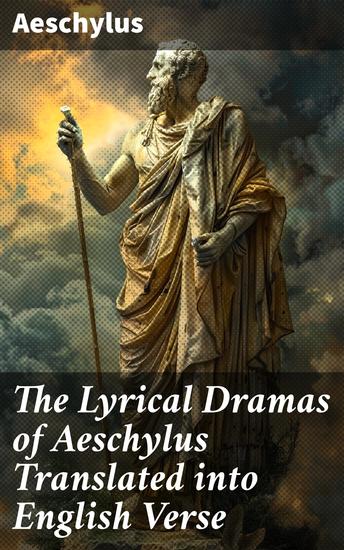
The Lyrical Dramas of Aeschylus Translated into English Verse - Timeless Tragedies of Fate and Divine Intervention in English Verse - cover

The Lyrical Dramas of Aeschylus Translated into English Verse - Timeless Tragedies of Fate and Divine Intervention in English Verse

Aeschylus Aeschylus

Translator John Stuart Blackie

Publisher: Good Press

  • 0
  • 0
  • 0

Summary

In "The Lyrical Dramas of Aeschylus Translated into English Verse," Aeschylus deftly melds the elements of tragedy with a profound lyrical quality, showcasing his innovative use of language and form. This collection highlights some of the most significant works of the father of tragedy, exploring themes of fate, justice, and the divine interplay in human affairs. The translation embraces the rhythmic patterns and musicality inherent in Aeschylus'Äô original texts, allowing contemporary readers to appreciate the emotional depth and dramatic tension that have rendered these works timeless in the canon of literature. Aeschylus, an Athenian playwright born in 525 BC, is often referred to as the 'father of tragedy' for his pioneering contributions to the genre. His experiences as a soldier in various battles, including the Persian Wars, deeply influenced his thematic explorations, intertwining personal and collective suffering with grand historical narratives. This rich context not only gives weight to his characters'Äô struggles but also reflects the socio-political currents of his time, inviting readers to consider the relevance of his insights in the modern age. This remarkable translation is a must-read for enthusiasts of classical literature and drama, as it successfully transports Aeschylus'Äô profound messages into a form accessible to contemporary audiences. Not only does it serve as an introduction to the complexities of ancient Greek tragedies, but it also inspires reflection on the timeless questions of morality and the human experience, making it an essential addition to any literary collection.
Available since: 11/14/2023.
Print length: 393 pages.

Other books that might interest you

  • The Time Machine: A Comedy - cover

    The Time Machine: A Comedy

    John Nicholson, Steven Canny

    • 0
    • 0
    • 0
    When the worlds of science-fiction and science-fact collide… extraordinary things can happen.
    Dave is the great-great grandson of H.G. Wells, author of the 1895 novella The Time Machine, a book that foretold (with suspicious accuracy) the future of the human species. What if the ideas in that book weren't entirely fiction? Right now, Dave and his friends Amy and Michael must set out on a journey through time… the journey of a lifetime!
    The Time Machine: A Comedy is (very loosely) adapted from H.G. Wells by Steven Canny and John Nicholson, whose previous adaptation of The Hound of the Baskervilles was a hit in the West End and subsequently for numerous companies worldwide. It was first produced in 2023 on a tour of the UK, before a run at Park Theatre, London, produced by Original Theatre and directed by Orla O'Loughlin.
    Fast-paced and wise-cracking, this riotous retelling zips from the nineteenth century to the end of the world, and (with any luck) back again. It will suit any theatre company looking for a time-bending adaptation of a well-loved story – and a surefire audience-pleaser.
    Show book
  • The Love Poems - cover

    The Love Poems

    Ovid

    • 0
    • 0
    • 0
    The Roman poet Publius Ovidius Naso (Ovid) is best known for his epic poem Metamorphoses, a collection of myths and legends from Ancient Greece and Rome. His works continue to be widely read and admired, and he is regarded as one of the most significant poets of ancient Rome.
    Ovid’s love poems are both brilliant and evocative. In Amores (‘Loves’), the romantic mysteriousness of elegiac love-poetry is exploded by his witty and ironic treatment of the form. Ars Amatoria (The Art of Love) and Remedia Amoris (The Cures for Love) both lay down the rules for the game of love, which both sexes can play.
    A.D. Melville’s translations, which also include the lesser-known Cosmetics for Ladies, have been specially licensed for this recording. It is delivered with customary panache by David Timson.
    Show book
  • Cornered by the Dark - cover

    Cornered by the Dark

    Harold J. Recinos

    • 0
    • 0
    • 0
    " Cornered by the Dark is a triumph."
    
    
    — Junot Dí az, author of The Brief Wondrous Life of Oscar Wao
    
    
    W. H. Auden, Jorge Luis Borges, Howard Thurman, Julia Equivel, Thomas Merton, Langston Hughes, Pedro Pietri and Miguel Piñ ero, in their work make a connection between poetry, social criticism and the meaning of life together— that is a part of Harold Recinos' literary labor. His work creates a fusion between the personal and the public in verse that is searching, expansive, and walking hurt streets. Cornered by the Dark is a work about truth-telling and witness-bearing to the marginal men, women, and children who tell their story about a culture of indifference and callousness while finding courage and compassion to hope in everyday life.
    
    
    Cornered by the Dark is published under Paraclete Press's Iron Pen imprint. In the book of Job, a suffering man pours out his anguish to his Maker. From the depths of his pain, he reveals a trust in God's goodness that is stronger than his despair, giving humanity some of the most beautiful and poetic verses of all time. Paraclete's Iron Pen imprint is inspired by this spirit of unvarnished honesty and tenacious hope.
    Show book
  • Female Poets of the Nineteenth Century The - Volume 2 - Beautiful collection of poems from women who struggled to get the credit they deserved at the time - cover

    Female Poets of the Nineteenth...

    Ella Wheeler Wilcox

    • 0
    • 0
    • 0
    For much of history women have been seen rather than heard. Their thoughts, their views have lain too long in the shadows of our culture.  Whilst this traditional view has some merit it is not entirely accurate. 
    Here, gathered together in these volumes, we can, through their words, experience their lives; we can hear their voices, their thoughts, joys, loves and losses. 
    For the Female Poet there was always the confining hand of men to instruct that their time was perhaps spent more productively elsewhere.  These lines, these gilded verses often protest otherwise. 
    The contribution of women in these earlier centuries is immense and in this series we bring together poets who have created some of the most beautiful and expressive verses ever written.  And remember these words, these telling lines, have been written against the grain of society's male bias.  With their remembered words these female poets have given us a history that we can all now share. 
    This volume comes to you from Portable Poetry, a specialized imprint from Deadtree Publishing.  Our range is large and growing and covers single poets, themes, and many compilations.
    Show book
  • Home Burial - Poem about the challenges of everyday life from a Pulitzer prize winner - cover

    Home Burial - Poem about the...

    Robert Frost

    • 0
    • 0
    • 0
    Robert Lee Frost was born on the 26th March 1874 in San Francisco, California. 
    His father found providing for the family a constant challenge and he died, when Frost was 11, from tuberculosis and left an estate valued at only $8.  The family moved east to Lawrence, Massachusetts, and a better life with his grandfather. 
    After graduating from High School, and then a few months at Dartmouth college, he returned home to take on a variety of menial jobs to help support his mother.  Their drudgery and poor money encouraged him to move in a different direction: a career as a poet. 
    He sold his first poem in 1894 for $15.  With this milestone he proposed to his high school sweetheart who declined as she was still studying at university.  The following year she graduated and they married.  A year later the first of their six children arrived.   
    After a stint at Harvard for two years he received the gift of a farm from his ailing grandfather.  Frost worked the farm and wrote unpublished poetry for several years before turning to a teaching position. 
    Upon the death of one of his children the grief-stricken family decided to quit everything and live in England, moving across the Atlantic in 1912.  The following year he published his first poetry book and with it came critical acclaim.  He was now in his late thirties. 
    The onset of World War I saw Frost return to America with a glowing reputation, and here he launched himself into a career of writing, teaching and lecturing.  
    In 1924 he received the first of four Pulitzer Prizes, for his book ‘New Hampshire: A Poem with Notes and Grace Notes’.  He received a second Pulitzer in 1931 for ‘Collected Poems’.  A third Pulitzer Prize was presented in 1937 for ‘A Further Range’.  His fourth Pulitzer was awarded in 1943 for ‘A Witness Tree’. 
    Frost was also nominated for the Nobel Prize in Literature 31 times. 
    During these years personal tragedy had enveloped him.  A daughter had died in her late 20s from the effects of her puerperal fever at childbirth, his wife had died of breast cancer, and a son had committed suicide.  
    Then, at the age of 86, was asked to read his poem ‘The Gift Outright’ at President John F Kennedy’s inauguration on the 20th January, 1961.  
    Robert Frost died on the 29th January 1963 in Boston of complications arising from prostate surgery.  He was 88.
    Show book
  • On the Subject of Fallen Things - cover

    On the Subject of Fallen Things

    James Kearns

    • 0
    • 0
    • 0
    "you start every new day with an inventory: a moth, a cape, a parachute, a coffin, a gun, the wall you built to mount the gun."
    On the Subject of Fallen Things is an addictive, Chekhovian metanarrative: phenomenological, absurd, and dripping with black humour. James Kearns' speaker keeps company with Lazarus, an inept psychic, and a deceased superhero, but finds himself increasingly alone—lost in dialogue with mortality, both personal and anthropological. Permanence, culpability, the function and corruption of human storytelling: all come into play in a surge of momentum that grips the reader, even as it breaks apart: a lean explosion, a gunshot in the distance.
    "On the Subject of Fallen Things weaves whimsy into narrative epiphanies that you never see coming. Each line aggregating weight like the lightness of snowflakes gathering into an avalanche. Hugely enjoyable. Get it now." Roger Robinson, A Portable Paradise, Winner of the 2019 T.S. Eliot Prize
    "This is a really brilliant sequence of poems. Like Ponge, or Herbert, or Steger, or Simic, it manages to be both serious and fleeting, weighty and funny. It's hopeful, actually." S.J. Fowler, 3:AM Magazine
    Show book