Join us on a literary world trip!
Add this book to bookshelf
Grey
Write a new comment Default profile 50px
Grey
Subscribe to read the full book or read the first pages for free!
All characters reduced
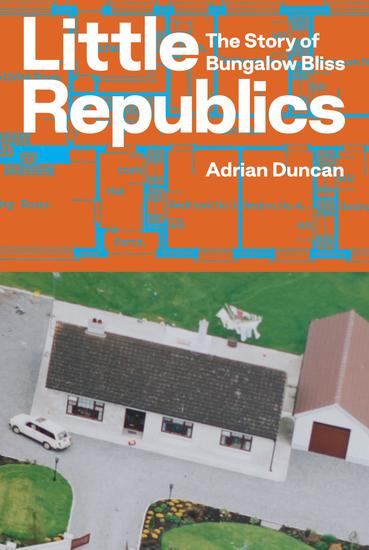
Little Republics: The Story of Bungalow Bliss - The Story of Bungalow Bliss - cover

Little Republics: The Story of Bungalow Bliss - The Story of Bungalow Bliss

Adrian Duncan

Publisher: The Lilliput Press

  • 0
  • 0
  • 0

Summary

Bungalow Bliss, first published in 1971, was a book of house designs that buyers could use to build a home for themselves affordably. It first appeared two years before Ireland was to join the EEC as a self-published catalogue by Jack Fitzsimons from his Kells Art Studios in County Meath. He and his wife designed and collated it and printed it locally.
Fitzsimons sold these books out of his car to newsagents, petrol garages and bookshops.
Over the course of thirty years, Fitzsimons sold over a quarter of a million copies of his catalogue. The first edition contained twenty designs – the final edition contained two hundred and sixty.
This guidebook of how to build your own home radically transformed housing in Ireland. Now, for the first time, author and structural engineer Adrian Duncan looks at the cultural impact that Bungalow Bliss and the accessible bungalow design had on the housing market, the Irish landscape, and on the individual families who made these bungalows their homes.
Available since: 10/20/2022.
Print length: 172 pages.

Other books that might interest you

  • Earthmusic - cover

    Earthmusic

    Paul Winter

    • 0
    • 0
    • 0
    Since the 1960s, Paul Winter has been in the vanguard of musicians whose art expresses special appreciation for the natural music of our world--wolf, whale, wind and water, combined with everything from Bach to Bossa Nova. In this visit Paul tells about the making of Missa Gaia, and his lifelong love affair with music that "presses your wonder button."
    Show book
  • Zen Buddhism And Its Relation To Art - cover

    Zen Buddhism And Its Relation To...

    Arthur Waley

    • 0
    • 0
    • 0
    A great primer on the history of Japanese art as it evolved under the Buddhist (and later Zen) movements embedding in Japan's culture. Written by the first great populariser of Chinese and Japanese cultural artefacts, including translating a great number of Chinese poems and literary works.
    Show book
  • We Oughta Know - How Céline Shania Alanis and Sarah Ruled the ’90s and Changed Music - cover

    We Oughta Know - How Céline...

    Andrea Warner

    • 0
    • 0
    • 0
    A lively collection of essays that re-examines the extraordinary legacies of the four Canadian women who dominated ’90s music and changed the industry forever
    		 
    Fully revised and updated, with a foreword by Vivek Shraya
    		 
    “A fascinating, fun, and infuriating read.” — Tegan Quin, Tegan and Sara 
    		 
    In this of-the-moment essay collection, celebrated music journalist Andrea Warner explores the ways in which Céline Dion, Shania Twain, Alanis Morissette, and Sarah McLachlan became bonafide global superstars while revolutionizing ’90s music. In an era when male-fronted musical acts dominated radio and were given serious critical consideration, these four women were reduced, mocked, and disparaged by the media and became pop culture jokes, even as their albums were topping the charts and demolishing sales records.
    		 
    With empathy, humor, and reflections on her own teenaged perceptions of Céline, Shania, Alanis, and Sarah, Andrea offers us a revised and expanded edition of her 2015 book, providing a new perspective on the legacies of the four Canadian women who dominated the ’90s airwaves and influenced an entire generation of current day popstars with their voices, fashion, and advocacy. As the world is now reconsidering the treatment and reputations of key women in ’90s entertainment, We Oughta Know is definitively entering the chat.
    Show book
  • Classic Beer Radio Commercials - Volume 1 - cover

    Classic Beer Radio Commercials -...

    Various Various

    • 0
    • 0
    • 0
    This fascinating and historical audio program includes actual radio commercials for the following classic beers: Hamm's, Killian's Irish Red, Lucky, Miller, Miller High Life, Milwaukee's Best, Pabst Blue Ribbon, Rheingold, Schaefer's, Schlitz, Walter's
    Show book
  • Ludwig van Beethoven: The Life and Music of the Great Composer - cover

    Ludwig van Beethoven: The Life...

    Editors Charles River

    • 0
    • 0
    • 0
    Among all of history’s greatest musicians, few have been as admired or influential as Ludwig van Beethoven, whose name remains synonymous with composing. Works like his Fifth and Ninth symphonies remain instantly recognizable over 200 years after they were composed, and their sweeping and grandiose nature are made all the more amazing by the fact that their author was gradually going deaf and couldn’t hear music very well by the time he was composing them. Similarly, the “Moonlight Sonata” and "Für Elise" are renowned across the world and are some of the most famous piano pieces of all time. 
    At the same time, Beethoven’s work ushered in a new era in art, helping the transition from the Classical era to the Romantic era. In the 180 years since his death, Beethoven has been enshrined by modern society as one of the most esteemed classical composers in the history of civilization, but he had a profound and immediate influence on the German musical lineage that would pass through Robert Schumann, Richard Wagner, Gustav Mahler and Richard Strauss all the way to composers of the 20th and early 21st centuries. At a time when music was very much viewed as science, Beethoven was a giant in the field, and as such he was viewed as a genius. As Beethoven himself once put it, “Music is the one incorporeal entrance into the higher world of knowledge which comprehends mankind but which mankind cannot comprehend.” 
    In terms of assessing the essence of Beethoven’s era, character or musical output, no unqualified categorization is possible, for he straddled a titanic shifting of social ideologies, performance and compositional practices, intra-continental upheavals and an emergence of the championed self in all forms of civic and artistic expressions. The ideals of the Enlightenment, an intellectual tide that swept throughout the late 18th century and opened the door to a new individualism, did not remain static through his lifetime.
    Show book
  • Empire of Ife - The Cradle of Yoruba Culture and the Kingdom of Sculptors - cover

    Empire of Ife - The Cradle of...

    Rolf Hedger

    • 0
    • 0
    • 0
    The origins of Ife are deeply rooted in mythology, oral traditions, and historical accounts, making it one of the most revered ancient cities in West Africa. Ife is often referred to as the cradle of the Yoruba civilization, a place where culture, religion, and governance took form. The story of its beginning is intertwined with Yoruba cosmology, particularly the legend of Oduduwa, who is considered the progenitor of the Yoruba people. 
    According to Yoruba mythology, Olodumare, the Supreme Being, entrusted Oduduwa with the sacred task of creating the earth. He descended from the heavens with a chain, a handful of earth, and a rooster. Upon reaching the watery expanse that covered the world, he spread the earth on the surface, and the rooster scattered it, forming the first landmass. This sacred land became known as Ile-Ife, meaning “The Land of Expansion.” Over time, Oduduwa and his followers established a kingdom that became the center of Yoruba civilization, laying the foundation for its political, spiritual, and artistic traditions. 
    Beyond mythology, historical and archaeological evidence suggests that Ife was already a flourishing city-state by the 9th century, possibly earlier. It grew as a hub of trade, attracting merchants and artisans from different parts of West Africa. Its strategic location allowed for the exchange of goods, ideas, and cultural practices, contributing to the city’s rapid development. The city’s early rulers, often referred to as the Oonis, played a crucial role in consolidating power and maintaining the harmony between religious and political institutions. The Ooni of Ife, regarded as both a king and a divine figure, acted as the intermediary between the people and the gods, reinforcing Ife’s status as a sacred city.
    Show book