Join us on a literary world trip!
Add this book to bookshelf
Grey
Write a new comment Default profile 50px
Grey
Subscribe to read the full book or read the first pages for free!
All characters reduced
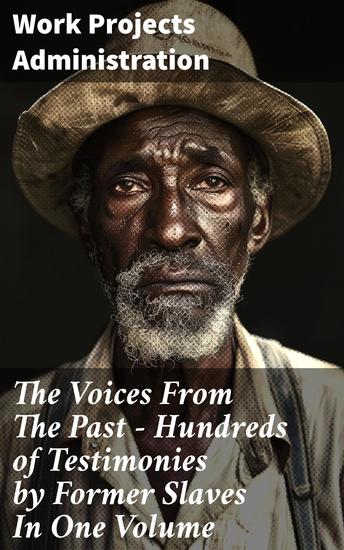
The Voices From The Past – Hundreds of Testimonies by Former Slaves In One Volume - Echoes of Suffering and Strength: Stories of Resilience from Former Slaves - cover

The Voices From The Past – Hundreds of Testimonies by Former Slaves In One Volume - Echoes of Suffering and Strength: Stories of Resilience from Former Slaves

Administration Work Projects

Publisher: Good Press

  • 0
  • 0
  • 0

Summary

In "The Voices From The Past 'Äì Hundreds of Testimonies by Former Slaves In One Volume," the Work Projects Administration compiles a poignant anthology of firsthand accounts from former slaves, capturing the raw and unfiltered experiences that shaped their lives. This comprehensive volume employs a documentary literary style, weaving together narratives that reflect the emotional, psychological, and cultural dimensions of slavery in America. Set against the backdrop of the New Deal era, the project serves as both a historical archive and a testament to resilience, illuminating voices that have been silenced across generations. The Work Projects Administration (WPA), established during the Great Depression, sought to provide employment and preserve American history through public works and cultural projects. This initiative was influenced by an urgent need to document the legacies of African American slavery before they faded into memory, reflecting the socio-political climate of the time. The narratives presented in this book are not merely historical artifacts; they convey the lived experiences that continue to resonate in contemporary discussions on race and identity. I highly recommend "The Voices From The Past" to scholars, educators, and general readers alike. This essential collection serves not only as an important historical document but also as an evocative exploration of humanity, urging readers to reflect on the enduring impact of slavery in American society.
Available since: 01/15/2024.
Print length: 7860 pages.
Other books that might interest you

  • Knowledge in a Nutshell: Sigmund Freud - The complete guide to the great psychologist - cover

    Knowledge in a Nutshell: Sigmund...

    Alan Porter

    • 0
    • 0
    • 0
    This accessible and entertaining guide introduces Sigmund Freud's life and ideas, from dream analysis to the superego. 
     
    Sigmund Freud's theories on the unconscious revolutionised the way we approach human behaviour. This essential introduction explores his theories and the implications they had for understanding an array of psychological issues, including trauma, repressed memory, childhood development and more. 
     
    It also explores Freud's life as a scientist - the conflicts and controversies he faced when proposing his new ideas to his contemporaries - and the ways in which his theories have influenced psychology today. 
     
    Sections include: 
     
    Freud's early lifePsychoanalysisFree associationThe unconsciousInterpreting dreamsThe Oedipus complexCase historiesModern evaluations of Freud 
     
    Perfect for students on anyone wanting to get to grip with Freud's ideas, this book is the perfect introduction to the great psychoanalyst and his ground-breaking concepts. 
     
    ABOUT THE SERIES: The critically-acclaimed Knowledge in a Nutshell series provides accessible and engaging introductions to wide-ranging topics, written by experts in their fields.
    Show book
  • The Three Waves of Volunteers & The New Earth - cover

    The Three Waves of Volunteers &...

    Dolores Cannon

    • 0
    • 3
    • 0
    In 1945 when the atomic bombs were dropped in WWII, our “protectors” and “watchers” in outer space saw that Earth was on a collision course with disaster. The prime directive of non-interference prevented them from taking any action, but then they came up with a brilliant plan to save Earth and assist her in her ascension. They couldn’t interfere from the “outside”, but maybe they could influence from the “inside”. So the call went out for volunteers to come and help. “Earth is in trouble – who wants to volunteer?” The native souls living on Earth were too caught up on the wheel of karma. The only hope was to ask for pure souls to come who had never been trapped on the karmic cycle. Dolores in her hypnosis work has discovered three waves of these volunteers. Some have come direct from the “Source” and have never lived in any type of physical body before. Others have lived as space beings on other planets or other dimensions. Because all memory is erased upon entry to the Earth dimension, they do not remember their assignment. Thus these beautiful souls have a difficult time adjusting to our chaotic world. These souls have a vital role to play as they help all of the rest of us ascend to the New Earth. * Characteristics of the Three Waves of Volunteers * The Difficulties being Experienced by First-Timers * How the Shift is affecting the Physical Body * The Roles of ETs and Light Beings in the Shift * Keepers of the Grid * The Separation of the Old and New Earth * What is the New Earth? * What is the Significance of 2012?
    Show book
  • History of the United Kingdom - Events and Details from Scottish and Irish History - cover

    History of the United Kingdom -...

    Kelly Mass

    • 0
    • 0
    • 0
    This is a book with 6 different titles, all related to Great Britain and its history. The titles are the following: 
    Partition of Ireland 
    The Irish Potato Famine 
    Ghosts of Scotland 
    Scottish History 
    Wars of Scottish Independence 
    William Wallace
    Show book
  • Psychoanalytic and Spiritual Perspectives on Terrorism - Desire for Destruction - cover

    Psychoanalytic and Spiritual...

    Nina E. Cerfolio

    • 0
    • 0
    • 0
    Nina E. Cerfolio masterfully explores the deeper spiritual and psychoanalytic understanding of the origins of human aggressive and destructive instincts which underlie mass shootings and terrorism. 


    The author survived two terrorist attacks: developing breast cancer from being a first responder at 9/11, and being poisoned by an FSB agent while providing humanitarian aid in the Second Chechen War. Through a personal, scholarly investigation into her psyche, the author describes the spiritual awakening that was catalyzed by these events and their traumatic impact, and examines how a world could create the firmament for the kinds of destructive aggression that are a daily occurrence. Featuring cutting-edge quantitative research and case material, which illustrates the prevalence of undiagnosed and untreated psychiatric illness among mass shooters and terrorists, this book encourages dialogue about the stigma of mental illness and challenges the perception of terrorists as monsters with no societal responsibility. 


    Championing the forgotten collective humiliation of the marginalized—which in turn breeds terrorism—and documenting a new spiritual lens through which healing is possible, this book will be essential listening for mental health workers and anyone wishing to understand the traumatizing epoch in which we are living.
    Show book
  • Plato: A short biography - 5 Minutes: Short on time - long on info! - cover

    Plato: A short biography - 5...

    5 Minutes, 5 Minute Biographies,...

    • 0
    • 0
    • 0
    Plato, legendary Greek philosopher: Life and works in a short biography! Everything you need to know, brief and concise. Infotainment, education and entertainment at its best!
    Show book
  • Battle of Tsushima The: The History and Legacy of the Decisive Naval Battle that Ended the Russo-Japanese War - cover

    Battle of Tsushima The: The...

    Editors Charles River

    • 0
    • 0
    • 0
    By the end of the 19th century, the Russian Empire seemed to be at the zenith of its power and reach. It was the largest country in the world, stretching from the Black Sea on the eastern edge of Europe to the Bering Straits in the extreme east of Asia. Even by rail, it took over ten days to travel from one side of the country to the other. Its standing army of over 1.3 million men was the largest in the world, and the “Russian Steamroller” was regarded as one of the most potent military forces available to any ruler. 
    	The sudden and unexpected rise of Japanese influence in the region was opposed by Russia, Germany, and France, who threatened war with Japan unless the terms that ended the war were changed. Reluctantly, the Japanese agreed to withdraw from Manchuria, but they never forgot or forgave what they saw as the way in which the unwarranted European influence was used against them.  
    	Japanese suspicions were reinforced when Russia subsequently concluded a treaty of alliance with China and forced the tottering regime to grant a lease of the Liaodong peninsula to Russia. Russian troops occupied Port Arthur and began to build massive fortifications around the city. The port was linked to Russia by a new railroad that connected to the Trans-Siberian Railroad at the Chinese city of Harbin. Russia also insisted on the right to use its troops to defend the new railroad throughout its length in China. Although the terms by which Russia leased the port from China were temporary, it was clear that Port Arthur was intended to become Russia’s new warm-water port on the Pacific.  
    	To most observers, it seemed clear that Japan and Russia were destined to come into conflict in Korea and Manchuria. Both empires were set on expansion, and both saw these areas as important. However, Russia’s vastly larger population, army, and navy seemed to make it inevitable that Japan would lose if the conflict escalated into war.
    Show book