Join us on a literary world trip!
Add this book to bookshelf
Grey
Write a new comment Default profile 50px
Grey
Subscribe to read the full book or read the first pages for free!
All characters reduced
The Horrors of Slavery in America - cover

The Horrors of Slavery in America

Administration Work Projects

Publisher: DigiCat

  • 0
  • 0
  • 0

Summary

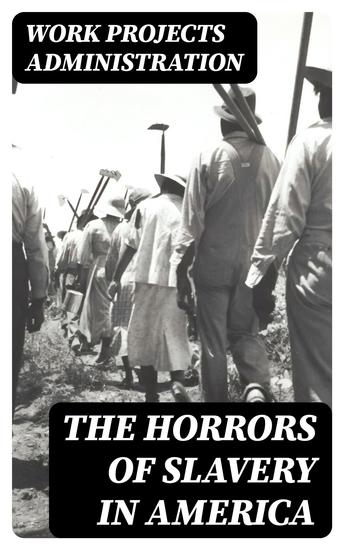
In "The Horrors of Slavery in America," the Work Projects Administration presents a poignant and unflinching documentation of the brutal realities faced by enslaved individuals in the antebellum United States. This comprehensive compilation encompasses firsthand narratives, historical accounts, and vivid testimonials, skillfully employing a blend of oral histories and archival research to paint a harrowing picture of the inhumanity of slavery. The literary style is grounded in realism, utilizing rich, evocative language that immerses readers in the lived experiences of those who endured servitude and oppression, positioned within the broader socio-political context of 20th-century America. The Work Projects Administration (WPA), established during the New Deal, aimed to provide jobs and stimulate the economy through the arts and humanities. Through this project, American writers and historians, compelled by the ethical urgency of documenting marginalized voices, sought to confront the legacy of slavery and its lingering impact on American society. Their commitment to preserving these stories reflects a crucial moment in American history and literature, where rediscovered histories were brought to the fore. This book is essential for readers interested in American history, social justice, and the complex narratives surrounding slavery. It serves as both an educational resource and a powerful statement against the atrocities of the past, encouraging a deep reflection on the enduring scars of slavery in contemporary society.
Available since: 11/13/2022.
Print length: 7859 pages.

Other books that might interest you

  • Swapped for My Lesbian - Gender Swap - cover

    Swapped for My Lesbian - Gender...

    Kinky Press

    • 0
    • 0
    • 0
    Peter and Jessie are best friends, but they don’t hit for the same team… for now. 
      
    After years of sexual frustration, Peter is finally ready to do something so he can be with his hot and horny lesbian friend. 
      
    Seeking advice at the local magic shop, he searches for a love potion that will not force his will on Jessie — and is given one very unique solution… Give Jessie everything she wants. 
      
    Will the love between friends turn into something much more erotic if only Peter grows a pair… of tits?
    Show book
  • The Siege of Stalingrad - The Turning Point in the War on the Eastern Front - cover

    The Siege of Stalingrad - The...

    Sage Winters

    • 0
    • 0
    • 0
    The Battle of Stalingrad stands as one of the most defining events of the 20th century, a turning point that shifted the trajectory of World War II. Situated along the banks of the Volga River, Stalingrad was not only a city of industrial and strategic importance but also a symbolic prize for both Adolf Hitler and Joseph Stalin. The ferocity and scale of the battle transformed it into a microcosm of the broader conflict between Nazi Germany and the Soviet Union.  
      
    When Germany launched Operation Barbarossa in June 1941, the Wehrmacht seemed unstoppable as it swept across the Soviet Union. Hitler’s ambitions of seizing Soviet territories were fueled by his vision of Lebensraum and the destruction of Bolshevism. By the summer of 1942, German forces were pressing deeper into the southern front, aiming to capture the oil fields of the Caucasus and secure Stalingrad as a vital stepping stone. For Hitler, Stalingrad held immense propaganda value, carrying the name of his adversary, Stalin. Its fall would signify not just a military triumph but a psychological blow to the Soviet people.  
      
    For the Soviet Union, the defense of Stalingrad became a matter of national survival and pride. Stalin’s orders to defend the city at all costs rallied both soldiers and civilians. The infamous directive “Not a step back!” underscored the desperation and determination of the Soviet war effort. As the battle unfolded, Stalingrad was transformed into a hellish landscape of rubble, where every building and street became a battlefield. 
    Show book
  • Motivation - Creativity Emotional Intelligence Motivation Self-Discipline and Survival (5 in 1) - cover

    Motivation - Creativity...

    Coral Nunez

    • 0
    • 0
    • 0
    This book contains five titles, which are: 
    Creativity 
    Emotional Intelligence  
    Motivation 
    Self-Discipline 
    Survival 
    Take advantage of this big discounted bundle now!
    Show book
  • Mythology - Gods Kings Spirits Calendars and Myths from Different Nations (6 in 1) - cover

    Mythology - Gods Kings Spirits...

    Matthew Fillard

    • 0
    • 0
    • 0
    This book consists of 6 titles, which are the following: 
    Aztec Mythology - The Aztec Empire, one of the most powerful and complex civilizations of Mesoamerica, was not only remarkable for its military conquests and grand architecture but also for its deeply spiritual and mythological worldview. 
    Inca Mythology - The Inca Empire, at its zenith, spanned much of South America, including present-day Peru, Ecuador, Bolivia, and parts of Chile and Argentina. Known for its advanced architecture, agricultural systems, and administrative organization, the Inca civilization also possessed a deeply spiritual culture. 
    Japanese Mythology - Japanese mythology is a rich tapestry woven from the threads of ancient stories, religious beliefs, and cultural practices that have evolved over centuries. At its core, this mythology provides a window into the Japanese worldview, where nature, spirituality, and humanity are deeply interconnected. 
    Korean Mythology - The unique characteristics of Korean mythology are closely tied to the geography and history of the region. The Korean Peninsula, surrounded by mountains, forests, and the sea, provided a fertile backdrop for the imagination of its people. 
    Maya Mythology - The mythology of the Maya was not an isolated system of stories—it was deeply embedded in every aspect of their daily lives. From the way they organized their cities to the structure of their calendar, mythology shaped their worldview and guided their actions. 
    Native American Mythology - Unlike written records, Native American myths were shared through storytelling, ceremonies, and rituals. This oral tradition allowed stories to evolve, adapting to the needs and experiences of each generation.
    Show book
  • Reconsidering Reparations - cover

    Reconsidering Reparations

    Olúfẹ́mi Táíwò

    • 0
    • 0
    • 0
    Reparations for slavery have become a reinvigorated topic for public debate over the last decade. Most theorizing about reparations treats it as a social justice project—either rooted in reconciliatory justice focused on making amends in the present; or, they focus on the past, emphasizing restitution for historical wrongs. Olúfémi O. Táíwò argues that neither approach is optimal, and advances a different case for reparations—one rooted in a hopeful future that tackles the issue of climate change head on, with distributive justice at its core. This view, which he calls the "constructive" view of reparations, argues that reparations should be seen as a future-oriented project engaged in building a better social order; and that the costs of building a more equitable world should be distributed more to those who have inherited the moral liabilities of past injustices. 


    This approach to reparations, as Táíwò shows, has deep and surprising roots in the thought of Black political thinkers such as James Baldwin, Martin Luther King Jr, and Nkechi Taifa, as well as mainstream political philosophers like John Rawls, Charles Mills, and Elizabeth Anderson. Táíwò's project has wide implications for our views of justice, racism, the legacy of colonialism, and climate change policy.
    Show book
  • Knowledge and Learning are Two Different Things - Eight Public Meetings with Young People Claremont Colleges USA 1968 - cover

    Knowledge and Learning are Two...

    Jiddu Krishnamurti

    • 0
    • 0
    • 0
    A radical transformation in the psyche itself," 8 November 1968. Duration: 80 minutes.To communicate we must know that the word is not the thing and also be in that state of mind whose quality is attention, care. That can take place only if we are serious.We are the world, and the world is us. To bring about a radical transformation, which is so essential in society, there must be radical transformation in ourselves.Analysis of violence does not end violence, nor is violence ended by thinking of nonviolence.There is no teacher outside, no saviour, no master; you yourself have to change, and therefore you have to learn to observe, to know yourself.Knowledge and learning are two different things.What is this silence you talk about? The silence that I am experiencing comes and goes."Thought is the cause of fear," 10 November 1968. Duration: 76 minutes.Though we have plenty of energy, apparently we lack the drive, enthusiasm, vitality to bring about a change in ourselves.As long as there is fear, there must be violence, aggression, anger, hatred. Thought is the source of fear.Is it possible to live everyday life without thought interfering?
    Show book