Join us on a literary world trip!
Add this book to bookshelf
Grey
Write a new comment Default profile 50px
Grey
Subscribe to read the full book or read the first pages for free!
All characters reduced
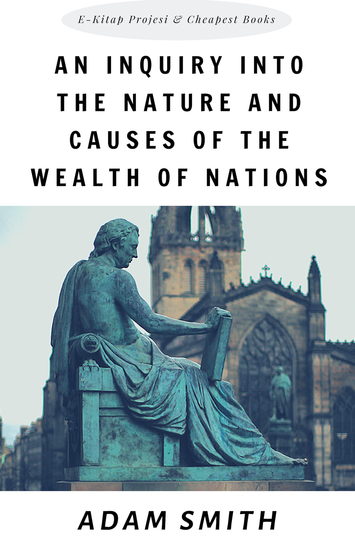
An Inquiry into the Nature and Causes of the Wealth of Nations - cover

An Inquiry into the Nature and Causes of the Wealth of Nations

Adam Smith

Publisher: E-Kitap Projesi & Cheapest Books

  • 0
  • 0
  • 0

Summary

An Inquiry into the Nature and Causes of the Wealth of Nations, generally referred to by its shortened title The Wealth of Nations, is the magnum opus of the Scottish economist and moral philosopher Adam Smith. First published in 1776, the book offers one of the world's first collected descriptions of what builds nations' wealth, and is today a fundamental work in classical economics. By reflecting upon the economics at the beginning of the Industrial Revolution, the book touches upon such broad topics as the division of labour, productivity, and free markets.

The Wealth of Nations was published 9 March 1776, during the Scottish Enlightenment and the Scottish Agricultural Revolution. It influenced several authors and economists, such as Karl Marx, as well as governments and organisations, setting the terms for economic debate and discussion for the next century and a half. For example, Alexander Hamilton was influenced in part by The Wealth of Nations to write his Report on Manufactures, in which he argued against many of Smith's policies. Hamilton based much of this report on the ideas of Jean-Baptiste Colbert, and it was, in part, Colbert's ideas that Smith responded to, and criticised, with The Wealth of Nations.

Why Adam Smith is important:

Adam Smith (1723-1790) was a Scottish philosopher and economist who is best known as the author of An Inquiry into the Nature and Causes of the Wealth Of Nations (1776), one of the most influential books ever written.

The old view of economics:

In Smith's day, people saw national wealth in terms of a country's stock of gold and silver. Importing goods from abroad was seen as damaging because it meant that this wealth must be given up to pay for them; exporting goods was seen as good because these precious metals came back. So countries maintained a vast network of controls to prevent this metal wealth draining out – taxes on imports, subsidies to exporters, and protection for domestic industries. The same protectionism ruled at home too. Cities prevented artisans from other towns moving in to ply their trade; manufacturers and merchants petitioned the king for protective monopolies; labour-saving devices were banned as a threat to existing producers.
Available since: 11/27/2023.
Print length: 800 pages.


Other books that might interest you

  • Pieces of Mee - cover

    Pieces of Mee

    Anexis Matos

    • 0
    • 0
    • 0
    Unleash your inner teen, fangirl, and your best and worse parts in this debut poetry collection. 
    The cringe of being a teenage girl. Blindness in all its glory and challenge. The fantastic parts of fandom. The power of stories. From reflections to a tragic love story of Death and their priestess, a poem is waiting to become your favorite.
    Show book
  • Crécy and Agincourt: The History of the Hundred Years’ War’s Most Famous Battles - cover

    Crécy and Agincourt: The History...

    Editors Charles River

    • 0
    • 0
    • 0
    Although it ended over 550 years ago, the Hundred Years’ War still looms large in the historical consciousness of England and France, even if the name of the famous war is a misnomer. The war was more of a series of separate conflicts between the English and French monarchies, interspersed with periods of peace, and its reputation remains an odd one, in part because its origins were based on royal claims that dated back centuries. Furthermore, the English and French remained adversaries for nearly 400 years after it ended.  
    	That said, the war was transformative in many respects, and the impact it had on the geopolitical situation of Europe cannot be overstated. While some might think of the war as being a continuation of the feudal tradition of knights and peasants, the Hundred Years’ War revolutionized European warfare, and it truly helped to usher in the concept of nationalism on the continent. In England, it is remembered as a period of grandeur and success, even though the English lost the war and huge swathes of territory with it, while the French remember it as a strategic victory that ensured the continued independence of France and the denial of English hegemony. The legacy of the war has lived on ever since, helping determine how England became politically severed from the continent, how the knightly chivalric tradition slid into irrelevance, and how battlefield dominance can still leave a nation a loser in war.  
    Indeed, nothing characterized that dominance quite like the campaign that culminated with the Battle of Crécy, where the English used their diverse forces to maximum effect to defeat the French, a victory that allowed the English to eventually take and hold Calais. Agincourt was a hard-fought battle, and Henry V at one point ordered prisoners executed to avoid allowing them to be rescued. In the end the English won a decisive victory, taking 1,500 prisoners and marching on safely to Calais. 
    Show book
  • Phaedrus - Plato - cover

    Phaedrus - Plato

    Plato

    • 0
    • 0
    • 0
    Phaedrus is one of the dialogues written by the ancient Greek philosopher Plato, and it explores the nature of love, beauty, and rhetoric. The dialogue is set on a hot summer day outside the walls of Athens, where Socrates and Phaedrus engage in a conversation about love and the art of rhetoric. 
    Throughout the dialogue, Socrates and Phaedrus discuss the power of love to inspire greatness and the role of rhetoric in communication and persuasion. They examine the different types of love and how they relate to beauty, knowledge, and the soul. They also explore the ethical implications of rhetoric and its ability to manipulate people's beliefs and opinions. 
    Phaedrus is one of Plato's most famous works, and it continues to be studied and debated by scholars and philosophers today. Its themes of love, beauty, and rhetoric are central to many philosophical and literary traditions, and its exploration of these concepts continues to be relevant to contemporary discussions in ethics, aesthetics, and communication studies.
    Show book
  • Between the Waves - ‘A rich and incisive new history of British Euroscepticism’ <i>The Economist< i> - cover

    Between the Waves - ‘A rich and...

    Tom McTague

    • 0
    • 0
    • 0
    **Longlisted for the Baillie Gifford Prize for Non-Fiction**This is the definitive history of Britain’s tumultuous relationship with Europe – as it’s never been told before.'Powerful, precise, morally engaged, wonderfully alert to character, context and the greater purpose of political life' – Rory Stewart, author of Politics on the Edge'A lucid, thoughtful and richly provocative book' – Dominic Sandbrook, The Sunday TimesIn a story of ambition and underhand politics, of nation, identity and belief, acclaimed political writer Tom McTague chronicles the battle of ideas, events and personalities that first took the country into the Common Market in 1973. Only to take it out of the European Union in an explosive referendum a little over forty years later.Drawing on unpublished sources and exclusive interviews, McTague unearths the roots of ideological conflict that raged between the leading politicians of the twentieth century as they fought for the future of Europe – Charles de Gaulle, Harold Macmillan, Jean Monnet, Enoch Powell and Margaret Thatcher.Alongside these famous figures are the lesser-known actors in Britain’s great post-war drama: a coterie of Eurosceptic student radicals, Cold Warriors, eccentric billionaires and political strategists who turned the tide of history.A riveting story of the clashing ideals that have pulled at Britain’s public imagination for more than seven decades, Between the Waves raises that most elemental of questions: who are we?'A sweeping, impressive and ambitious history of modern Europe' – Helen Lewis, author of Difficult Women'Compelling, hugely well-informed . . . will stand for many years as the authoritative political history’ – David Kynaston, author of Austerity Britain, 1945-1951
    Show book
  • Forgotten By Design - The Silent Epidemic of Digital Dementia - cover

    Forgotten By Design - The Silent...

    Hardik Goel

    • 0
    • 0
    • 0
    Ever opened a tab and forgotten why? 
    Mid-scroll, mid-thought… and poof—it’s gone? 
    No, it’s not just you. And no, it’s not early-onset anything, 
    You’ve simply been Forgotten. By. Design. 
    In Forgotten by Design: The Silent Epidemic of Digital Dementia, tech meets soul in this genre-bending, mind-bending manifesto on how your memory, focus, and very sense of time are being subtly stolen—and sold back to you. 
    This isn’t another “digital detox” guilt trip. 
    This is a call to remember who you were before 
    the algorithm got your number. 
    ◆ Neuroscience meets Vedic rituals. 
    ◆ Ancient myths collide with dopamine loops. 
    ◆ Real-life stories, surreal insights, and soul-searching questions. 
    Meet the yogi hidden in your nervous system, 
    Decode the ghost data shaping your identity. 
    And answer the only question that matters now: 
    If your mind’s been outsourced to machines… 
    what’s left of you? 
    This is not self-help. This is self-awakening. 
    (Warning: Once remembered, you can’t go back.) 
    ABOUT THE AUTHOR 
    Hardik Goel has spent over a decade wrangling data by day and words by caffeine-fueled night. By trade, he’s a data engineer and scientist, by temperament. a writer, editor, and part-time overthinker with an eye for patterns—whether in code, conversation, or comic coincidence. 
    This book is what happens when spreadsheets meet Sanskrit, and logic makes a late-night deal with mythology.
    Show book
  • Trapped in America’s Safety Net - One Family’s Struggle - cover

    Trapped in America’s Safety Net...

    Andrea Louise Campbell

    • 0
    • 0
    • 0
    When Andrea Louise Campbell’s sister-in-law, Marcella Wagner, was run off the freeway by a hit-and-run driver, she was seven-and-a-half months pregnant. She survived—and, miraculously, the baby was born healthy. But that’s where the good news ends. Marcella was left paralyzed from the chest down. This accident was much more than just a physical and emotional tragedy. Like so many Americans—50 million, or one-sixth of the country’s population—neither Marcella nor her husband, Dave, who works for a small business, had health insurance. On the day of the accident, she was on her way to class for the nursing program through which she hoped to secure one of the few remaining jobs in the area with the promise of employer-provided insurance. Instead, the accident plunged the young family into the tangled web of means-tested social assistance.
     
    A social policy scholar, Campbell thought she knew a lot about means-tested assistance programs. What she quickly learned was that missing from most government manuals and scholarly analyses was an understanding of how these programs actually affect the lives of the people who depend on them. Using Marcella and Dave’s situation as a case in point, she reveals their many shortcomings in Trapped in America’s Safety Net. 
     
    
    And, while Marcella and Dave’s story is tragic, the financial precariousness they endured even before the accident is all too common in America, where the prevalence of low-income work and unequal access to education have generated vast—and growing—economic inequality. The implementation of Obamacare has cut the number of uninsured and underinsured and reduced some of the disparities in coverage, but it continues to leave too many people open to tremendous risk.
     
    
    Behind the statistics and beyond the ideological battles are human beings whose lives are stunted by policies that purport to help them. In showing how and why this happens, this book offers a way to change it.
    Show book