Join us on a literary world trip!
Add this book to bookshelf
Grey
Write a new comment Default profile 50px
Grey
Subscribe to read the full book or read the first pages for free!
All characters reduced
Mechanics Using Matlab - An Introductory Guide - cover

Mechanics Using Matlab - An Introductory Guide

Aayushman Dutta

Publisher: Educohack Press

  • 0
  • 0
  • 0

Summary

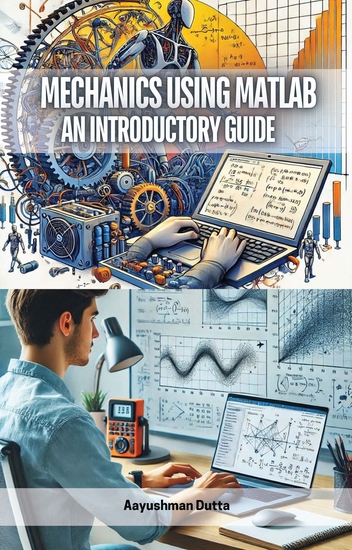
"Mechanics Using Matlab: An Introductory Guide" bridges the gap between fundamental principles of mechanics and their practical implementation using Matlab, a powerful computational tool widely used in engineering and scientific applications. We offer an invaluable resource for students, educators, and professionals seeking to deepen their understanding of classical mechanics and enhance their problem-solving skills through computational techniques.
We begin by laying a solid foundation in core concepts of mechanics, including kinematics, dynamics, and energy principles. Through clear explanations and illustrative examples, we guide readers through essential theories and equations governing the motion of particles and rigid bodies. Emphasis is placed on developing a conceptual understanding of the underlying physics, reinforced through Matlab-based exercises and simulations.
One of the key strengths of our book lies in its integration of theory with practical application. Each chapter elucidates the theoretical framework and demonstrates how to implement it computationally using Matlab scripts and functions. Topics covered include particle dynamics, projectile motion, Newton's laws of motion, circular motion, conservation principles, rotational dynamics, oscillations, and orbital mechanics.
Throughout the text, Matlab code snippets are provided alongside explanations, allowing readers to gain hands-on experience in solving mechanics problems numerically. This interactive approach reinforces theoretical concepts and equips readers with valuable computational skills.
With worked examples and practice problems, "Mechanics Using Matlab: An Introductory Guide" challenges readers and reinforces their understanding. This book serves as a practical reference for engineers, scientists, and researchers in fields where mechanics plays a crucial role.
Available since: 02/20/2025.
Print length: 306 pages.


Other books that might interest you

  • Healing Through Your Body's Innate Wisdom - Elevate your healing journey! Listen to audio lessons that harness your body's natural wisdom for optimal well-being - cover

    Healing Through Your Body's...

    Gideon Thornecroft

    • 0
    • 0
    • 0
    Healing Through Your Body's Innate Wisdom: Simplified Guide & Explanations Included 
    Are you on a journey to deepen your understanding and unlock the profound self-healing capabilities of your body? 
    Seeking a comprehensive guide that provides all the necessary tools for embracing your body’s innate wisdom? 
    Your search ends here! 
    This guide is your definitive companion for tapping into your body’s natural healing abilities, presenting knowledge in an easily digestible way. 
    Key features of this enriched guide: 
    - Profound insights into unlocking your body’s healing potential 
    - Detailed explanations about accessing your inner wisdom for self-healing 
    - Effective strategies for preparing yourself mentally and physically for the healing journey 
    Our guide stands out with its thorough coverage of essential concepts, ensuring you gain all the knowledge needed for your self-healing path. The content is not merely glanced over but explored deeply and precisely. 
    Please note that this guide is an independent resource and is not affiliated with any official healing organization. 
    Designed with a clear structure and easy-to-understand language, our guide ensures smooth transitions between topics. Say goodbye to dense jargon and welcome clear, precise, and technically accurate content. 
    So, why wait? Click the BUY NOW button, secure your copy, and begin your journey to inner wisdom and self-healing success!
    Show book
  • Plastics: Just a Load of Rubbish? - Just a Load of Rubbish? - cover

    Plastics: Just a Load of...

    Alicia Chrysostomou

    • 0
    • 0
    • 0
    A decade to save the planet. 
    That's the current call to arms. Targets are set, governments vow to do their bit and on a societal level we are encouraged to do ours by choosing to forego all things plastic. The question is whether this is the right decision or are we inadvertently at risk of doing more harm than good? Are there other factors in play needing equal consideration? 
    The book will follow the story of plastic, and to an extent rubber (known collectively as polymers), and all with an eye to the overarching theme of the environment. It will ask some challenging questions but also sets out to inform. It begins by building a picture. Just what exactly is a plastic, how did it gain such a dominant role in our lives? Are recent denouncements fully justified? 
    By better understanding plastics, a clearer opinion can be formed of their usefulness and their potential to alleviate serious environmental concerns.
    Show book
  • Holy Sonnets (version 2) - cover

    Holy Sonnets (version 2)

    John Donne

    • 0
    • 0
    • 0
    The Holy Sonnets—also known as the Divine Meditations or Divine Sonnets—are a series of nineteen poems by the English poet John Donne (1572–1631). The sonnets were first published in 1633—two years after Donne's death.  Summary from Wikipedia.
    Show book
  • Magic Data - Harnessing the Power of Algorithms and Structures Part 1 - cover

    Magic Data - Harnessing the...

    Chuck Sherman

    • 0
    • 0
    • 0
    Are you ready to dive deep into the world of data structures and algorithms? Whether you're a novice programmer or an experienced developer, "Magic Data: Harnessing the Power of Algorithms and Structures" is your roadmap to mastering the essential building blocks of computer science. 
    In this comprehensive book, you'll embark on a journey that demystifies the intricate realm of data structures and algorithms. Starting with the basics, you'll grasp fundamental concepts such as time and space complexity, Big O notation, and algorithmic analysis. From there, you'll explore a diverse array of topics, ranging from classic data structures like arrays, linked lists, and trees to advanced techniques like dynamic programming, greedy algorithms, and more. 
    Whether you're preparing for coding interviews, looking to enhance your problem-solving abilities, or aiming to create efficient and optimized code, "Magic Data: Harnessing the Power of Algorithms and Structures" equips you with the knowledge and tools you need to excel in the dynamic world of computer science. 
    Don't just write code—craft elegant solutions. Uncover the secrets of algorithms and data structures, and embark on a transformative journey toward becoming a master problem solver. This book is your ultimate companion in the realm of efficient computation and intelligent design. 
     
    Show book
  • James Webb Space Telescope The: The History of the Most Powerful Telescope in Space - cover

    James Webb Space Telescope The:...

    Editors Charles River

    • 0
    • 0
    • 0
    On April 24, 1990, the Space Shuttle Discovery lifted off from Kennedy Space Center on the Space Shuttle Program’s 35th mission, but this was no ordinary mission. In its payload bay, Discovery was carrying the Hubble Space Telescope, with the objective of putting the telescope into orbit. 	The Hubble telescope, working in space less than 400 miles above the Earth’s surface, produced photos of galaxies previously unseen as they existed only 500 million years before the “Big Bang.” It was fortuitous that Hubble outlived its anticipated lifespan by many years, because the launch of its successor, the James Webb Space Telescope, was delayed by 15 years.   
    	Several new obstacles delayed the launch, but NASA believed that it was finally prepared to proceed in 2020 after completion of construction four years prior. Then came the COVID pandemic, and 2020 became the year of “delayed events,” with the launch of the most sophisticated space telescope in history proving to be no exception.  
    	The increase in excitement was palpable. Scientists had viewed much of the universe through Hubble, almost as it was when it was formed, but they learned that none of these galaxies were the first ones formed. Then ultimately realized that “Hubble wasn’t the right instrument to detect those first galaxies.” “The farther we can see in space, the farther we can see in time…and that’s not a metaphor. That’s actually literally true,” explained scientist Amber Straughn. The Webb Space Telescope represents “looking in a part of space that we’ve never seen before.” The telescope will be able to detect the earliest galaxies because of its unparalleled sensitivity. Another factor is the kind of light it will collect, “light that our eyes aren’t designed to see.”
    Show book
  • Biotechnology and Bioinformatics - From Gene Editing to Personalized Medicine - cover

    Biotechnology and Bioinformatics...

    Daniel Garfield

    • 0
    • 0
    • 0
    "Biotechnology and Bioinformatics: Fundamentals and Applications" is a comprehensive guide to the cutting-edge technologies and practices that are driving modern science. This book covers the basics of biotechnology and bioinformatics, including their definitions, histories, and applications in various fields. 
    Readers will gain an understanding of the fundamental techniques used in biotechnology, such as genetic engineering, gene editing, PCR, DNA sequencing, and microarray technology. The book also explores the applications of biotechnology in agriculture, biomedical science, industrial biotechnology, and environmental biotechnology. 
    Bioinformatics is introduced as an essential component of modern biology, and readers will learn about genomics, proteomics, transcriptomics, metabolomics, and systems biology. This book provides an overview of the various tools and techniques used in bioinformatics, including database management systems, sequence alignment algorithms, statistical analysis tools, and visualization tools. 
    The applications of bioinformatics are explored in depth, including drug discovery, personalized medicine, biomedical research, agriculture, and environmental science. The book also delves into the ethical and social implications of biotechnology and bioinformatics, and the regulation and governance of these technologies. 
    Finally, readers will gain insight into the future of biotechnology and bioinformatics, including the challenges and obstacles that must be overcome to realize the full potential of these technologies. This book is an essential resource for students, researchers, and professionals in the fields of biology, biotechnology, bioinformatics, and related disciplines, as well as anyone interested in the fascinating world of modern science.
    Show book