Unisciti a noi in un viaggio nel mondo dei libri!
Aggiungi questo libro allo scaffale
Grey
Scrivi un nuovo commento Default profile 50px
Grey
Iscriviti per leggere l'intero libro o leggi le prime pagine gratuitamente!
All characters reduced
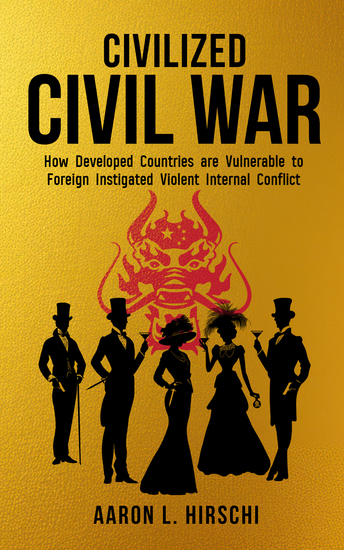
Civilized Civil War - How Developed Countries Are Vulnerable to Foreign Instigated Violent Internal Conflict - cover

Civilized Civil War - How Developed Countries Are Vulnerable to Foreign Instigated Violent Internal Conflict

Aaron L. Hirschi

Casa editrice: Defiance Press and Publishing

  • 0
  • 0
  • 0

Sinossi

"Civilized Civil War" is a chilling exploration of the vulnerabilities lurking within modern Western democracies. Drawing on his extensive background in military intelligence and national security, Aaron Hirschi presents a meticulously crafted scenario of how a foreign power – implicitly China – could orchestrate internal conflict in a developed nation without firing a single shot.
 
This groundbreaking analysis delves deep into the strategies and tactics of both the foreign-backed elites (FBE) seeking to subvert democracy and the national resistance forces (NRF) fighting to preserve it. Hirschi's unique insight brings to life the shadowy world of 5th Gradient Warfare, where battles are fought through information manipulation, economic sabotage, and social engineering rather than traditional military confrontation.
 
But "Civilized Civil War" is more than just a hypothetical war game. It serves as a stark wake-up call, highlighting real-world vulnerabilities in our energy policies, education systems, and media landscapes that could be exploited by adversaries. Hirschi challenges readers to reconsider long-held assumptions about governance, international cooperation, and the very nature of modern conflict.
 
As tensions between China and the West continue to escalate, this book provides crucial insight into the potential battlegrounds of the future. It is essential reading for policymakers, military strategists, and concerned citizens alike – anyone who seeks to understand and defend against the invisible threats to our democratic way of life.
Disponibile da: 04/09/2025.
Lunghezza di stampa: 236 pagine.

Altri libri che potrebbero interessarti

  • On Distant Service - The Life of the First US Foreign Service Officer to be Assassinated - cover

    On Distant Service - The Life of...

    Susan M. Stein

    • 0
    • 0
    • 0
    On July 18, 1924, a mob in Tehran killed U.S. foreign service officer Robert Whitney Imbrie. His violent death, the first political murder in the history of the service, outraged the American people. Though Imbrie’s loss briefly made him a cause célèbre, subsequent events quickly obscured his extraordinary life and career. 
    Susan M. Stein tells the story of a figure steeped in adventure and history. Imbrie rejected a legal career to volunteer as an ambulance driver during World War I and joined the State Department when the United States entered the war. Assigned to Russia, he witnessed the October Revolution, fled ahead of a Bolshevik arrest order, and continued to track communist activity in Turkey even as the country’s war of independence unfolded around him. His fateful assignment to Persia led to his death at age forty-one and set off political repercussions that cloud relations between the United States and Iran to this day. Drawing on a wealth of untapped materials, On Distant Service returns readers to an era when dash and diplomacy went hand-in-hand.
    Mostra libro
  • A Nation of Moochers - America's Addiction to Getting Something for Nothing - cover

    A Nation of Moochers - America's...

    Charles J. Sykes

    • 0
    • 0
    • 0
    We have experienced a shift in American character: we've become a nation of moochers. Increasingly dependent on the efforts of others over our own, Americans are free to freeload. From the corporate bailouts on Wall Street to the alarming increases in personal default and dependency, from questionable tax exemptions to enormous pension, healthcare, and other entitlement costs, the new moocher culture cuts across lines of class, race, and private and public sectors. And the millions that plan and behave sensibly, only to bail out the profligate? They're angry.Charles Sykes' argument is not against compassion or legitimate charity, but targets the new moocher culture, in which self-reliance and personal responsibility have given way to mass grasping after handouts. A Nation of Moochers is a persuasively argued and entertaining rallying cry for Americans who are tired of playing by the rules and paying for those who don't.
    Mostra libro
  • Book 1 Bricks that Build Us - Family Community Beliefs Philosophy Laws Conflict and Society - cover

    Book 1 Bricks that Build Us -...

    Rob Howat

    • 0
    • 0
    • 0
    Ideas build and destroy civilizations. Things are not going well. The need for action is now. After thousands of years of human development, our humanity seems to be intent upon disassembling itself with WOKE, Politically Correct thought police, rejected lessons from history and art, ‘book burning’, minorities DICTATING how we live and what we MUST think, riots, homelessness or helplessness and political polarizations with open conflicts and theft in our streets. How to revitalize harmonious existence, individual respect, laws equally for us all, and spirituality either via religion or constructive logic. So to create the conditions for cooperative, harmonious, self-disciplined inter-personal life: a return to greater stability of both mind and action working together for the good of communities and an increasingly interdependent World Social Family. 
    This building and rebuilding process will take generations, the current alternative will be humanity’s exit which would be both painful and permanent. This need not be. We each can learn so confidently form a renewal of our children’s real future but only by rebuilding our thought processes, awareness, and understanding with and through calm debate, discussion, and sharing of mind.  
    Industry, agriculture, and the use of both people’s time and natural abilities matter greatly: smaller could well be far more beneficial. Creating public demand to raise output and income too often leads to waste and even harm while generating wealth for a minority, too many of whom are amoral or undeserving.  
    What is reality other than what we decide it to be? All stems from family upbringing, mental inputs and experiences; educational practices, understood beliefs, the free flow of ideas; respecting other's thoughts, and community actions, which all coalesce into formed concepts and so beliefs. These and more build our minds, humour, fears and needs. These are the very Bricks that Build Us
    Mostra libro
  • Homegrown Radicals - A Story of State Violence Islamophobia and Jihad in the Post-9 11 World - cover

    Homegrown Radicals - A Story of...

    Youcef Soufi

    • 0
    • 0
    • 0
    In 2007, three Muslim university students left the Canadian Prairies, seemingly without a trace. In the ensuing months, their disappearance raised fears that the men had become "radicalized," posing a grave threat to national security. From presidential briefings and targeted drone assassinations to a politically charged trial, the men's story sheds new light not only on the figure of the "radical," but also on the "moderate" Muslim, represented by a community forever changed by the men's departure. 


    Homegrown Radicals offers a case study of the complex entanglements of the radical and moderate Muslim in post-9/11 North America. Youcef Soufi brings these figures together, providing insight into how state violence has inextricably tied them together. Focusing on the radicalization of the three students, the book traces the general sense of affective injury among North American Muslims over the loss of Muslim life in Western military campaigns overseas. In this context, a new theory of jihad rooted in a Muslim utopian imagination emerged, marking a significant rupture with premodern Islamic thought. The three "radicals" were among thousands of Anglophone Muslims who found this new theory compelling as both a diagnosis and a solution to the violence unleashed in the War on Terror. The book examines how and why this theory resonated, as well as its consequences.
    Mostra libro
  • Barred - Why the Innocent Can’t Get Out of Prison - cover

    Barred - Why the Innocent Can’t...

    Daniel S. Medwed

    • 0
    • 0
    • 0
    A groundbreaking exposé of how our legal system makes it nearly impossible to overturn wrongful convictions Thousands of innocent people are behind bars in the United States. But proving their innocence and winning their release is nearly impossible.  In Barred, legal scholar Daniel S. Medwed argues that our justice system’s stringent procedural rules are largely to blame for the ongoing punishment of the innocent. Those rules guarantee criminal defendants just one opportunity to appeal their convictions directly to a higher court. Afterward, the wrongfully convicted can pursue only a few narrow remedies. Even when there is strong evidence of a miscarriage of justice, rigid guidelines, bias, and deference toward lower courts all too often prevent exoneration.  Offering clear explanations of legal procedures alongside heart-wrenching stories of their devastating impact, Barred exposes how the system is stacked against the innocent and makes a powerful call for change.  “In our screwed-up legal system, it’s fairly easy to convict an innocent person and send them to prison. Tragically, and as Daniel S. Medwed explains so clearly in Barred, it is almost impossible to get them out. Punishing the innocent is not just a problem in other places. We do it every day in America.” ―John Grisham“By blending tales of real-life wrongful convictions with straightforward explanations of legal procedures, Medwed’s Barred demystifies the mysterious path for the innocent after trial. His clear and engaging writing style makes the topic accessible to anyone interested in the hazards of our criminal justice system. A must-read!”―Sister Helen Prejean, author of Dead Man Walking“Barred is a stunning account of the myriad procedural roadblocks that keep innocent people trapped in our nation’s prisons. With harrowing stories from his public-defense practice, Medwed reveals how prosecutors, judges, and other officials revere finality and efficiency over fairness and truth. By exposing this rampant disregard for defendants’ culpability, Barred powerfully calls into question the justice of the entire criminal punishment system and proposes urgent ways to mitigate its damage.”―Dorothy Roberts, author of Torn Apart“For every innocent prisoner we’ve freed over the past three decades, countless others remain behind bars. Barred brilliantly illustrates the absurdity of this situation: how it is far too easy to convict the innocent, and far too hard to correct those mistakes.” ―Barry Scheck, cofounder of the Innocence Project“For every newspaper photo of an innocent person exiting the prison gates, clutching the hand of their triumphant lawyer, there are uncountable others whom we will never allow to see that day—who will die in prison because our laws make it so difficult to prove their innocence in court. In Barred, Daniel S. Medwed gives us an urgent tour of the darkest corners of our judicial system, where persuasive evidence becomes trapped in a labyrinth of legal procedure. Underlying Medwed’s sharp legal analysis is a political question: Is this the country we want to be?” ―Maurice Chammah, author of Let the Lord Sort Them“A lucid and persuasive call for change.”―Publishers Weekly“Informative and poignant… [An] important addition to the literature on America’s addiction to incarceration.”―Kirkus“Eye-opening… Readers interested in criminal justice will find an elucidating look at the challenges and possibilities for the wrongfully convicted.”―Booklist
    Mostra libro
  • Phocion - Good Citizen in a Divided Democracy - cover

    Phocion - Good Citizen in a...

    Thomas R. Martin

    • 0
    • 0
    • 0
    "Elegant and enlightening." —Dominic Green, Wall Street Journal 


    Phocion (402–318 BCE) won Athens's highest public office by direct democratic election an unmatched forty-five times and was officially honored as a "Useful Citizen." A student at Plato's Academy, Phocion gained influence and power during a time when Athens faced multiple crises stemming from Macedonia's emergence as an international power under Philip II and his son Alexander the Great. Following Athens's defeat by Macedonia, Phocion unsuccessfully sought mild terms of surrender. Oligarchy was imposed on democratic Athens, and more than twelve thousand "undesirable" Athenians were exiled. When the oligarchic regime was overthrown and the exiles returned, dispossessed Athenians took out their volcanic anger on Phocion, who throughout his career had often been a harsh critic of the citizens' political decisions. His inflammatory rhetoric contributed to the popular conclusion that he lacked a genuine sense of belonging to the community he wished so desperately to preserve. When he was eighty-four, the Athenians convicted him of treason and condemned him to die by hemlock. In this fresh biography, Thomas R. Martin explores how and why Phocion ultimately failed as a citizen and as a leader. His story offers unsettling lessons for citizens in democracies today.
    Mostra libro