Join us on a literary world trip!
Add this book to bookshelf
Grey
Write a new comment Default profile 50px
Grey
Subscribe to read the full book or read the first pages for free!
All characters reduced
Sting and The Police - Walking in Their Footsteps - cover

Sting and The Police - Walking in Their Footsteps

Aaron J West

Publisher: Rowman & Littlefield Publishers

  • 0
  • 0
  • 0

Summary

“An excellent look at how the Police accomplished success . . . West is especially good at examining how the band used the nascent MTV to define themselves.” ―Publishers Weekly   During the 1980s, The Police were one of the biggest bands in the world. Yet after only five albums—and at the peak of their popularity—they disbanded, and Sting began a solo career that made him a global pop star. Today, artists from Puff Daddy to Gwen Stefani credit The Police and Sting as major influences on their own work.   In this book, Aaron J. West explores the cultural and musical impact of Stewart Copeland, Andy Summers, and Sting. West details the distinctive hybrid character of The Police’s musical output, which would also characterize Sting’s post-Police career. Sting’s long-lived solo career embodies the power of the artful appropriation of musical styles, while capitalizing on the modern realities of pop music consumption. The Police—and Sting in particular—were pioneers in music video, modern label marketing, global activism, and the internationalization of pop music.  Sting and The Police: Walking in Their Footsteps is a feast for fans—and by placing the band within its various musical, cultural, commercial, and historic contexts, it’s also fascinating reading for anyone interested in global popular music culture.
Available since: 06/14/2023.
Print length: 204 pages.

Other books that might interest you

  • Kaizen - 1% Better Every Day - cover

    Kaizen - 1% Better Every Day

    Araki Yoshikawa

    • 0
    • 0
    • 0
    Have you also often tried to change your life and found that it is not so easy? Maybe it was trying to lose weight, personal development, sports, finances or self-employment, etc. Do you remember the attempts you failed at? When you gave in to your inner pig for the sake of peace, or when you were no longer able or willing to withstand the pressure and you felt put on the defensive?Then you should definitely take a look at the Japanese change philosophy "Kaizen". With this philosophy you will learn how to approach your success and your goals with small steps but with high efficiency and how to reach your goals after all. Would you like to revive dreams and goals that have long since been filed away and to come closer step by step, without much effort, until the realization is inevitable? Wouldn't life immediately become much more meaningful again?Then turn to this book with its Japanese philosophy, which found its origin in large business groups and has continued its successful path into personal development. Kaizen means to approach improvements step by step instead of trying to bring about radical changes. The goal of the method is to continuously bring about minimal change and thus come inevitably closer to the goal.
    Show book
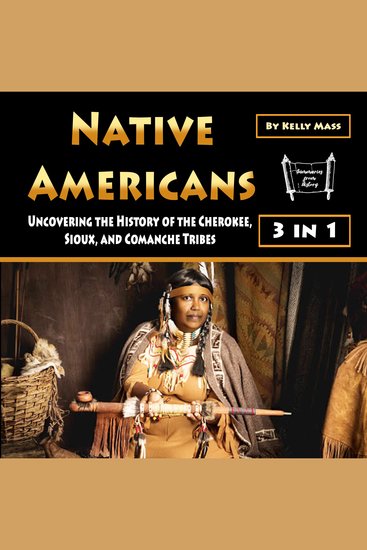
  • Native Americans - Uncovering the History of the Cherokee Sioux and Comanche Tribes - cover

    Native Americans - Uncovering...

    Kelly Mass

    • 0
    • 0
    • 0
    This is a combo of several books, which are: 
    1 - The Cherokee are among the native tribes of the United States' Southeastern Woodlands. They resided in communities along river valleys in what's now southwestern North Carolina, southeastern Tennessee, the limits of western South Carolina, northern Georgia, and northeastern Alabama just before the 18th century. Cherokee belongs to the Iroquoian language family. One oral legend tells of the people moving south in age-old times from the Great Lakes area, where other Iroquoian-speaking tribes were based, according to James Mooney, an early American ethnographer. 
    2 - The Comanche are a Native American people from the contemporary United States' Great Plains. Most of contemporary northwestern Texas, and also surrounding parts in eastern New Mexico, southeastern Colorado, southwestern Kansas, western Oklahoma, and northern Chihuahua, were previously part of their historical domain. 
    The Comanche people are acknowledged by the federal government as the Comanche Country, which is headquartered in Lawton, Oklahoma. 
    The Comanche language belongs to the Uto-Aztecan family of Numic languages. It started as a Shoshoni dialect, but has since developed into its own language. 
    3 - The Sioux, also called the Oceti Sakowin are a North American people of Native American tribe and First Countries tribes. The contemporary Sioux are split into 2 significant groups based upon language: Dakota and Lakota; they're called together as the Ohéthi akówi ("7 Council Fires"). The term "Sioux" is an exonym stemmed from a French transliteration of the Ojibwe term "Nadouessioux," and can apply to any ethnic group or language dialect within the Great Sioux Country.
    Show book
  • When Indian Rupee was the Arab world's legal tender - cover

    When Indian Rupee was the Arab...

    Amit Schandillia

    • 0
    • 0
    • 0
    Today, the American dollar is legal tender in as many as seven sovereign nations besides the United States of America. But there was a time, not too long ago, when another currency enjoyed a similar influence far from home. It was legal tender in half a dozen countries besides its own, all of them in a region that influences the global economy more than any other on the planet today. It's the Indian rupee. This is the rarely-told story of how a currency from a nation as impoverished as ours went on to enjoy such clout in one of the wealthiest parts of the world, and how it ended.
    Show book
  • Otto Hahn: A short biography - 5 Minutes: Short on time – long on info! - cover

    Otto Hahn: A short biography - 5...

    5 Minutes, 5 Minute Biographies,...

    • 0
    • 0
    • 0
    Otto Hahn, German physicist and discoverer of atomic fission: Life and work in a short biography! Everything you need to know, brief and concise. Infotainment, education and entertainment at its best!
    Show book
  • Complex PTSD Trauma and Recovery - Through Mindfulness and Emotional Regulation Exercises Transition from Trauma to Self-Recovery (2022 Guide for Beginners) - cover

    Complex PTSD Trauma and Recovery...

    SKYE JENKINS

    • 0
    • 0
    • 0
    Don't let your trauma define you – help and healing are available in this Powerful guide! 
    Too frequently, individuals lash out for no apparent reason. Other times, individuals become so conscious of their trauma that it permeates their identity. 
    While neither result is ideal, it is not completely the person's responsibility. 
    There is little assistance and advice available. Those that are accessible either need a large sum of money or are just not a good match. 
    But everything is not lost... 
    While there is no one-size-fits-all solution to the intricacies of PTSD from trauma, aid is available with "A PTSD from Trauma Healing." 
    People with PTSD may find all the knowledge they need in this thorough book to keep them going on the right path. 
    Readers will learn the following from this book:Investigate the most prevalent ramifications of trauma.Investigate PTSD in further depth, including why and how it occurs.Begin your recovery journey by learning about various therapeutic options and self-care approaches.Get your hands dirty with the healing process from beginning to end... after that some 
    And more, much more! 
    Even if you don't yet have the insight you need to overcome what's holding you back, "A PTSD from Trauma Healing" will help you sit with your feelings and sorrow so you can take the actions required to get the treatment you need. 
    Scroll up and click "Buy Now with 1-Click" to get your copy now!
    Show book
  • The Sociology of Religion - How Faith and Belief Systems Shape Social Life - cover

    The Sociology of Religion - How...

    Fred Grandsen

    • 0
    • 0
    • 0
    Religion has long been a fundamental aspect of human society, influencing cultures, shaping social norms, and providing meaning to people’s lives. The sociology of religion examines how faith and belief systems function within society, analyzing their impact on individuals, communities, and institutions. Unlike theological approaches that focus on the truth or divinity of religious doctrines, sociologists study religion as a social phenomenon, investigating its role in maintaining social order, fostering group identity, and driving social change. 
    One of the key concerns in the sociology of religion is understanding how religious beliefs and practices are shaped by broader social structures. Religious traditions do not exist in isolation; they are influenced by historical contexts, political systems, and economic conditions. For example, the rise of industrialization and urbanization has been linked to shifts in religious affiliation, with some societies experiencing a decline in traditional religious practices while others see the emergence of new forms of spirituality. 
    Sociologists also explore the role of religion in social cohesion and conflict. Many theorists, including Émile Durkheim, argue that religion serves as a unifying force, bringing people together through shared rituals, moral values, and collective worship. In this sense, religion helps to reinforce social bonds and provide a sense of belonging. However, religion can also be a source of division, contributing to sectarian conflicts, discrimination, and political struggles. The study of religious pluralism and interfaith relations highlights both the possibilities for coexistence and the challenges posed by religious diversity.
    Show book