


A Maynard Barbour – The Major Collection
A. Maynard Barbour
Publisher: Benjamin
Summary
Best Collection of A. Maynard Barbour


At the Time Appointed
That Mainwaring Affair
The Award of Justice
Available since: 06/27/2018.

Publisher: Benjamin
Best Collection of A. Maynard Barbour At the Time Appointed That Mainwaring Affair The Award of Justice

A man disgraced. A chance for escape. A temptation that destroys what little he has left.
After a scandal ends his career, Peter Willems seeks refuge in a remote trading outpost deep in the Eastern archipelago. But when passion and ambition collide, he becomes entangled in betrayal—of friends, of trust, and of the very people who offered him a second chance. As lies tighten around him, Willems spirals into a darkness of his own making.

Praised as "a haunting early masterpiece by Conrad," this novel explores isolation, corruption, and the fragile line between weakness and wickedness. Its lush atmosphere and psychological depth make it a gripping study of human fallibility.

If you enjoy intense moral drama, exotic settings, and stories where character becomes destiny, this classic will stay with you long after the final page.

Open the book—and witness the downfall of a man who cannot escape himself.
Show book

The Adventure of the Creeping Man (1923) is one of 12 Sherlock Holmes short stories by Arthur Conan Doyle collected in The Case-Book of Sherlock Holmes (1927). The story was first published in the Strand Magazine in the UK and Hearst's International in the US in March 1923.A man named Trevor Bennett comes to Holmes with a most unusual problem. He is Professor Presbury's personal secretary, and Mr Bennett is also engaged to the professor's only daughter, Edith. Professor Presbury is himself engaged to a young lady, Alice Morphy, a colleague's daughter, although he himself is already 61 years of age. Their impending marriage does not seem to have caused a great scandal, so that is not Mr Bennett's problem. Nonetheless, the trouble seems to have begun at about the time of Professor Presbury's and Alice's engagement. First, the professor suddenly left home for a fortnight without telling anyone where he was going. He returned looking rather travel-worn, and it was only through a letter from a friend sent to Mr Bennett that the family learnt that Professor Presbury had been to Prague. Upon returning from Prague, Presbury told Mr Bennett that certain letters would arrive with a cross under the stamp, and that he was not to open these. Until this time, Mr Bennett had enjoyed the professor's implicit trust and had opened all his letters as part of his job. As the professor said, such letters did arrive, and he gave them straight to the professor. Whether any replies were sent Mr Bennett does not know, as they never passed through his hands. The professor also brought a small carved wooden box back with him from Prague. One day, as Mr Bennett was looking for a cannula, he picked the box up, and the professor became very angry with him. Mr Bennett was quite shaken by the incident...Famous works of the author Arthur Conan Doyle: A Study in Scarlet, The Sign of the Four, The Adventures of Sherlock Holmes, The Memoirs of Sherlock Holmes, The Hound of the Baskervilles, The Return of Sherlock Holmes, The Valley of Fear, His Last Bow, The Case-Book of Sherlock Holmes, Stories of Sherlock Holmes, The Lost World.Show book

Since its immediate success in 1813, Pride and Prejudice has remained one of the most popular novels in the English language. Jane Austen called this brilliant work “her own darling child” and its vivacious heroine, Elizabeth Bennet, “as delightful a creature as ever appeared in print.” The romantic clash between the opinionated Elizabeth and her proud beau, Mr. Darcy, is a splendid performance of civilized sparring. And Jane Austen’s radiant wit sparkles as her characters dance a delicate quadrille of flirtation and intrigue, making this book the most superb comedy of manners of Regency England.

©2020 Pandora's Box (P)2020 Pandora's Box
Show book

Though The Street tries to remain in the realm of horror and the supernatural, what it really amounts to is one of the earliest written documents of Lovecraft’s political stance and stance on other races. In this story, the street is the protagonist. Lovecraft documents its growth from quaint and colonial New England town to downtrodden and dirty as immigrants move in after the first world war. When a “vast group of terrorists” living in the neighborhood plot to overthrow the federal government on July 4th, the street decides to take mattersinto its own (metaphorical) hands.Show book

‘It was the best of times, it was the worst of times…we had everything before us, we had nothing before us, we were all going direct to Heaven, we were all going direct the other way…’
 Charles Darnay is an exiled French soldier. Sydney Carter, a disreputable but brilliant English lawyer. In Dickens’ gripping, vivid historical drama the lives of these two men become enmeshed through their love for Lucie Manette, the daughter of a political prisoner.
 The lives of Charles and Sydney are drawn from the calm, peaceful roads of London to the bloodstained streets of Paris at the height of the Reign of Terror. Soon they fall under the shadow of La Guillotine…
Show book
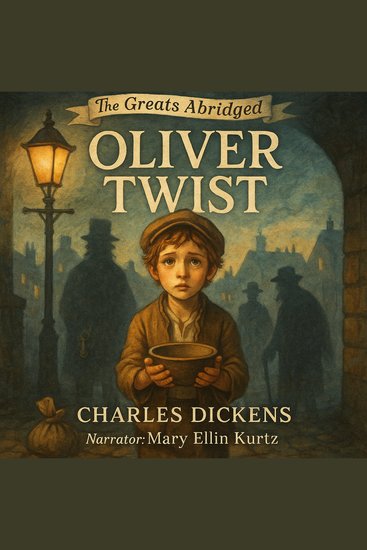
Step into the grim yet hopeful world of Oliver Twist, Charles Dickens' timeless tale of hardship, perseverance, and the quest for belonging—now thoughtfully abridged for modern listeners. Follow young Oliver, an orphan born into poverty and misfortune, as he escapes the harsh workhouse system only to be swept into the dark underworld of London crime led by the cunning Fagin and his band of pickpockets. Along the way, Oliver’s journey brings him face to face with both the cruelest and kindest sides of Victorian society.
This abridged version retains all the heart, tension, and social commentary of the original while offering a streamlined narrative ideal for students, families, and first-time Dickens readers. Narrated with warmth and clarity by Mary Ellin Kurtz, The Greats Abridged: Oliver Twist brings new life to a classic for all ages.
Show book





