Join us on a literary world trip!
Add this book to bookshelf
Grey
Write a new comment Default profile 50px
Grey
Subscribe to read the full book or read the first pages for free!
All characters reduced
The Man from Snowy River (Poetry) - Enriched edition - cover

The Man from Snowy River (Poetry) - Enriched edition

A. B. Paterson

Publisher: Musaicum Books

  • 0
  • 0
  • 0

Summary

A.B. Paterson's 'The Man from Snowy River' is a timeless collection of poetry that captures the rugged beauty and harshness of the Australian outback. Paterson's use of vivid imagery and unique rhyme scheme adds depth to his portrayal of life in the bush, making this work a classic of Australian literature during the late 19th century. The poems in this collection highlight the struggles faced by the working class, the bond between man and nature, and the spirit of perseverance in the face of adversity. Paterson's writing style is both evocative and engaging, drawing readers into the world of his characters with vivid descriptions and emotive language. A.B. Paterson, also known as Banjo Paterson, drew inspiration from his own experiences living and working in the Australian bush, as well as his observations of everyday life in the rural communities. His deep connection to the land and its people is evident in the authenticity and passion of his poetry, making 'The Man from Snowy River' a reflection of his personal values and beliefs. I highly recommend 'The Man from Snowy River' to readers interested in Australian literature, poetry, and exploration of themes such as nature, hardship, and resilience. Paterson's work offers a poignant and captivating glimpse into the soul of the Australian outback, making it a must-read for anyone seeking to understand the rich cultural heritage of the region.

In this enriched edition, we have carefully created added value for your reading experience:
- A comprehensive Introduction outlines these selected works' unifying features, themes, or stylistic evolutions.
- A Historical Context section situates the works in their broader era—social currents, cultural trends, and key events that underpin their creation.
- A concise Synopsis (Selection) offers an accessible overview of the included texts, helping readers navigate plotlines and main ideas without revealing critical twists.
- A unified Analysis examines recurring motifs and stylistic hallmarks across the collection, tying the stories together while spotlighting the different work's strengths.
- Reflection questions inspire deeper contemplation of the author's overarching message, inviting readers to draw connections among different texts and relate them to modern contexts.
- Lastly, our hand‐picked Memorable Quotes distill pivotal lines and turning points, serving as touchstones for the collection's central themes.
Available since: 12/17/2020.
Print length: 63 pages.
Other books that might interest you

  • Rhyme A Dozen A - Unrequited Love - 12 Poets 12 Poems 1 Topic - cover

    Rhyme A Dozen A - Unrequited...

    A E Housman, William...

    • 0
    • 0
    • 0
    ‘A dime a dozen’ as known in America, is perhaps equal to the English ‘cheap as chips’ but whatever the lingua franca of your choice in this series we hereby submit ‘A Rhyme a Dozen’ as 12 poems on many given subjects that are a well-rounded gathering, maybe even an essential guide, from the knowing pens of classic poets and their beautifully spoken verse to the comfort of your ears. 
     
    1 - A Rhyme A Dozen - 12 Poems, 12 Poets, 1 Topic - Unrequited Love - An Introduction 
    2 - Because I Liked You  by A E Housman 
    3 - Sonnet 87 - Farewell! Thou Art Too Dear For My Possessing by William Shakespeare 
    4 - No One So Much As You by Edward Thomas 
    5 - No Platonic Love by William Cartwright 
    6 - Sonnets On Miss Savage by Samuel Butler 
    7 - I Prithee Send Me Back My Heart by Sir John Suckling 
    8 - Heart We Will Forget Him by Emily Dickinson 
    9 - The Spring by Thomas Carew 
    10 - The Forsaken Lover Consoleth Himself With Rememberance of Past Happiness by Sir Thomas Wyatt 
    11 - The Given Heart by Abraham Cowley 
    12 - Longing by Matthew Arnold 
    13 - Annabel Lee by Edgar Allan Poe
    Show book
  • The Prophet - by Kahlil Gibran - cover

    The Prophet - by Kahlil Gibran

    Kahlil Gibran

    • 0
    • 0
    • 0
    The Prophet by Khalil Gibran is a timeless masterpiece of poetic prose that explores universal themes of love, life, and the human experience. Written in a deeply lyrical and spiritual tone, the book follows Almustafa, a wise prophet, as he prepares to leave the city of Orphalese after twelve years. Before his departure, the townspeople gather to seek his counsel, prompting him to share profound reflections on 26 essential aspects of life, including love, marriage, work, freedom, joy, and sorrow. Through its eloquent and thought-provoking insights, The Prophet offers readers an inspiring guide to living with purpose, compassion, and self-awareness. Its enduring relevance and universal wisdom have made it a beloved literary treasure across generations.
    Show book
  • The Inspector-General - cover

    The Inspector-General

    Nikolai Gogol

    • 0
    • 0
    • 0
    "The Inspector General" tells the story of a young and naive government clerk named Khlestakov who is mistaken for a high-ranking government inspector by the corrupt officials of a small provincial town. The officials go to great lengths to win favor with Khlestakov, unaware that he is an imposter. The play explores themes of corruption, greed, and the absurdity of human behavior.
    Show book
  • Foam - cover

    Foam

    Harry McDonald

    • 0
    • 0
    • 0
    'You forget I knew you were a queer long before I knew you were a fascist.'
    1974, a public lavatory. Nicky shaves his head, watched by an older man.
    Publicly, Nicky is a skinhead. And a neo-Nazi. But right now, in this place, that doesn't matter. This is not the first man Nicky has met in a public toilet, and he won't be the last…
    Spanning twenty years and inspired by a true story, Foam examines the nature of identity and the consequences of right-wing extremist ideology against the backdrop of London's skinhead and gay scenes of the 1970s and 1980s.
    Colliding the terrifyingly personal and the violently political, Harry McDonald's play Foam was first performed at the Finborough Theatre, London, in 2024, directed by Matthew Iliffe.
    Show book
  • The Theogony - cover

    The Theogony

    Hesiod

    • 0
    • 0
    • 0
    The Theogony "the genealogy or birth of the gods" is a poem by Hesiod (8th – 7th century BC) describing the origins and genealogies of the Greek gods, composed c. 730–700 BC. It is written in the Epic dialect of Ancient Greek and contains 1022 lines. 
    Hesiod's Theogony is a large-scale synthesis of a vast variety of local Greek traditions concerning the gods, organized as a narrative that tells how they came to be and how they established permanent control over the cosmos. It is the first known Greek mythical cosmogony. The initial state of the universe is chaos, a dark indefinite void considered a divine primordial condition from which everything else appeared. Theogonies are a part of Greek mythology which embodies the desire to articulate reality as a whole; this universalizing impulse was fundamental for the first later projects of speculative theorizing.
    Hesiod appropriates to himself the authority usually reserved to sacred kingship. The poet declares that it is he, where we might have expected some king instead, upon whom the Muses have bestowed the two gifts of a scepter and an authoritative voice (Hesiod, Theogony 30–3), which are the visible signs of kingship. It is not that this gesture is meant to make Hesiod a king. Rather, the point is that the authority of kingship now belongs to the poetic voice, the voice that is declaiming the Theogony.
    Show book
  • A God in Need of Help - cover

    A God in Need of Help

    Sean Dixon

    • 0
    • 0
    • 0
    Nominated for the 2014 Governor General's Literary Award for Drama


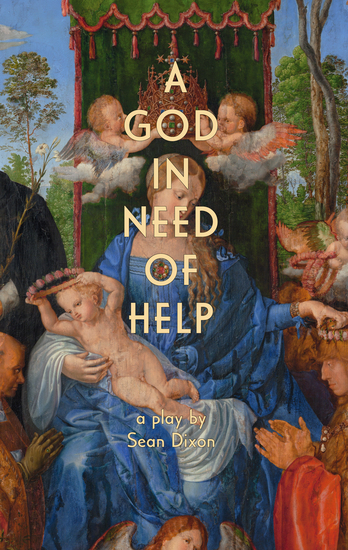
       It's 1606 and Europe is at war over God. At the behest of the Holy Roman Emperor, Rudolf II, Venice's four strongest men are charged with transporting a holy painting - Albrecht Dürer's  The Brotherhood of the Rosary  - across the Alps to Prague. In the small Alpine village of Pusterwald, they are set upon by Protestant zealots; their escape is attributed to a miracle.


       The strongmen and their captain are summoned to an inquiry, led by the magistrate of Venice and the cardinal archbishop of Milan, to determine whether something divine did indeed occur. Each man's recounting adds a layer of colour to the canvas.


       Through this vividly painted mystery, inspired by true events, Sean Dixon challenges the role of faith at thedawn of the Age of Reason.
    Show book