
Join us on a literary world trip!
Add this book to bookshelf
Grey
Write a new comment Default profile 50px
Grey
Subscribe to read the full book or read the first pages for free!
All characters reduced
An ivory trader in North Kenia - Expedition through Kikuyu to Galla-land in Africa; with an account of the Rendili and Burkeneji tribes - cover

An ivory trader in North Kenia - Expedition through Kikuyu to Galla-land in Africa; with an account of the Rendili and Burkeneji tribes

A. Arkell-Hardwick

Publisher: Good Press

  • 0
  • 0
  • 0

Summary

In "An Ivory Trader in North Kenya," A. Arkell-Hardwick offers a compelling narrative that intricately weaves the realities of 20th-century ivory trading with the socio-political landscape of colonial East Africa. The book is characterized by its vivid descriptions and nuanced characterizations, employing a narrative style rich in detail and evocative imagery. Arkell-Hardwick's exploration of ethical dilemmas faced by traders amidst the booming ivory trade captures the conflicts between indigenous cultures and colonial enterprises, resonating with historical context while reflecting on timeless themes of greed and environmental stewardship. A. Arkell-Hardwick, a noted anthropologist and historian, draws upon his extensive field research and firsthand experience in East Africa to provide an authentic account. His passion for wildlife conservation and cultural anthropology deeply informs his interpretations of the ivory trade's impact on both the ecosystem and local communities. These personal and professional insights lend a depth of authenticity to the narrative, making it both engaging and enlightening. Highly recommended for both historians and general readers alike, this book opens a window into a bygone era, challenging readers to reflect on the lasting consequences of colonialism and the ongoing issues related to wildlife conservation. Arkell-Hardwick's work serves as both a historical account and a cautionary tale, making it essential reading for those interested in the complexities of human-animal relationships.
Available since: 03/02/2025.
Print length: 120 pages.

Other books that might interest you

  • Threat Multiplier - Climate Military Leadership and the Fight for Global Security - cover

    Threat Multiplier - Climate...

    Sherri Goodman

    • 0
    • 0
    • 0
    Threat Multiplier takes us onto the battlefield and inside the Pentagon to show how the US military is confronting the biggest security risk in global history: climate change. More than thirty years ago, Sherri Goodman became the Pentagon's first chief environmental officer. Indeed, for much of the twentieth century, the Department of Defense (DOD) was better known for containing the Soviet nuclear threat than protecting the environment. And yet, today, the military has moved from an environmental laggard to a clean energy and climate leader, recognizing that a warming world exacerbates every threat—from hurricanes and forest fires, to competition for increasingly scarce food and water, to terrorism and power plays by Russia and China. The Pentagon now considers climate in war games, disaster relief planning, international diplomacy, and even the design of its own bases. 


    What was the key to this dramatic change in military thinking? What keeps today's generals and admirals up at night? How can we safeguard our national defense and our planet? No one is better poised to answer these questions than Sherri Goodman, who was at the vanguard of environmental leadership among our armed forces and civilian representatives. In Threat Multiplier, she tells the inside story of the military's fight for global security, a tale that is as hopeful as it is harrowing.
    Show book
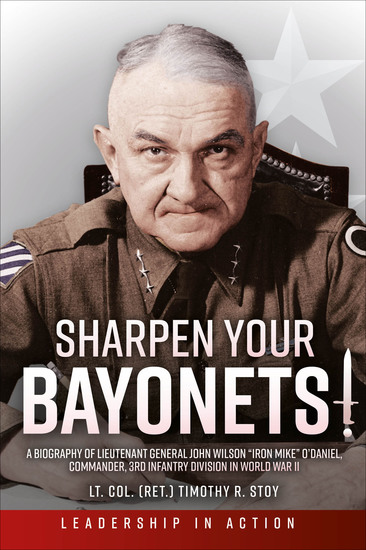
  • Sharpen Your Bayonets - A Biography of Lieutenant General John Wilson “Iron Mike” O'Daniel Commander 3rd Infantry Division in World War II - cover

    Sharpen Your Bayonets - A...

    Timothy R. Stoy, Anthony A. Cucolo

    • 0
    • 0
    • 0
    The first full-length biography of World War II general and Cold Warrior John Wilson "Iron Mike" O’Daniel, featuring "the very essence of the man… who spent more time under fire with his front-line troops than behind the safety of his office desk." — ARGunners.comJohn Wilson “Iron Mike” O’Daniel was one of the U.S. Army’s great fighting generals of the 20th century. He began his military career with the Delaware Militia in 1914, served on the Mexican border in 1916, received a Distinguished Service Cross in World War I, was Mark Clark’s man for hard jobs in the early days of World War II, and commanded the storied 3rd Infantry Division from Anzio to the end of the war in Europe, ending the war in Salzburg after liberating Munich, and Hitler’s Berghof and Eagle’s Nest on the Obersalzberg, Bavaria, Germany. “Iron Mike “commanded I Corps in Korea 1951–1952 and ended his career as the Chief of the Military Assistance Advisory Group in Vietnam in the early days of American involvement there.  LTC Stoy paints a vivid picture of this great American warrior who played an important role in World War II, became an ardent anti-Communist crusader after duty in Moscow as Military Attaché 1948–1950 as the Cold War intensified, laid the foundation for the Army of the Republic of Vietnam, and remained an ardent supporter of President Ngo Dinh Diem while serving as Chairman of the American Friends of Vietnam from his retirement in 1956 until 1963, shortly before Diem’s assassination.
    Show book
  • One Shot - One Kill - American Combat Snipers World War II Korea Vietnam Beirut - cover

    One Shot - One Kill - American...

    Craig Roberts, Charles W. Sasser

    • 0
    • 0
    • 0
    They are the lone wolves of the battlefield. Tracking the enemy, lying in wait for the target to appear—then they shoot to kill. Armed with an unerring eye, infinite patience and a mastery of camouflage, combat snipers stalk the enemy with only one goal . . . In World War II, Korea, Vietnam, and Beirut, American snipers honed the art of delivering a single deadly shot from nowhere—and devastating enemy morale. They met the enemy on his own turf, picking off officers, unwary soldiers, and even other snipers from extraordinary distances of up to 1 ½ miles. Now, these uncommon men tell their stories: of the emotions felt when a man's face came into their crosshairs and they pulled the trigger, of the nerve-wracking hours and days of waiting, motionless, for the enemy, of the primal savagery of a sniper duel.Often trained haphazardly in wartime, and forgotten in times of peace, combat snipers were officially recognized after the Vietnam War, when the Marine Corps became the first military branch to start a full-time sniper school. One Shot-One Kill is their powerful record of desperate trials and proud victories.
    Show book
  • Psycholinguistics - A Very Short Introduction - cover

    Psycholinguistics - A Very Short...

    Fernanda Ferreira

    • 0
    • 0
    • 0
    This Very Short Introduction to psycholinguistics is an accessible and engaging description of how people use language. Talking and understanding language probably seem like simple and straightforward skills, but research in psycholinguistics has shown that complex computations take place behind the scenes when you communicate with others. Recent debates concerning how AI tools such as ChatGPT work highlight some of these core questions about the language faculty and how it is that humans comprehend, produce, and learn language. 


    The book begins with an overview of the fields of linguistics and psychology and how they have cooperated from the earliest days of psycholinguistics. Issues that are considered include: (1) How successfully do people adapt what they say to the needs of their audience when they design their phrases and sentences? (2) How do people read languages such as Chinese, which do not use an alphabetic writing system? (3) Do the size and efficiency of a person's memory affect how effectively people use language? (4) Is bilingualism cognitively advantageous, and if so, what are the mechanisms that lead to this so-called bilingual advantage? And (5) Do users of sign language gesture when they communicate? These questions and more are answered using insights from the latest research based on methods from the cognitive and neurosciences.
    Show book
  • Richard Nixon - The Prominent Republican President from California - cover

    Richard Nixon - The Prominent...

    Kelly Mass

    • 0
    • 0
    • 0
    Richard Milhous Nixon was the United States' 37th president, serving from 1969 to 1974. Nixon, a Republican politician, formerly worked as the 36th Vice President from 1953 to 1961, after rising to country prominence as a California agent and senator. 
    Following the Watergate occurrence, he ended up being the only president to leave from office after 5 years in the White Home that observed the end of the Vietnam War, détente with the Soviet Union and China, the first manned moon landings, and the starting of the Epa. 
    Let’s learn more about this president who was serving in a crucial time period in American history.
    Show book
  • No Children It Makes Sense! - Survey on the Phenomenon of Non-Parents - cover

    No Children It Makes Sense! -...

    Nathalie Six

    • 0
    • 0
    • 0
    “Kids are great. It’s a unique process that everyone should experience.” Except that today, 1 in 20 French people refuse to have children. What are the reasons for this “voluntary infertility?”
    Do we really know why we have children? Isn’t having children an obstacle to personal and professional development? In an overpopulated and polluted world, isn’t it selfish to take up too much space by having a family? Don’t children cost too much to individuals and to society?
    The author investigates with dozens of women and men for whom the “duty to procreate” rings hollow. Among these “non-parents” are exclusive lovers, artists, careerists, religious people, traumatized children, eternal teenagers, environmentalists, convinced Malthusians, as well as feminist activists who have made their refusal to give birth a standard, in order to assert themselves in a society that praises all mothers and family values.
    Show book