Join us on a literary world trip!
Add this book to bookshelf
Grey
Write a new comment Default profile 50px
Grey
Subscribe to read the full book or read the first pages for free!
All characters reduced
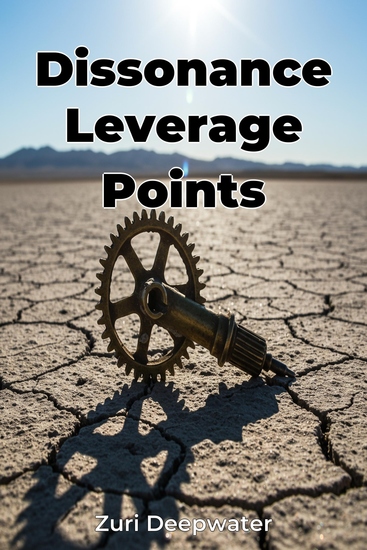
Dissonance Leverage Points - cover

Dissonance Leverage Points

Zuri Deepwater

Translator A AI

Publisher: Publifye

  • 0
  • 0
  • 0

Summary

"Dissonance Leverage Points" explores the compelling intersection of psychology and business management through the lens of cognitive dissonance—the mental discomfort we experience when our beliefs clash. This book argues that understanding and strategically managing this dissonance can be a powerful tool for influencing behavior and driving positive change. It reveals how businesses can create carefully crafted interventions at "dissonance leverage points" to align individual actions with desired outcomes, turning potential conflict into opportunities for growth and improvement.

 
The book begins by grounding readers in the core principles of cognitive dissonance, drawing from seminal research in social psychology to illustrate its profound impact on decision-making. It then progresses to examine specific techniques for ethically creating dissonance, showcasing real-world case studies of successful and unsuccessful applications. Furthermore, it details strategies for resolving dissonance, emphasizing transparency and respect for individual autonomy.

 
This unique approach provides a practical framework for readers seeking to understand and apply psychological principles in a business context. Whether you're a leader aiming to motivate your team, a marketer crafting persuasive campaigns, or simply curious about the science of influence, "Dissonance Leverage Points" offers actionable insights into harnessing the power of cognitive dissonance.
Available since: 02/27/2025.
Print length: 84 pages.

Other books that might interest you

  • African Americans and the Gettysburg Campaign - cover

    African Americans and the...

    James M Paradis

    • 0
    • 0
    • 0
    The Sesquicentennial edition of African Americans and the Gettysburg Campaign updates the original 2006 edition, as James M. Paradis introduces readers to the African-American role in this famous Civil War battle. In addition to documenting their contribution to the war effort, it explores the members of the black community in and around the town of Gettysburg and the Underground Railroad activity in the area.
    Show book
  • Combat Trauma - A Personal Look at Long-Term Consequences - cover

    Combat Trauma - A Personal Look...

    James D Johnson

    • 0
    • 0
    • 0
    “In this incredibly courageous expose,” Vietnam veterans discuss the long-lasting effects of PTSD and their strategies for coping (Publishers Weekly). Though much has been written about the short-term experience of combat trauma, very few resources discuss how that trauma continues to impact individuals into later life. In this volume, retired Army Chaplain James D. Johnson relates how fifteen Vietnam veterans have been affected by the terror they experienced four decades ago, and how it continues to affect them today.   With candor and vivid detail, they reveal how their combat trauma symptoms still infect their thoughts, feelings, and behaviors on a daily basis. Their stories offer valuable insight for today’s soldiers returning from battle, as well as for their loved ones. The experiences shared here can help them address and cope with the ongoing challenges of PTSD.   Those who still carry these wounds will find that they are not alone, and that there are ways of dealing with the horror, no matter how long ago it took place.
    Show book
  • Daily Roman Life - How Ordinary Citizens Lived Worked and Worshiped (3 in 1) - cover

    Daily Roman Life - How Ordinary...

    Rogan Fish

    • 0
    • 0
    • 0
    This bundle of books brings the ancient world of Rome to life by immersing readers in the everyday experiences of its people. Far from the battles and politics that dominate history books, this volume explores how Roman citizens spent their days—from bustling markets in the forum to quiet evenings with family in modest insula apartments or rural villas. Readers will gain insight into the structure of Roman homes, the diet of the average citizen, and the significance of clothing, hygiene, and household roles in shaping Roman identity. 
    The second part of the book focuses on work and social structure. Whether farmers in the countryside, artisans in the city, or traders in the empire’s vast markets, Romans occupied a wide range of roles. The influence of slaves, apprenticeships, and labor guilds is discussed alongside the rising middle class and their contributions to the Roman economy. Readers will also learn about education for boys and girls, how marriage and divorce functioned, and the importance of public spaces like bathhouses, theaters, and circuses in daily life. 
    The final section explores Roman religious life—both public and private. From ancestor worship at household shrines to elaborate temple ceremonies for gods like Jupiter, Venus, and Mars, religion permeated every aspect of Roman existence. This section also covers omens, superstitions, and the Roman calendar of festivals that blended spirituality with community. Daily Roman Life presents a vivid portrait of a complex, vibrant society—reminding us that behind every empire are the lives of ordinary people who cooked, prayed, worked, and dreamed.
    Show book
  • Conquer Your Bad Habits - Secrets to Long-Lasting Change - cover

    Conquer Your Bad Habits -...

    MD Amen

    • 0
    • 0
    • 0
    Habits, whether good or bad, run our lives. What if there's a simple, practical way to get rid of the bad ones and replace them with healthy ones?
    
    If you find yourself habitually overeating, overspending, procrastinating, getting distracted, interrupting, people-pleasing, wasting time, automatically saying no, or drinking too much alcohol, neuropsychiatrist and best-selling author Daniel Amen, MD, has encouraging news for you: Your brain does what you train it to do. So even if you've trained your brain to normalize unhealthy behavior, you can also train it to turn bad habits into good ones in order to experience more joy and contentment.
    
    
    In Conquer Your Bad Habits, Dr. Amen combines approachable neuroscience and years of clinical research as he reveals:
    
    - the six most important brain systems that run your life
    - the five basic steps to conquering your unhealthy habits and setting new goals
    - how to overcome ten common bad habits
    - what to do when bad habits become addictions
    There's no better time than now to let Dr. Amen show you how to retrain your brain and eliminate your negative behaviors once and for all—so you can live a happier, healthier life.
    Show book
  • America's Youngest Ambassador - The Cold War Story of Samantha Smith’s Lasting Message of Peace - cover

    America's Youngest Ambassador -...

    Lena Nelson

    • 0
    • 0
    • 0
    In 1982, amid the nuclear paranoia that engulfed the US and the Soviet Union, Samantha Smith, a fifth grader from Manchester, Maine, wrote a letter to the Kremlin asking the Soviet leader if he was going to start a war. When Pravda, the biggest Soviet newspaper, published her letter—and Samantha received an unprecedented invitation to visit the Soviet Union —her family embarked on a historic journey. 


    The story of a young American girl's letter to the Soviet leader and her innocent curiosity about the other side of the Iron Curtain holds an important lesson for every American. America's Youngest Ambassador provides insights into a forgotten era and has an important message for young people who strive to be more involved in facilitating change, both locally and worldwide. 


    Juxtaposing Samantha's narrative with that of her own childhood in the Soviet Union in the 1980s, Lena Nelson explores the consequences of government propaganda on both sides of the ocean and reveals how Samantha Smith's journey in the summer of 1983 helped melt the hearts of the Soviets and thaw the ice of the Cold War. Drawing on interviews conducted in both the US and Russia with key players in the events of those days, Nelson blends storytelling, anecdotes, and analysis of Soviet-American relations to tell the story of this unprecedented moment in history.
    Show book
  • Statistical Physics - The Physics of Particles and Systems - cover

    Statistical Physics - The...

    Mark Hedges

    • 0
    • 0
    • 0
    Statistical mechanics is the branch of physics that applies probability theory and statistics to describe the behavior of systems with a large number of particles. It provides a framework for understanding macroscopic phenomena in terms of the microscopic properties of individual particles. The central goal of statistical mechanics is to connect the microscopic world of atoms and molecules with the macroscopic world of thermodynamic variables like temperature, pressure, and volume. 
    Historically, statistical mechanics emerged in the 19th century as scientists sought to explain the observed laws of thermodynamics, which describe the behavior of systems in equilibrium. Classical thermodynamics, while incredibly successful, was primarily phenomenological and lacked a fundamental microscopic understanding. This gap was filled by the development of statistical mechanics, largely attributed to the works of Ludwig Boltzmann, James Clerk Maxwell, and Josiah Willard Gibbs. 
    At its core, statistical mechanics is based on the idea that the behavior of macroscopic systems can be understood by considering the collective behavior of their microscopic constituents. Instead of directly tracking every particle, which is practically impossible for large systems, statistical mechanics calculates the statistical properties of the system. These properties are derived from the laws of probability
    Show book