
Unisciti a noi in un viaggio nel mondo dei libri!
Aggiungi questo libro allo scaffale
Grey
Scrivi un nuovo commento Default profile 50px
Grey
Iscriviti per leggere l'intero libro o leggi le prime pagine gratuitamente!
All characters reduced
Big Data Surveillance - cover

Big Data Surveillance

Zuri Deepwater

Traduttore A AI

Casa editrice: Publifye

  • 0
  • 0
  • 0

Sinossi

Big Data Surveillance explores the pervasive world of data collection by corporations and governments, revealing how our digital footprints impact individual privacy and societal control. The book examines the techniques used to gather and analyze personal data, the ethical dilemmas arising from its usage, and the legal frameworks intended to safeguard our information. Did you know that algorithms can inadvertently perpetuate biases, leading to unequal outcomes for certain groups? Understanding these dynamics is crucial in an era where our digital lives are constantly monitored. This book uniquely links corporate and governmental surveillance, highlighting their interconnectedness and the challenges they pose to privacy. By examining the historical evolution of data collection and its social implications, it empowers readers to critically assess current practices. It progresses from introducing big data surveillance to exploring data economics, algorithmic influence, and culminates with solutions such as policy recommendations and personal privacy strategies.
Disponibile da: 05/05/2025.
Lunghezza di stampa: 83 pagine.

Altri libri che potrebbero interessarti

  • Searching for George Gordon Meade - The Forgotten Victor of Gettysburg - cover

    Searching for George Gordon...

    Tom Huntington

    • 0
    • 0
    • 0
    A historian chronicles the life of the Union Civil War general while recounting his own unusual journey during his investigation into the past. Who was George Gordon Meade? He should be remembered as one of the Civil War’s most important generals. Instead, history has pushed him aside. The hot-tempered Meade received command of the Union’s dysfunctional Army of the Potomac only three days before he defeated Robert E. Lee’s Confederates at Gettysburg. After that, Meade watched his reputation decline, thanks in part to the escape of Lee’s army, hostility from politicians and the press, the machinations of Gen. Daniel Sickles, and the rise of Ulysses S. Grant. “I suppose after a while,” Meade once grumbled, “it will be discovered I was not at Gettysburg at all.”  The Rodney Dangerfield of Civil War generals, Meade gets no respect—and author Tom Huntington wanted to find out why. In Searching for George Gordon Meade, he tells the story of the general’s life and his participation in the Civil War’s great engagements, from George McClellan’s Richmond Campaign to Appomattox. Huntington also provides accounts of his own investigations of Meade’s legacy. Along the way he hikes across battlefields, recites the names of fallen soldiers at a candlelit ceremony at Gettysburg, drinks a champagne toast at Meade’s grave on New Year’s Eve, and visits a severed leg, a buried arm, and a horse’s head. The result is a quirky and compelling mash-up of history, biography, travel, and journalism that casts new light on an overlooked figure from the past. Praise for Searching for George Gordon Meade“Unique and irresistible.” —Harold Holzer, chairman of Lincoln Bicentennial Foundation“Huntington’s wry, boisterous biography-within-a-travel journal . . . strives to remake the reputation of Meade and offers a compelling new way to approach biography.” —John G. Shelby, Meade: The Price of Command, 1863–1865 “It’s the rare reader who will not enjoy accompanying Huntington on his search for Meade.” —America’s Civil War "A refreshingly readable and well-researched book. . . . Searching for George Gordon Meade should be required reading for all those interested in Civil War history.” —Civil War News
    Mostra libro
  • Mothers and Other Fictional Characters - A Memoir in Essays - cover

    Mothers and Other Fictional...

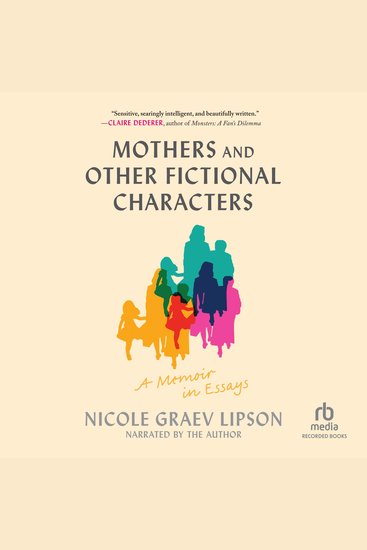
    Nicole Graev Lipson

    • 0
    • 0
    • 0
    In this intimate and riveting memoir, Best American Essayist Nicole Graev Lipson breaks through the ready-made stories of womanhood, rescuing truth from the fiction that infiltrates our lives. 
      
    What does it take to escape the plotlines mapped onto us? Searching for clues in the work of her literary foremothers, Lipson untangles what it means to be a girl, a woman, a lover, a partner, a daughter, and a mother in a world all too ready to reduce us to stock characters. Whether she’s testing the fragile borders of fidelity, embracing the taboo power of female friendship, escaping her family for the solitude of the mountains, grappling with what to do with her frozen embryos, or letting go of the children she imagined for the ones she’s raising, Lipson pushes beyond the easy, surface stories we tell about ourselves to brave less certain territory.  
      
    As Lipson journeys through this thorny terrain, literature becomes her lodestar. Kate Chopin’s erotic story “The Storm” helps her reckon with the longings stirring below the surface of her marriage. Watching her son absorb the stifling codes of manhood, she finds unlikely parenting inspiration in Philip Roth’s most cartoonish overbearing mother. Summoning Gwendolyn Brooks, she asks, Can destroying one’s frozen embryos be understood as a maternal act? And accompanied by Shakespeare’s gender-bending heroine Rosalind, she seizes on the truest meaning of loving her oldest child.  
      
    Risky and revealing, nourishing and affirming, rigorous and sexy, Mothers and Other Fictional Characters is a shimmering love letter to our forgotten selves—and the ones we’re still becoming. 
      
    “Sensitive, searingly intelligent, and beautifully written.”—Claire Dederer, author of Monsters: A Fan’s Dilemma
    Mostra libro
  • Inheriting the Ancient Near East after Alexander the Great: The Rise and Fall of the Seleucid Empire and the Ptolemaic Kingdom - cover

    Inheriting the Ancient Near East...

    Editors Charles River

    • 0
    • 0
    • 0
    On his deathbed, some historians claim that when he was pressed to name a successor, Alexander the Great muttered that his empire should go “to the strongest”. Other sources claim that he passed his signet ring to his general Perdiccas, thereby naming him successor, but whatever his choices were or may have been, they were ignored. Alexander’s generals, all of them with the loyalty of their own corps at their backs, would tear each other apart in a vicious internal struggle that lasted almost half a century before four factions emerged victorious: Macedonia, the Seleucid Empire in the east, the Kingdom of Pergamon in Asia Minor, and the Ptolemaic dynasty in Egypt. During the course of these wars, Alexander’s only heir, the posthumously born Alexander IV, was murdered, extinguishing his bloodline for ever.  
    	For a time, the Seleucids commanded the largest empire in the world as it stretched from the high plains and deserts of what is now Afghanistan in the east to parts of the Levant and Asia Minor in the west. The empire’s early kings were strong and shrewd and committed to the ideas of Hellenism as much as holding power and expanding the realm of their empire, but later rulers did not prove as capable. In time, the Seleucid royal house often descended into orgies of violence which were driven by ambitious men and women.   
    	Although Alexander never lived to rule over Egypt, one of his generals, Ptolemy I, did, and it was he who established the last great pharaonic dynasty in Egypt, known as the Ptolemaic Dynasty. Despite the infighting among them, one thing Alexander’s generals did agree upon was their Hellenistic culture. Most famously, Ptolemy’s line firmly established the Hellenistic culture of the Greeks while ruling over Egypt, and by marrying within their family line, the Ptolemaic pharaohs kept their Hellenistic heritage until the very end of Ptolemy’s line, which died with Cleopatra in 30 BC.
    Mostra libro
  • Painted People: Humanity in 21 Tattoos - cover

    Painted People: Humanity in 21...

    Matt Lodder

    • 0
    • 0
    • 0
    In 1881, a writer in the Saturday Review called tattooing ‘an art without a history’. ‘No-one’, it went on, ‘has made it the business of his life to study the development of tattooing.’ Until now. 
    Painted People is a beguiling and intimate look at an untold history of humanity. 
    The earliest tattoos yet identified belonged to Ötzi, the ‘iceman’, whose mummy allows us a brief glimpse into the prehistory of the practice. We know that over the more than five thousand years since he was tattooed, countless cultures have performed this ancient practice, and people in every corner of the world have been tattooed. For the most part, these fascinating histories remain stubbornly untold, and the secrets of Siberian princesses, Chinese generals and Victorian socialites have been hidden on the skin, under layers of clothing and under layers of history. Now with access to a wealth of new and unreported material, this book will roll up its sleeves and reveal the artwork hidden beneath them. 
    In Painted People, Dr Matt Lodder, one of the world’s foremost experts on tattooing, tells the stories of people like Arnaq, who was tattooed in keeping with her cultural and religious traditions in sixteenth-century Canada, and Horace Ridler, who was tattooed as a means to make money in 1930s London. And in between these two extremes, he describes tattoos inked for love, for loyalty, for sedition and espionage and for self-expression, as well as tattoos inflicted on the unwilling, to ostracise. Taken together, these twenty-one tattoos paint a portrait of humanity as both artist and canvas. 
    Lodder's Painted People is a top-tier exploration of body art, blending science and design in a unique anthropological study. His criticism of popular views on tattooing offers a fresh perspective on this ancient practise. 
    For fans of Nick Schonberger (The Language of Tattoos), John Miller (The Philosophy of Tattoos), Trent Aitken-Smith (The Tattoo Dictionary), Caroline Vout (Exposed), and Yori Moriarty (Japanese Tattoos). 
    HarperCollins 2022
    Mostra libro
  • Unreasonable Acts of Limitless Generosity - "Ignite your journey with our audiobook on Unreasonable Acts of Limitless Generosity for transformative insights and success!" - cover

    Unreasonable Acts of Limitless...

    Orlin Sutherland

    • 0
    • 0
    • 0
    Unreasonable Acts of Limitless Generosity 
    ⭐⭐ A Simplified Guide for Impactful Giving ⭐⭐ 
    Are you eager to enhance your career and reinforce your understanding of inspiring generosity, ensuring you can create unforgettable experiences and lasting connections? 
    In search of an all-encompassing guide that includes everything you need to foster truly generous acts in your personal and professional life? 
    Look no further! 
    This guide is your ultimate resource for deepening your insights, applying your newfound skills, and participating in practical exercises. With this companion, you're set on the path to success. 
    Updated to reflect the latest insights and practices surrounding inspiring generosity. 
    Key highlights of this comprehensive guide: 
    - In-depth reflections on the impact of inspiring generosity on relationships and communities 
    - Thorough exploration of the principles behind creating meaningful connections 
    - Effective strategies for cultivating generosity and making a real difference 
    What sets our guide apart is its exhaustive coverage, essential for achieving your goals. Concepts are thoroughly explored rather than glossed over, ensuring clarity and understanding. 
    Crafted with a clear framework and straightforward language, our guide guarantees a smooth transition between topics. Bid farewell to confusing jargon and embrace content that is lucid, precise, and technically sound. 
    So, what are you waiting for? Click the BUY NOW button, secure your copy, and embark on your journey towards mastering acts of limitless generosity!
    Mostra libro
  • The Navalny case Conspiration to serve foreign policy - cover

    The Navalny case Conspiration to...

    Jacques Baud

    • 0
    • 0
    • 0
    Was Navalny deliberately poisoned? Does the evidence we have justify sanctions against Russia? Was the recording with the KGB agent a set-up? Is Navalny really the "main opponent of Vladimir Putin"? Does his film about "Putin's Palace" reflect reality? This book is the first investigation of the Navalny case. It is based on official American, British, Russian, French and German documents. Written by an ex-agent of the Swiss secret service who fought for ten years against the Soviet Union, this account highlights a new way of practicing foreign policy: passionate, disordered, without hindsight or constructive purpose. The immediate application of sanctions while the facts remain unclear removes all space for diplomacy. The Western unison around this affair and the censorship against dissenting voices reveal a disturbing evolution of society and its growing vulnerability to manipulation. We create realities out of our prejudices: this is the definition of conspiracy, which has become the main weapon of Western countries. We do what we reproach the autocrats for. Jacques Baud, a colonel in the Swiss army, is an expert in chemical and nuclear weapons, and trained in counter-terrorism and counter-guerrilla warfare. In the service of the United Nations, he was head of doctrine for peacekeeping operations in New York, and engaged in Africa. At NATO, he led the fight against the proliferation of small arms. 
    This audiobook is read by a synthesized voice.
    Mostra libro