¡Acompáñanos a viajar por el mundo de los libros!
Añadir este libro a la estantería
Grey
Escribe un nuevo comentario Default profile 50px
Grey
Suscríbete para leer el libro completo o lee las primeras páginas gratis.
All characters reduced
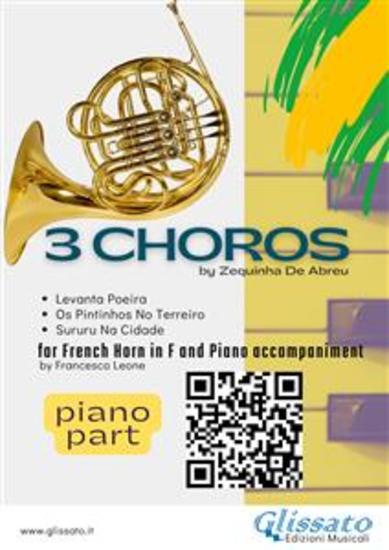
Piano accompaniment part: 3 Choros by Zequinha De Abreu for Horn and Piano - Levanta Poeira - Os Pintinhos No Terreiro - Sururu Na Cidade - cover

Piano accompaniment part: 3 Choros by Zequinha De Abreu for Horn and Piano - Levanta Poeira - Os Pintinhos No Terreiro - Sururu Na Cidade

Zequinha De Abreu

Editorial: Glissato Edizioni Musicali

  • 0
  • 0
  • 0

Sinopsis

Piano accompaniment part of 3 Choros by Zequinha De Abreu (author of Tico Tico) arranged for intermediate/advanced Horn and intermediate Piano, duration 7.00 (+-). Content titles: 1. Levanta Poeira 2. Os Pintinhos No Terreiro 3. Sururu Na Cidade. French Horn part available in series. Scan Qr code (in cover) for audio demo or visit www.glissato.it. product code: EG1444.

	To enhance the understanding of the compositions and the maestro behind them, multilingual sheets are provided. These sheets, invaluable for concert presentations, are available in English, French, German, Spanish, Portuguese, Italian, Korean, Japanese, and Chinese.
	Choro, also popularly called chorinho ("little cry" or "little lament"), is an instrumental Brazilian popular music genre which originated in 19th century Rio de Janeiro. Despite its name, the music often has a fast and happy rhythm. It is characterized by virtuosity, improvisation and subtle modulations, and is full of syncopation and counterpoint. Choro is considered the first characteristically Brazilian genre of urban popular music.
Disponible desde: 19/03/2022.
Otros libros que te pueden interesar

  • Kill Bill - Volume 2 - The Ultimate Trivia Collection - From The Movie Directed By Quentin Tarantino - cover

    Kill Bill - Volume 2 - The...

    Film Trivia Metaverse

    • 0
    • 0
    • 0
    KILL BILL: VOLUME 2 
    THE ULTIMATE TRIVIA COLLECTION 
      
    FROM THE MOVIE DIRECTED BY QUENTIN TARANTINO 
      
    CREATED BY FILM TRIVIA METAVERSE 
      
    ABOUT THE FILM 
    Kill Bill: Vol. 2 is a 2004 martial arts film directed by Quentin Tarantino, and the second part of a two-film revenge saga. The story follows Beatrix Kiddo, also known as The Bride, who continues her quest to avenge the brutal betrayal by her former comrades in the Deadly Viper Assassination Squad. As she hunts down those responsible for the massacre at her wedding, the film explores themes of vengeance, betrayal, and redemption, blending western, samurai, and kung fu genres. Tarantino's signature style includes sharp dialogue, dynamic action sequences, and an exploration of complex relationships. 
      
    TRIVIA SAMPLES: 
      
    "The brothel scene where the Bride meets Esteban Vallejo (played by Michael Parks) was the last scene filmed. It was shot at a real Mexican brothel, with the female extras being actual prostitutes who worked there." 
      
    "Robert Rodriguez composed the film's score for just one dollar. In return, Tarantino agreed to direct a segment of Rodriguez's Sin City (2005) for the same fee." 
      
    "Pai Mei’s three-inch punch is a reference to Bruce Lee’s famous three-inch knockout punch." 
      
    "After the credits, an alternate take shows the Bride ripping out one of the Crazy 88’s eyes."
    Ver libro
  • The Smut Revolution - From Taboo to Trend - cover

    The Smut Revolution - From Taboo...

    Skyler Bosse

    • 0
    • 0
    • 0
    There is a reason your pulse quickens when you turn to that one particular scene in a book – the one where tension spills over, where restraint shatters, and where characters surrender to something primal, something undeniable. That moment, the one so many readers secretly crave, is smut. 
    Once whispered about behind closed doors, hidden beneath the guise of “guilty pleasures,” smut has clawed its way into mainstream literature, proving that what was once considered taboo is now a genre in its own right. From centuries-old erotic manuscripts to today’s bestselling scorchers, smut has evolved, adapted, and seduced millions along the way. 
    But why do we read it? Why do we write it? And why does society continue to both embrace and condemn it in equal measure? 
    Each chapter in this book begins with an excerpt – an unfiltered glimpse into the heart of smut – before shifting to the forces that shape it, the way it has been challenged, censored, and celebrated. Some scenes will linger, some may provoke, but all of them exist because smut, at its core, is more than just raw lust – it is a reflection of desire, fantasy, and the ever-changing boundaries of storytelling. 
    So, turn the page. But be warned: once you indulge, there is no going back.
    Ver libro
  • The Bond Code - cover

    The Bond Code

    Philip Gardiner

    • 0
    • 0
    • 0
    Ian Fleming was a true visionary, a dualistic individual who spent much time in his early life in a "special" school in Austria. It was here where he learned the sacred ways of the early Gnostics and Occultists and developed the very root of the enigmatic secret and eternal charisma of James Bond. 
     
    Fleming explicitly said that Bond was Manichean, a distinctly Gnostic concept. The Bond books and films are strategically seeded with alchemical and Gnostic references for those with "the eyes to see". Fleming associated with mystics and initiated individuals around the globe. 
     
    In the Bond Code, we shall see how deep this web of the occult truly went. Fleming lived in a fantasy world that led him into a land of sinister and esoteric thought. He created his own alter-ego as a great alchemical work to fulfill his own tumultuous and chaotic mind, and he left behind a set of clues and codes for us to decipher. 
     
    Philip Gardiner finally unravels the secret of James Bond, piece by piece, radically reappraising everything we thought we knew about this secret agent and his creator. 
     
    Join us on this journey in a very special and unique audio book version.
    Ver libro
  • Globo Arte april 2024 issue - helping artist in their art career - cover

    Globo Arte april 2024 issue -...

    Globo Arte team

    • 0
    • 0
    • 0
    This is april 2024 issue packed with travel with your art topics, how to support your art and make it full time articles, art motivations tips, ways to increase your revenue in your art business, art features and so much more to help an artist/creative person in creating life of their dreams and support their art, see you in audiobook
    Ver libro
  • Shane - Adapted from the screenplay & performed for radio by the original film stars - cover

    Shane - Adapted from the...

    Mr Punch

    • 0
    • 0
    • 0
    Mr Punch Presents: SHANE, the classic western, nominated for six Academy Awards, is set in the late 1860’s and tells the story of the mysterious retired gunslinger (Alan Ladd), who arrives at the ranch of a family of homesteaders, only to find himself involved in a violent range war. In this special radio production both Alan Ladd and Van Heflin reprise their original film roles from the Oscar winning movie. 
     
    This high-quality audiobook has been re-mastered and re-edited from the original radio broadcast. 
      
    Also available as part of the Hollywood Playhouse BOX SET, a collection of 14 Oscar winning ear-movies, adapted from the original screenplays & performed for the radio by many of the original film stars in front of a live studio audience. 
      
    These radio dramas were….to become as popular as the movies themselves. Hollywood Movie Memories 
      
    This is an excellent audio product that will appeal to the majority of audiobook listeners. Talking Business 
      
    A lovely series to add to any film, audio or crime lovers’ collection. Audio World 
     
    Ver libro
  • Kakatiya Dynasty - Fortresses Flourishing Trade and Administrative Genius - cover

    Kakatiya Dynasty - Fortresses...

    Rolf Hedger

    • 0
    • 0
    • 0
    The Kakatiya Dynasty emerged as a formidable power in the Deccan region of India, leaving behind a rich legacy of military strength, administrative brilliance, and cultural contributions. Their origins can be traced back to the 10th century, though historical records regarding their early rulers remain scarce. Initially, the Kakatiyas served as feudatories under the Rashtrakutas and later the Western Chalukyas, gradually expanding their influence over the Telugu-speaking region. 
    The name "Kakatiya" is believed to have originated from their association with the goddess Kakati, a form of Durga, who was worshipped as their family deity. The earliest known ruler, Venna or Beta I, established the dynasty’s foundation, but it was during the reign of Prola I that the Kakatiyas started asserting their independence. Prola II played a crucial role in strengthening their foothold by resisting Chalukyan dominance and expanding Kakatiya control over the eastern Deccan. 
    During this period, the Deccan was a contested space where multiple regional powers sought dominance. The Kakatiyas capitalized on the declining influence of the Western Chalukyas, strategically aligning themselves with or resisting various rulers to carve out an independent identity. Their stronghold was initially located in Hanamkonda, which later evolved into the grand city of Warangal, a center of Kakatiya power and cultural patronage.
    Ver libro