Join us on a literary world trip!
Add this book to bookshelf
Grey
Write a new comment Default profile 50px
Grey
Subscribe to read the full book or read the first pages for free!
All characters reduced
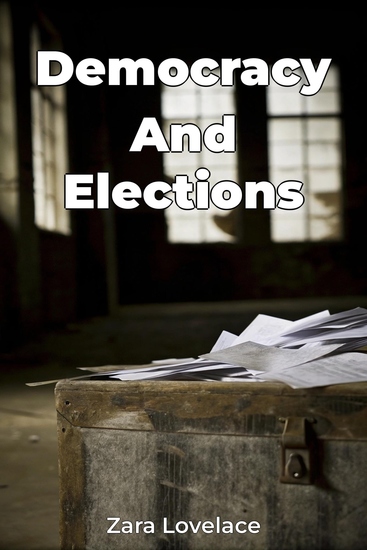
Democracy And Elections - cover

Democracy And Elections

Zara Lovelace

Translator A AI

Publisher: Publifye

  • 0
  • 0
  • 0

Summary

"Democracy And Elections" examines the critical link between elections and effective democratic governance, questioning whether elections truly represent the cornerstone of democracy or merely mask deeper systemic issues. The book explores various voting systems globally, highlighting both their strengths and weaknesses, while also scrutinizing modern challenges like voter suppression and the influence of money in politics. One intriguing fact is the historical evolution of suffrage, revealing the long struggles for universal voting rights and ongoing debates surrounding electoral reforms. The book argues that elections alone are insufficient for a truly representative society, emphasizing the need for constant vigilance, active citizen participation, and addressing systemic inequalities that distort electoral outcomes. It begins by establishing a historical context and then moves to core principles of democratic theory and electoral systems. Later chapters evaluate the practical implications of different systems and investigate challenges that impede fair representation, such as voter ID laws and gerrymandering. This approach provides readers with a comprehensive understanding of the complexities inherent in achieving genuine political representation.
Available since: 02/15/2025.
Print length: 97 pages.

Other books that might interest you

  • Dark Web Chronicles: The Hidden Underbelly Shaping Our World - Dive into Dark Web Chronicles! Unveil secrets with riveting audio for a thrilling enlightening experience - cover

    Dark Web Chronicles: The Hidden...

    Thane Witterly

    • 0
    • 0
    • 0
    Dark Web Chronicles: The Hidden Underbelly Shaping Our World 
    ⭐⭐ Simplified Audio Guide ⭐⭐ 
    Are you looking to progress in your career and solidify your knowledge by successfully navigating the intricate realm of the dark web? 
    Seeking a comprehensive guide that provides all necessary elements to understand the hidden underbelly shaping our world? 
    Your search ends here! 
    This audiobook serves as your definitive companion for deepening your understanding, applying your skills, and engaging in hands-on exercises. With this, you're geared for success. 
    Updated with the latest insights and trends of the digital landscape. 
    Key features of this enriched guide: 
    - Profound insights about the hidden aspects shaping our world 
    - Detailed explanation of the dark web and its influence 
    - Fruitful strategies for protecting yourself and navigating safely 
    Our guide distinguishes itself through comprehensive coverage, which is essential for your understanding and awareness. Concepts aren't merely skimmed; they are delved into with precision. 
    Please note that this guide is not affiliated with any official entity and is purely an independent resource for your benefit. 
    Designed with a clear structure and easy-to-understand language, our guide ensures smooth transitions between topics. Say goodbye to dense jargon and welcome clear, precise, and technically accurate content. 
    So, why wait? Click the BUY NOW button, secure your guide, and begin your journey to understanding the hidden underbelly shaping our world!
    Show book
  • Black Power Scorecard - Measuring the Racial Gap and What We Can Do to Close It - cover

    Black Power Scorecard -...

    Andre M. Perry

    • 0
    • 0
    • 0
    From the creator of “a unified field theory of racism” (NPR’s Planet Money), a dollars-and-cents reckoning of the state of Black America and a new framework to close the power gap Historically, Black Americans’ quest for power has been understood as an attempt to gain equal protections under the law. But power in America requires more than basic democratic freedoms. It is inextricably linked with economic influence and ownership—of one’s self, home, business, and creations. Andre M. Perry draws on extensive research and analysis to quantify how much power Black Americans actually have. Ranging from property, business, and wealth to education, health, and social mobility, Black Power Scorecard moves across the country, evaluating people’s ability to set the rules of the game and calculating how that translates into the ultimate means of power—life itself, and the longevity of Black communities. Along the way, Perry identifies woefully overlooked areas of investment that could close the racial gap and benefit everyone. An expansive take on power supported by documentation and data, Black Power Scorecard is a fresh contribution to the country’s reckoning with structural inequality, one that offers a new approach to redressing it.A Macmillan Audio production from Metropolitan Books.
    Show book
  • Political Philosophy - Ideas and Foundations of Governance - cover

    Political Philosophy - Ideas and...

    Hector Davidson

    • 0
    • 0
    • 0
    Political philosophy plays a central role in the development of societies, offering profound insights into the principles and ideas that shape governance and human relations. At its core, political philosophy seeks to understand the fundamental questions of power, authority, justice, and the rights of individuals within a collective. By examining these issues, political philosophy provides a framework for interpreting and evaluating the structures that govern our lives, from the most intimate social arrangements to the global political order. It is through political philosophy that we come to grips with the nature of justice, equality, freedom, and the role of the state in promoting the common good. 
    In every society, political philosophy serves as a critical lens for understanding the legitimacy of authority and the relationship between the individual and the state. Whether through the ideas of ancient philosophers like Plato and Aristotle or the modern theorists such as Hobbes, Locke, and Rousseau, the study of political philosophy allows us to explore the moral and practical foundations of governance. These thinkers sought answers to questions that remain relevant today: What is the rightful role of the government? What are the limits of state power? How can societies balance the competing interests of freedom, equality, and social order? 
    Moreover, political philosophy is essential for the functioning of a healthy democracy. By engaging with political ideas and questioning the established norms, political philosophers encourage critical thinking and the evaluation of political systems. They provide the intellectual tools for assessing the values that underlie our laws, policies, and political institutions. Political philosophy also serves as a guide for navigating complex moral dilemmas in governance, offering insights into how we can create a just society where the rights of individuals are respected while promoting the collective well-being.
    Show book
  • Leveraging Latency - How the Weak Compel the Strong with Nuclear Technology - cover

    Leveraging Latency - How the...

    Tristan A. Volpe

    • 0
    • 0
    • 0
    When does nuclear latency—the technical capacity to build the bomb—enable states to pursue effective coercion? 


    In Leveraging Latency, Tristan A. Volpe argues that having greater capacity to build weaponry doesn't translate to greater coercive advantage. Volpe finds that there is a trade-off between threatening proliferation and promising nuclear restraint. States need just enough bomb-making capacity to threaten proliferation, but not so much that it becomes too difficult for them to offer nonproliferation assurances. The boundaries of this sweet spot align with the capacity to produce the fissile material at the heart of an atomic weapon. 


    To test this argument, Volpe includes comparative case studies of four countries that leveraged latency against superpowers: Japan, West Germany, North Korea, and Iran. In doing so, Volpe identifies a generalizable mechanism—the threat-assurance trade-off—that explains why more power often makes compellence less likely to work. This framework illuminates how technology shapes broader bargaining dynamics and helps to refine policy options for inhibiting the spread of nuclear weapons. As nuclear technology continues to cast a shadow over the global landscape, Leveraging Latency provides a systematic assessment of its coercive utility.
    Show book
  • Lifehouse - Taking Care of Ourselves in a World on Fire - cover

    Lifehouse - Taking Care of...

    Adam Greenfield

    • 0
    • 0
    • 0
    How to reclaim power in a time of perpetual crisis 


    We are living through a Long Emergency: a near-continuous train of pandemics, heatwaves, droughts, resource wars, and other climate-driven disasters. In Lifehouse, Adam Greenfield asks what might happen if the tactics and networks of care that spring up in response to these times might be brought together in a single, coherent way of life? 


    Using examples from the Black Panthers' "survival programs," the astonishingly effective Occupy Sandy disaster-relief effort, and the neighborhood-based mutual aid groups that sustained many during COVID lockdowns to the large-scale, self-organized polities of municipalist Spain and Kurdish Rojava, Greenfield argues for rethinking local power as a bulwark against despair—a way to discover and develop the individual and collective capacities that have gone underutilized during all the long years of late capitalism, and a means for thriving in the face of impending catastrophe.
    Show book
  • Israel: The Last Vestige of European Colonialism in the Middle East - cover

    Israel: The Last Vestige of...

    A.A. Castor

    • 0
    • 0
    • 0
    "Israel: The Last Vestige of European Colonialism in the Middle East" is an in-depth examination of the historical and ongoing impact of European colonialism on the formation and expansion of Israel. Through a critical lens, this book challenges the mainstream narratives that depict Israel as the rightful homeland of the Jewish people and instead explores its colonial roots and the displacement of the indigenous Palestinian population. 
      
    The book delves into the role of European powers, from the Zionist movement's inception in the late 19th century to the political maneuvers that facilitated the establishment of Israel in 1948. It uncovers how Western support, particularly from Britain and the United States, enabled the colonization of Palestine while ignoring the rights of the native population. It also analyzes the demographic changes brought about by waves of European Jewish immigration and presents genetic evidence highlighting the European ancestry of much of the modern Israeli population. 
      
    By exploring topics such as the marginalization of non-European Jewish communities, the ongoing occupation of Palestinian territories, and the influence of Western powers, this book aims to shed light on the historical injustices and colonial dynamics that continue to shape the Israeli-Palestinian conflict. Readers will be encouraged to question established narratives, understand the broader geopolitical implications, and consider the pathways to justice and accountability for the Palestinian people.
    Show book