Junte-se a nós em uma viagem ao mundo dos livros!
Adicionar este livro à prateleira
Grey
Deixe um novo comentário Default profile 50px
Grey
Assine para ler o livro completo ou leia as primeiras páginas de graça!
All characters reduced
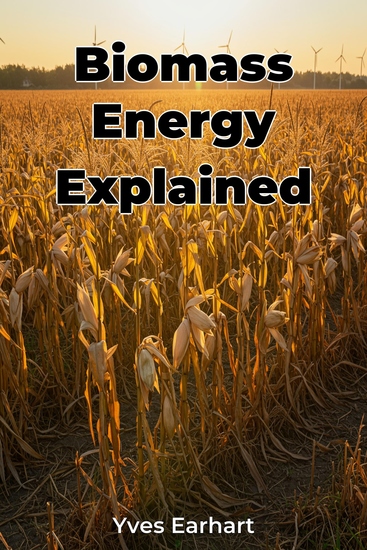
Biomass Energy Explained - cover
LER

Biomass Energy Explained

Yves Earhart

Tradutor A AI

Editora: Publifye

  • 0
  • 0
  • 0

Sinopse

Biomass Energy Explained explores the potential of biomass energy as a renewable resource in our global energy transition. It examines how organic materials can be converted into power, addressing the critical need for sustainable energy sources. The book highlights the environmental implications, including the potential to reduce reliance on fossil fuels and promote energy security.

 
Did you know that biomass has been used as a primary energy source since the days of wood-burning stoves? Or that biomass can contribute to a circular economy by reducing waste?

 
The book begins by outlining the types of biomass resources, such as agricultural residues and energy crops, before dedicating chapters to conversion technologies like gasification and anaerobic digestion. It analyzes each technology's efficiency and environmental footprint, culminating in a comprehensive look at sustainability considerations.

 
Biomass Energy Explained uniquely focuses on integrating biomass with other renewable sources, providing a balanced perspective for policymakers, researchers, and anyone interested in sustainable development.
Disponível desde: 28/02/2025.
Comprimento de impressão: 90 páginas.
Outros livros que poderiam interessá-lo

  • The Way of Coffee - From the Cup Back to the Source — and All the Way Forward Again - cover

    The Way of Coffee - From the Cup...

    omaneo

    • 0
    • 0
    • 0
    This audiobook is narrated by an AI Voice. “Twelve gates, and at every one somebody decides.” 
     
    A journalist follows the cup that stands on his kitchen counter every morning: into a forest in Kaffa, onto a slope beneath shade trees, into a fermentation tank, onto a drying bed, into a container, a roastery — and back again to his kitchen. What he learns on the way is not how to make coffee. It is how little of it depends on him. 
     
    Botany, growing, harvest, processing — from the forest to the sack. 
    Price, seals, trade: where the nine euros of a bag actually go. 
    Roasting, grinding, water, extraction — with numbers that hold. 
    Nine parts, 42 chapters, over fourteen hours. 
     
    Every factual statement checked individually against sources. Where sources contradict one another, the contradiction stands in the text.
    Ver livro
  • I Am; Therefore I Think - Consciousness and Humanity in the Age of AI - cover

    I Am; Therefore I Think -...

    JP Pulcini

    • 0
    • 0
    • 0
    2026 Author of the Year— International Impact Book Awards 
    IndieReader Approved (4.4/5) 
    Winner of the Literary Titan Gold Book Award 
    AI can think. But can it ever be conscious? 
    And what if we've misunderstood what it means to be human all along? 
    As artificial intelligence advances, this question is no longer theoretical—it's defining our future. 
    This isn't a book about artificial intelligence. 
    It's about the one thing machines may never have— 
    experience. 
    We've spent decades measuring intelligence—processing power, learning speed, problem-solving. 
    But consciousness is something else entirely. 
    It is not just thinking. 
    It is experience. 
    In I Am; Therefore I Think, JP Pulcini explores the line between:Intelligence and awarenessComputation and experienceSimulation and consciousnessMemory and identityHuman imagination and machine generation 
    Drawing from philosophy, neuroscience, artificial intelligence, and the lived realities of human experience, this book asks whether consciousness can truly be reduced to code—or whether something essential is lost when thought is separated from embodiment, memory, emotion, and mortality. 
    I Am; Therefore I Think is a timely exploration of AI, consciousness, identity, and what it means to remain human in an age increasingly shaped by AI.
    Ver livro
  • Writing is Designing - Words and the User Experience - cover

    Writing is Designing - Words and...

    Andy Welfle, Michael J. Metts,...

    • 0
    • 0
    • 0
    Without words, apps would be an unusable jumble of shapes and icons, while voice interfaces and chatbots wouldn't even exist. Words make software human-centered, and require just as much thought as the branding and code. This book will show you how to give your users clarity, test your words, and collaborate with your team. You'll see that writing is designing.
    Ver livro
  • If Science is to Save Us - cover

    If Science is to Save Us

    Martin Rees

    • 0
    • 0
    • 0
    There has never been a time when 'following the science' has been more important for humanity. At no other point in history have we had such advanced knowledge and technology at our fingertips, nor had such astonishing capacity to determine the future of our planet. 


    But the decisions we must make on how science is applied belong outside the lab and should be the outcome of wide public debate. For that to happen, science needs to become part of our common culture. Science is not just for scientists: if it were, it could never save us from the multiple crises we face. For science can save us, if its innovations mesh carefully into society and its applications are channeled for the common good. 


    As Martin Rees argues in this expert and personal analysis of the scientific endeavor on which we all depend, we need to think globally, we need to think rationally and we need to think long-term, empowered by twenty-first-century technology but guided by values that science alone cannot provide.
    Ver livro
  • Our Little Farm - Adventures in Sustainable Living - cover

    Our Little Farm - Adventures in...

    Peter Wohlleben, Miriam Wohlleben

    • 0
    • 0
    • 0
    Called "a veritable tree whisperer" by the Wall Street Journal, Peter Wohlleben is known across the world for his illuminating books about forests and how to help them thrive. Now, the German forester invites listeners into his home for the first time in Our Little Farm, describing the steps he and his wife, Miriam, have taken to live sustainably and in harmony with nature. 


    Peter and Miriam moved from the city to a remote forest lodge in the early nineties. Amidst juggling careers and raising a young family, they learned how to plant and rotate crops, harvest and preserve nature's bounty, and tend to the unique needs of their animals and environment. Along the way, they made mistakes and abandoned some projects (sheep raising was not their thing) but maintained a sense of joy in their shared goal. 


    Brimming with insights, wisdom, and tips on everything from constructing farm buildings to choosing the perfect chicken, Our Little Farm shows that, with a little grit, humor, and self-compassion, it's possible to live according to our values and to care for the earth even as we care for ourselves, our homes, and our families.
    Ver livro
  • Signals in the Noise - Security Technology and the Hidden Patterns of Modern Risk - cover

    Signals in the Noise - Security...

    Timothy E Reed

    • 0
    • 0
    • 0
    Signals in the Noise: Security, Technology, and the Hidden Patterns of Modern Risk examines how clarity, judgment, and human discernment can survive in an age dominated by algorithms and information overload. 
    Drawing on lessons from intelligence tradecraft, behavioral science, and crisis management, Reed explores how modern organizations can recover the habits of mind that once defined strategic thinking. Each chapter translates operational insights—from aviation and medicine to corporate command centers—into practical methods for navigating uncertainty. 
    The book argues that true intelligence lies not in speed or scale, but in discernment: the ability to distinguish what matters from what merely shouts the loudest. Reed shows that the future of security depends not on better machines, but on better meaning.
    Ver livro